South Korean shares fall amid renewed US-China trade concerns


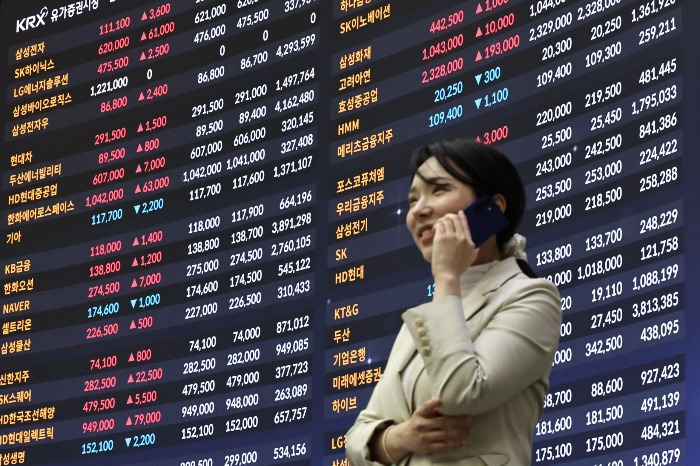
South Korean shares fell sharply on Friday, ending 1.8% lower after a volatile week marked by heavy selling in major tech stocks and renewed U.S.-China trade tensions.
The benchmark KOSPI dropped 72.69 points, or 1.81%, to close at 3,953.76, after hitting an intraday low of 3,887.32, News.Az reports, citing Yonhap.
Trading volume stood at 366.7 million shares worth 18.6 trillion won (US$12.8 billion), with 677 decliners outnumbering 211 gainers.
Foreign and institutional investors sold 472.2 billion won and 228.1 billion won in local shares, respectively, while retail investors purchased 695.9 billion won, cushioning the decline.
The week saw dramatic swings, with the KOSPI briefly surpassing 4,200 on Monday before plunging nearly 3% midweek. Friday’s weakness tracked overnight declines on Wall Street, where the Nasdaq fell 1.9%, the Dow Jones lost 0.84%, and the S&P 500 dropped 1.12% amid concerns over an overvalued AI sector and softening U.S. labor data.
Sentiment worsened after reports suggested the White House might block Nvidia from selling scaled-down AI chips to China, heightening trade tensions. Adding to worries, China’s October exports fell 1.1% year-on-year, the first decline since March 2024, raising fears of a similar impact on South Korea’s export-driven economy.
In Seoul, Samsung Electronics slid 1.31%, SK hynix fell 2.19%, Hyundai Motor declined 1.86%, and Kia dropped 1.7%. Battery makers also weakened, with LG Energy Solution down 1.38% and Samsung SDI tumbling 4.97%.
Defense and energy stocks were hit hard — Hanwha Aerospace lost 4.85%, LIG Nex1 plunged 16.53%, and Korea Electric Power slid 4.34%. HD Hyundai Electric nosedived 6.51%, while Doosan Enerbility dropped 1.77%.
Among a few gainers, Hanwha Ocean rose 3.09%, and Kakao surged 3.46% on better-than-expected quarterly earnings.
The Korean won weakened sharply to 1,456.9 per U.S. dollar, its lowest level in seven months, as foreign outflows pressured the currency. It was the first time since April that the won fell below the 1,450 threshold.
Bond yields climbed, with the three-year Treasury yield up 6 basis points to 2.894% and the five-year yield rising 5 basis points to 3.043%.


Similar news