SpaceX set to launch Falcon Heavy rocket for first time in 18 months


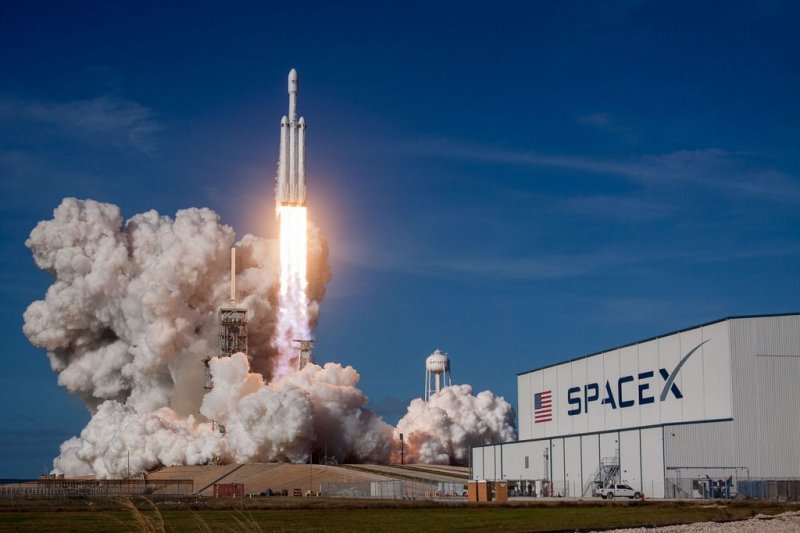
SpaceX’s powerful Falcon Heavy rocket is preparing to take flight for the first time in a year and a half, with a live broadcast allowing viewers to follow the mission in real time.
The Falcon Heavy, carrying the large ViaSat-3 F3 communications satellite, is scheduled to lift off from Kennedy Space Center on Monday (April 27), News.Az reports, citing Space.com.
The launch window will last 85 minutes, opening at 10:21 a.m. EDT (1421 GMT).
The liftoff will be streamed live via SpaceX, with coverage beginning around 15 minutes before launch.
RECOMMENDED STORIES
Falcon Heavy consists of three modified first-stage boosters derived from the Falcon 9, strapped together to provide additional power. The central core carries the upper stage, which is attached to the payload.
At launch, the three boosters together generate approximately 5.1 million pounds of thrust, making Falcon Heavy the second most powerful operational rocket today. It is surpassed only by Space Launch System, which produces 8.8 million pounds of thrust. Meanwhile, SpaceX’s Starship is designed to deliver an even greater 16.7 million pounds, though it remains under development.
Falcon Heavy first launched in February 2018, when it carried a Tesla Roadster belonging to Elon Musk into orbit around the sun. Since then, the rocket has completed 10 additional missions, all successfully.
However, the vehicle has not flown since October 2024, when it launched NASA’s Europa Clipper toward Jupiter.
The ViaSat-3 F3 satellite, weighing 6.6 tons (6 metric tons), will not travel as far. It is destined for geostationary orbit (GEO), located 22,236 miles (35,786 kilometers) above Earth. At this altitude, satellites orbit at the same rate as Earth’s rotation, allowing them to remain fixed over a specific region.
ViaSat-3 F3 will cover a wide area, delivering high-capacity broadband services across the Asia-Pacific region.
It will become the third satellite in the ViaSat-3 series to reach orbit. The first, ViaSat-3 F1, launched aboard a Falcon Heavy in April 2023, while ViaSat-3 F2 was sent into space in November 2025 on an Atlas V rocket operated by United Launch Alliance.
ViaSat-3 F1 is currently providing in-flight connectivity services, and ViaSat-3 F2 is expected to begin serving customers across the Americas next month. With the addition of ViaSat-3 F3, the three-satellite constellation will be complete.
“This launch marks a pivotal moment in our journey to bring fast, secure and reliable high capacity, highly flexible broadband to our commercial, defense and consumer customers,” said Dave Abrahamian, vice president of space systems at Viasat, in a recent company statement.
If all goes according to plan, the Falcon Heavy’s two side boosters will return to land at Cape Canaveral Space Force Station approximately eight minutes after liftoff. The central core, however, will not be recovered and is expected to fall into the Atlantic Ocean after completing its role.
The rocket’s upper stage will continue carrying ViaSat-3 F3 into geosynchronous transfer orbit, where the satellite is expected to be deployed roughly five hours after launch.
By Nijat Babayev


Similar news