Airbus introduces U145 autonomous cargo helicopter


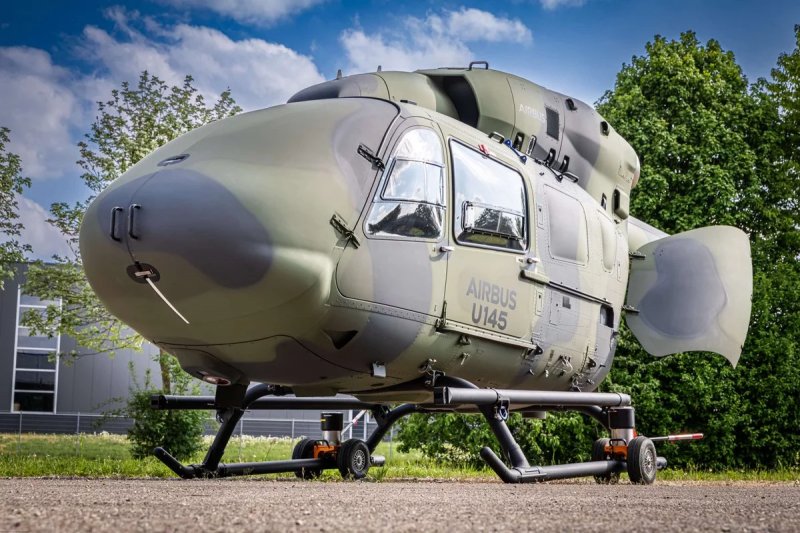
In a major development, Airbus announced that its H145 twin-engine light helicopter is being adapted into an uncrewed version, named the U145.
The move continues and expands the manufacturer’s work in the uncrewed helicopter space and reflects similar developments around the globe — most notably, an uncrewed version of the UH-72 Lakota, which is the U.S. Army’s variant of the H145, News.Az reports, citing TWZ.
RECOMMENDED STORIES
The U145 was officially revealed today, ahead of the ILA Berlin airshow, starting this week, during which a full-scale mock-up will be displayed. Airbus says it is planning a first flight of the U145 — with a safety pilot onboard — before the end of this year, and is aiming for entry into service at the beginning of the next decade.
“With the U145, we are offering our customers an autonomous, uncrewed version of our H145 helicopter — combining the proven airframe, power and useful load of the H145 with the autonomy of a UAS,” said Matthieu Louvot, CEO of Airbus Helicopters, in a company media release. “To develop the U145 and its capabilities as a multi-mission UAS, we will be teaming up with leading autonomous mission partners to further expand the UAS ecosystem in Europe,” he added.
The U145 will have a maximum takeoff weight of around 8,400 pounds, and is described as a “mission-agnostic solution for civil and military applications, primarily high-volume cargo supply.” Airbus has announced the payload will be up to 2,600 pounds. In comparison, the uncrewed version of the Lakota, the MQ-72C Lakota Connector, will carry a maximum payload of around 4,000 pounds, although this includes slung loads. With that in mind, the U145 and MQ-72C will likely end up offering very similar payload capacities.
The MQ-72C is expected to be able to cruise at speeds of 135 knots out to ranges of at least 350 nautical miles, according to the Airbus website.
Already at this stage, the company is pitching the U145 for specific military roles, including armed scouting and surveillance. Airbus is also planning to adapt the U145 as a “drone mothership” that will carry “launched effects,” on which the company is partnering with European missile house MBDA. A similar concept is currently being pitched by Sikorsky, with its uncrewed version of the Black Hawk helicopter, dubbed the U-Hawk, which is also intended to be able to fire dozens of launched effects such as surveillance and reconnaissance drones and loitering munitions.
Airbus also envisages the U145 operating in conjunction with conventional helicopters as part of crewed-uncrewed teaming.
The U145 will offer full autonomy, Airbus says, being equipped with a specialized sensor suite and artificial intelligence. For an uncrewed logistics aircraft, the ability to autonomously navigate along a predetermined route using programmed waypoints would provide a practical foundation for autonomous operations. However, more advanced capabilities — such as dynamically adjusting flight paths and responding in real time to emerging threats or unexpected obstacles — would also be very valuable, especially when conducting resupply missions in contested or high-risk environments.
The U145 will have no physical cockpit, so it cannot be flown with human pilots onboard. Other significant changes include adaptations for cargo missions, including a clamshell nose door, a loading platform, and a dedicated cargo floor. The existing rear clamshell doors are retained, as are the cabin side doors. The same configuration has been adopted for the MQ-72C, and a pass-through cargo hold is a big advantage that other crewed helicopters in this class cannot match.
Other features of the new uncrewed helicopter will be carried directly over from the H145, more than 1,800 of which are currently in service.
These features include a powerplant of two Safran Arriel 2E engines equipped with a full-authority digital engine control (FADEC) and a fenestron tail rotor.
The U145 is the next step in the manufacturer’s development of uncrewed helicopters. As such, it follows on from the smaller VSR700, a rotary-wing uncrewed air system which was derived from the crewed Cabri G2 light helicopter.
By Ulviyya Salmanli


Similar news