Tanker carrying Russian diesel diverts from Cuba after weeks at sea


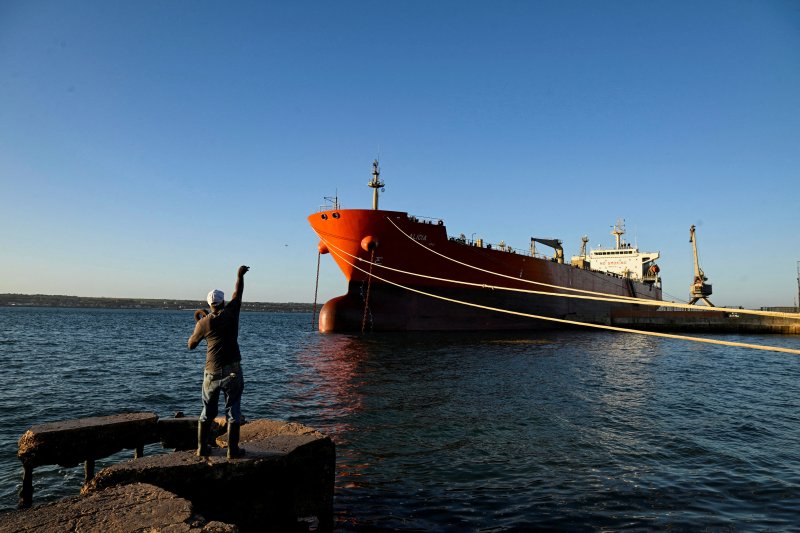
The Russian tanker Universal, which is under sanctions from the United States, the European Union, and the United Kingdom, reportedly sped up and changed course toward the South Atlantic, leaving the vicinity of Cuba after weeks of irregular movement in the North Atlantic, as the island continues to experience an energy crisis involving diesel and fuel oil shortages.
According to maritime tracking reports and researcher Jorge Piñon, director of the Latin America and Caribbean Energy Program at the University of Texas, the vessel went from traveling at about 1.3 knots on Monday to reaching 10.5 knots, a change suggesting a more defined destination, although tracking platforms still did not show a specific port of arrival, News.Az reports, citing UPI.
RECOMMENDED STORIES
"It is not only the change in route, but also the speed. After more than 30 days in limbo, the Universal has made a clear southeast course change entering the South Atlantic, far from Cuban shores," Piñon told Cuban outlet 14ymedio.
"Its speed has increased from 1.3 knots to 10.5 knots, which indicates a determined destination."
The Universal is carrying an estimated cargo of between 250,000 and 270,000 barrels of diesel and had been monitored since April as a possible fuel shipment to Cuba.
The vessel departed from the Russian port of Vysotsk on Jan. 18 and crossed the English Channel on April 8 escorted by a Russian frigate, with an estimated arrival in the Caribbean by late April.
However, the ship never reached Cuba.
Instead of advancing toward the island, it remained for more than a month at minimal speed or nearly adrift in the North Atlantic, about 1,000 miles from Cuban shores, without declaring a port of destination.
On April 27 it was sailing at 3.4 knots on a northwest course and by May 13 had reduced its speed even further, deepening uncertainty about its route.
The situation had already prompted warnings among sources consulted last week by UPI.
On Wednesday, May 20, the specialized account Russian Forces Spotter said the Universal situation appeared "more politically sensitive" than that of the tanker Anatoly Kolodkin, the only Russian cargo shipment that managed to reach Cuba this year.
"In the KOLODKIN case, Russia visibly signaled state protection through naval escort operations, and Washington ultimately tolerated the delivery into Cuba despite sanctions pressure," Russian Forces Spotter said.
"With UNIVERSAL, the prolonged stop mid-Atlantic could suggest stronger external pressure or operational issues."
The source added that the fact the Universal had not resumed movement until that moment was "notable" and could be part of a broader risk calculation by Moscow.
"The combination of increased U.S. surveillance, sanctions enforcement, and the political sensitivity around Cuba may make these voyages more complicated than before," it said.
Even so, the source warned it was still difficult to distinguish between geopolitical pressure and a more routine operational problem.
The difference with the Anatoly Kolodkin is central to understanding the case. That vessel arrived in Matanzas on March 31 carrying about 730,000 barrels of crude, a shipment that temporarily eased Cuba's situation but was exhausted only weeks later.
The Universal case also contrasts with the tone of support Moscow had shown weeks earlier.
In early April, Russian Foreign Minister Sergey Lavrov said Russia would not abandon Cuba amid the energy crisis.
Russian Energy Minister Sergey Yevgenyevich Tsivilyov also stated that "a Russian vessel broke the blockade; a second is being loaded at this moment. We will not leave the Cuban people in difficulty," referring to the Anatoly Kolodkin shipment and to a second cargo that at the time appeared destined for the island.
However, weeks later, the Universal ended up spending a month practically stationary in the North Atlantic without ever reaching Cuban waters.
Analyst Sebastian A. Arcos, interim director of the Institute for Cuban Studies, also urged caution regarding the Universal.
He said there is not enough information to determine what is happening with the vessel, but stated that the absence of active enforcement of a U.S. maritime quarantine does not mean there are no deterrent effects on Cuba's fuel suppliers.
"We do know that the U.S. is not actively enforcing the current fuel quarantine around Cuba, and there have been no boardings or interceptions at sea by U.S. Navy units," Arcos said.
"It appears that the risks of crossing Mr. Trump, including tariffs, is deterring any help from Russia or Mexico."
Arcos argued that Cuba's energy problem is not limited to fuel shortages, but also to the structural deterioration of the electrical grid.
"The key energy problem in Cuba is not necessarily lack of fuel, but lack of generating capacity and overall decrepitude of the electrical infrastructure," he said.
He added that Cuban domestic crude, because of its corrosive composition, has accelerated the deterioration of power plants in a context of chronic economic collapse and low investment.
Historian Lillian Guerra, professor of Cuban and Caribbean history and director of the Cuba Program at the University of Florida, said reports from citizens on the island indicate that the Russian oil previously received "has definitively run out." She also argued that one tanker, or even two, would not solve the crisis.
"Trump's May 1 executive imposing secondary sanctions, particularly on any entity or individual that invests or seeks to support the 'energy sector' controlled by the state in Cuba has little or no impact on Russia, as we have seen," Guerra said.
"But this tanker, like the last, is a band aid on a cardiac arrest. It will make no difference and prolong, not minimize suffering."
Cuba's internal crisis has continued escalating in parallel with the vessel's movements.
Energy and Mines Minister Vicente de la O Levy acknowledged on May 14 that the country had no reserves of fuel oil or diesel.
"We have absolutely no fuel oil and absolutely no diesel left. We no longer have reserves," he said in remarks cited by Cuban and international media.
According to 14ymedio, Cuba's Electric Union projected an impact of 2,147 megawatts during peak hours this week, with only 1,133 megawatts available against an estimated maximum demand of 3,250 megawatts.
The same report said the Antonio Guiteras thermoelectric plant, the country's largest generating unit, had once again gone offline, while the floating Regla power plant remained paralyzed because of fuel shortages.
The deterioration of the electrical system has triggered protests and pot-banging demonstrations in Havana. Local Cuban media reported demonstrations on Monte Street in Old Havana, where residents demanded food, electricity and freedom after prolonged hours without electrical service.
The Universal's course change does not yet confirm that Cuba has definitively lost that cargo, but it does mark the first clear operational movement after weeks of uncertainty.
If the vessel ultimately declares a destination other than Cuba, the island would be left without an immediate source of imported diesel at a time when its electrical system is operating at the limit, with insufficient generation, damaged plants and a population increasingly exposed to prolonged blackouts.
By Ulviyya Salmanli


Similar news