Trio wins 2025 Nobel Prize in physics for breakthroughs in quantum mechanics


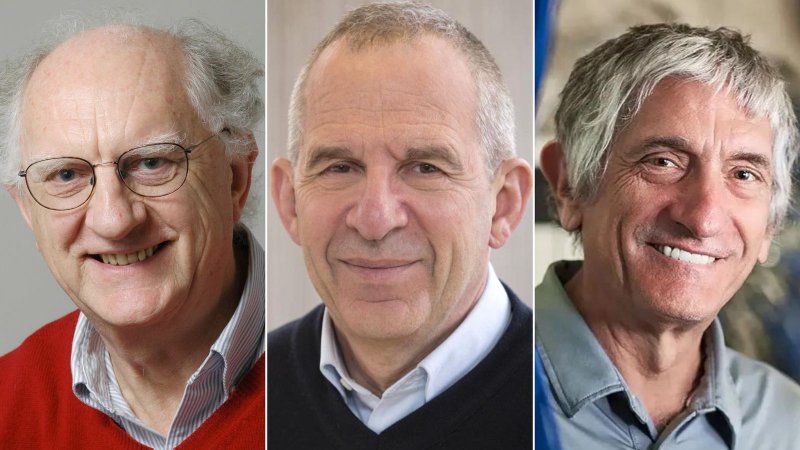
The 2025 Nobel Prize in Physics has been awarded to three scientists — from the United Kingdom, France, and the United States — in recognition of their pioneering discoveries that have advanced the understanding of quantum mechanics, News.Az reports, citing CNN.
John Clarke, Michel Devoret and John Martinis will share the prize “for the discovery of macroscopic quantum mechanical tunnelling and energy quantization in an electric circuit,” the Nobel Committee announced Tuesday at a ceremony in Stockholm, Sweden.
The committee praised the laureates for demonstrating that the “bizarre properties of the quantum world can be made concrete in a system big enough to be held in the hand.”
Clarke, taking questions at a news conference, said he was “completely stunned” to learn he had won the award.
“We had not realized in any way that this might be the basis of a Nobel prize,” Clarke said of their research in the 1980s at the University of California, Berkeley.
Quantum mechanics, which describes how matter and energy behaves at or below the scale of an atom, allows a particle to pass straight through a barrier, in a process called “tunnelling.”
But when a larger number of particles are involved, these quantum mechanical effects usually become insignificant. What is true at the microscopic level was not thought to be true at the macroscopic level. For instance, while a single atom could pass through a barrier, a tennis ball – made up of a huge amount of particles – cannot.
However, the trio of researchers conducted experiments to show that quantum tunnelling can also be observed on a macroscopic scale.
Last year, the prize was awarded to Geoffrey Hinton – often called the “Godfather of AI” – and John Hopfield, for their fundamental discoveries in machine learning, which paved the way for how artificial intelligence is used today.
In 2023, the prize went to a trio of European scientists who used lasers to understand the rapid movement of electrons, which were previously thought impossible to follow.


Similar news