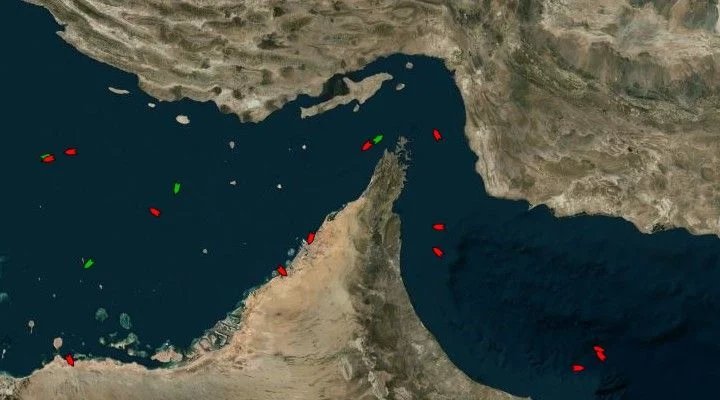
Instead, both vessels halted near the strait and then reversed course, returning toward safer positions in the Gulf. This marked one of the clearest and most visible disruptions to LNG shipping since the escalation of tensions in the region, News.az reports.
The tankers had initially been expected to pass through as part of routine export flows. However, the abrupt change in direction suggests a combination of operational risk, security concerns, and shifting control over maritime transit in the area. The incident immediately drew attention from energy markets, governments, and shipping operators worldwide.
This was not just a logistical adjustment. It represented a signal that even the most established energy supply routes are no longer guaranteed under current geopolitical conditions.
Why the Strait of Hormuz is critically important
The Strait of Hormuz is one of the most strategically significant maritime chokepoints on the planet. It connects the Persian Gulf with the Gulf of Oman and the Arabian Sea, serving as a gateway for energy exports from major producers in the region.
A substantial share of the world’s oil and liquefied natural gas passes through this narrow corridor every day. For Qatar in particular, the strait is indispensable because nearly all of its LNG exports must travel through it to reach global markets.
The geography of the strait makes it inherently vulnerable. It is narrow, heavily trafficked, and surrounded by countries with competing interests. This combination turns it into a pressure point where even limited disruption can ripple across global energy systems.
Why the tankers turned back instead of passing through
The decision to turn back was not random. It reflects a convergence of several risk factors that made transit through the strait untenable at that moment.
First, the security environment has deteriorated significantly. Ongoing tensions involving Iran, the United States, and Israel have transformed the strait into a zone of heightened military sensitivity. The presence of naval forces, missile threats, and surveillance operations increases the likelihood of confrontation.
Second, control over transit has become unpredictable. Permissions to pass through the strait are no longer purely procedural. Instead, they are influenced by political considerations and can change rapidly. A vessel that is cleared at one moment may face restrictions shortly afterward.
Third, commercial operators must weigh risk versus cost. LNG cargoes are extremely valuable, and any damage or delay can result in massive financial losses. Shipping companies are therefore more likely to err on the side of caution and avoid exposure to uncertain conditions.
Together, these factors created a situation where turning back was the most rational operational decision.
What this means for Qatar as the world’s leading LNG exporter
Qatar occupies a central position in the global LNG market. It is one of the largest exporters of liquefied natural gas, supplying key markets in Asia and Europe. However, its export model is highly dependent on maritime routes, particularly the Strait of Hormuz.
Unlike some oil producers that can rely on pipelines or alternative shipping corridors, Qatar’s LNG infrastructure is concentrated within the Gulf. This means that any disruption in the strait directly affects its ability to deliver gas to international buyers.
The turning back of tankers highlights a structural vulnerability. Even if production remains stable, the inability to transport cargo effectively can reduce export volumes and disrupt long term contracts. For Qatar, this raises strategic questions about resilience and diversification.
How global LNG markets are reacting
Energy markets are highly sensitive to supply disruptions, especially in the LNG sector where flexibility is limited. The incident has contributed to increased volatility and uncertainty.
Prices in spot LNG markets tend to rise when supply risks increase. Buyers begin competing for alternative cargoes, while sellers may hold back shipments in anticipation of higher returns. This dynamic can quickly drive up costs for importing countries.
In addition, shipping constraints create bottlenecks. Vessels waiting for clearance or rerouting lead to delays, which in turn affect delivery schedules. This can force utilities and energy companies to rely on reserves or seek emergency supplies.
The broader impact is a tightening of global gas markets, even if the disruption is temporary.
Why this matters for Europe and Asia
Both Europe and Asia depend heavily on LNG imports, and Qatar is a major supplier to both regions. In recent years, Europe has increased its reliance on LNG as part of efforts to diversify energy sources. Asia, meanwhile, remains the largest consumer of LNG globally.
When shipments from Qatar are disrupted, these regions feel the effects almost immediately. In Europe, reduced LNG availability can complicate energy security strategies, particularly during periods of high demand. In Asia, countries such as Japan, South Korea, and China may face increased competition for available cargoes.
This creates a chain reaction where supply uncertainty in one region drives price increases globally.
How shipping companies are adapting to the situation
Shipping companies are taking a cautious and highly calculated approach. The risks associated with transit through the Strait of Hormuz have forced operators to reconsider standard practices.
One common response is to delay transit altogether. Ships may anchor in safer waters while awaiting clearer signals about security conditions. This reduces immediate risk but creates logistical challenges.
Another approach involves rerouting or adjusting schedules. While alternative routes are limited, operators may attempt to optimize timing to minimize exposure during peak tension periods.
Insurance considerations are also critical. War risk premiums have increased significantly, and some insurers may impose restrictions or higher costs for vessels entering the area. This adds another layer of complexity to decision making.
What role geopolitics is playing in maritime transit
Geopolitics is the central factor shaping events in the Strait of Hormuz. The region has long been a focal point of strategic competition, but recent developments have intensified this dynamic.
Iran’s position is particularly significant. Its geographic proximity to the strait gives it substantial influence over maritime traffic. In times of tension, this influence can translate into direct control over who passes and under what conditions.
At the same time, the involvement of global powers adds another dimension. Military presence by the United States and its allies, combined with regional rivalries, creates a highly complex and volatile environment.
Diplomatic efforts by countries such as Pakistan and Türkiye have sought to reduce tensions and facilitate dialogue. While these efforts may help stabilize the situation temporarily, they have not eliminated the underlying risks.
Is the Strait of Hormuz effectively closed
The strait is not officially closed, but it is operating under severe constraints. This distinction is important because it reflects a shift from traditional blockades to more nuanced forms of control.
Transit is technically possible, but it is no longer guaranteed. Ships must navigate a combination of political approval, security assessments, and operational risk. This creates a system where access is conditional rather than open.
In practical terms, this can have effects similar to a closure, even if vessels are not physically prevented from entering the strait.
What this means for global oil markets
Although the focus is on LNG, oil markets are closely linked to developments in the Strait of Hormuz. A significant portion of the world’s oil exports also passes through this route.
Any disruption in the strait affects oil supply expectations, which in turn influences prices. Even the perception of risk can lead to price spikes as traders anticipate potential shortages.
At the same time, temporary easing of tensions can lead to rapid price corrections. This creates a highly volatile market environment where prices can fluctuate sharply within short periods.
Could the situation stabilize in the near term
Short term stabilization is possible but uncertain. Temporary ceasefire arrangements and diplomatic engagement can create windows of reduced tension. During these periods, some shipping activity may resume.
However, the underlying issues remain unresolved. The lack of trust between key actors, combined with ongoing military activity, means that any improvement could be fragile.
Sustained stability would require a broader political settlement, which appears unlikely in the immediate future.
What are the long term implications for energy security
The turning back of Qatar LNG tankers has broader implications for how countries think about energy security.
One key takeaway is the vulnerability of chokepoints. Even a single narrow passage can influence global supply chains. This is likely to encourage diversification strategies, including investment in alternative routes and energy sources.
Another implication is the growing role of geopolitics in energy markets. Supply is no longer determined solely by production capacity but also by political and military dynamics.
Over time, this could lead to structural changes in how energy is produced, transported, and consumed.
Why this event is seen as a turning point
The incident stands out because it represents a tangible disruption rather than a theoretical risk. For years, analysts have warned about the vulnerability of the Strait of Hormuz, but actual interruptions have been relatively rare.
The turning back of LNG tankers changes that perception. It shows that under certain conditions, even major exporters cannot guarantee delivery. This has implications for contracts, pricing, and long term planning.
It also signals a shift in how power is exercised in the region. Control over transit routes has become a strategic tool, influencing not only local dynamics but also global markets.
What to watch in the coming weeks
Several indicators will help determine how the situation evolves.
First, the behavior of shipping companies will be critical. If more vessels attempt transit, it could signal improving conditions. Continued avoidance, on the other hand, would suggest persistent risk.
Second, policy signals from regional actors will provide clues about future access to the strait. Changes in rhetoric or military posture can have immediate effects on market expectations.
Third, energy prices will remain a key barometer. Sustained increases would indicate ongoing supply concerns, while stabilization could reflect improved confidence.
Finally, diplomatic developments will play a crucial role. Any progress toward de escalation could open the door to more predictable shipping conditions.
Bottom line
The turning back of Qatar LNG tankers near the Strait of Hormuz is a clear demonstration of how fragile global energy systems can be in the face of geopolitical tension.
It highlights the central importance of the strait, the vulnerability of supply chains, and the growing influence of political dynamics on energy markets.
While the immediate impact is significant, the longer term consequences may be even more profound. The event could reshape how countries approach energy security, how companies manage risk, and how global markets respond to uncertainty.
In a world where energy flows are tightly interconnected, disruptions in one narrow passage can have far reaching effects across continents.