BP's Khankendi vessel deal: A $300 million leap into the future of subsea work


By Asif Aydinli
British company BP has signed a new contract for the operation of the subsea construction vessel Khankendi.
The scope of work under this substantial contract includes general management and maintenance of the Khankendi vessel, extensive subsea construction and installation works, thorough underwater inspections, and ensuring a rapid response capability in the Caspian Sea on all BP-operated assets. These assets include subsea pipelines and the infrastructure of production systems, which are critical for the efficient and safe extraction and transportation of hydrocarbons. Additionally, the contract covers the provision of services during the field operation period, encompassing comprehensive marine base support. This multifaceted approach underscores BP's commitment to operational excellence and safety in one of the world's most challenging environments.
BP's Vice President for Projects in Azerbaijan, Georgia, and Turkey, Cathal Kelly, emphasized the importance of this contract in advancing BP and its partners' "Single Vessel" strategy. This strategy is designed to enhance the safety and efficiency of marine operations in the Caspian Sea. By consolidating various operations onto a single, highly capable vessel, BP aims to streamline processes, reduce costs, and minimize environmental impact, all while maintaining the highest standards of safety and reliability.
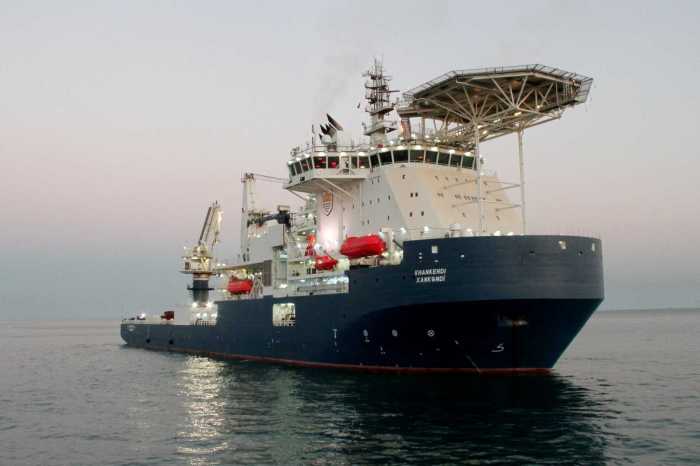
The Khankendi vessel itself is a marvel of modern engineering. It was constructed at the Baku Shipyard under the rigorous supervision of the international certification and classification society DNV GL, specifically for the Shah Deniz-2 project. The vessel's construction cost amounted to an impressive $378 million, and it was successfully launched in September 2017. The Khankendi boasts impressive technical specifications, including a length of 155 meters, a width of 32 meters, and a deck area of 2000 square meters. It has a maximum draft of 7.5 meters, a main deck height of 13 meters, a total weight of 17.6 thousand tons, and a maximum speed of 13.5 knots. The vessel's lifting capacity exceeds 5000 tons at a draft of 6.5 meters, and it can comfortably accommodate 175 people.
Equipped with cutting-edge technology, the Khankendi is fully outfitted with a dynamic positioning system capable of maintaining position in waves up to 3.5 meters high. Its main 900-ton metric crane is designed for complex subsea operations at depths of up to 600 meters. The vessel also features a system of two 18-person diving capsules, two remotely operated vehicles (ROVs), a moon pool for deploying reinforced equipment, and a suite of other essential apparatus. This array of advanced equipment enables the Khankendi to perform highly complex operations without the need for anchors, significantly enhancing its operational flexibility and safety.
The signing of this contract marks an important milestone for BP and its partners. It represents a significant advancement in the infrastructure and safety of subsea operations in the Caspian region. The "Single Vessel" strategy, facilitated by the Khankendi, is expected to substantially improve the efficiency of subsea work and minimize the risks associated with the operation of underwater facilities. This, in turn, is anticipated to have a positive economic impact on the region, creating additional jobs and fostering the development of related industries.
Furthermore, the new contract for the operation of the Khankendi vessel highlights BP's commitment to sustainable development and innovation in the oil and gas industry. By investing in advanced technology and fostering strategic partnerships, BP aims to enhance the safety, efficiency, and environmental sustainability of its operations. This contract not only strengthens BP's position in the Caspian region but also sets a new standard for subsea operations globally. The successful implementation of this contract will undoubtedly contribute to the long-term growth and prosperity of the Caspian region's oil and gas sector, ensuring that it remains a vital part of the global energy landscape.


Similar news