China and India: Who has the upper hand?


Editor's note: Seymur Mammadov, a special commentator for News.Az, is the director of the international expert club EurAsiaAz. The article expresses the personal opinion of the author and may not coincide with the view of News.Az.
The growing tensions between India and Pakistan have once again placed South Asia at the center of global anxiety. But this time, the stakes are far higher. The specter of conflict no longer hovers over two traditional rivals—it looms over two nuclear powers, entangled in a strategic web that extends beyond their borders. And at the heart of this web lies a deeper, more consequential question: Is this really a regional standoff—or the prelude to a proxy war between India and China?
Conventional metrics tell a familiar story: India outpaces Pakistan in population, size of the armed forces, and volume of military equipment. But military strength is no longer measured solely in numbers. Motivation, morale, battlefield experience, and—perhaps most crucially—alliances are now essential determinants of power. And in this regard, Pakistan has a trump card: China.
Many analysts see the escalating India–Pakistan dispute as a proxy for a broader geopolitical confrontation. China, they argue, will not hesitate to back Islamabad—not only out of loyalty to its strategic partner, but also due to its own festering disputes with New Delhi. India has increasingly positioned itself as a counterweight to Chinese influence in the Indo-Pacific, often with encouragement from Western powers. In Beijing’s eyes, India is not just a regional rival—it’s a pressure point being manipulated by external actors.
India, for its part, may be seeking allies of its own. Despite a nearly equal population and a larger reserve force, New Delhi knows it cannot compete with China alone. Nevertheless, it continues to portray itself as a bulwark against "Chinese aggression"—even as Beijing focuses its attention elsewhere. Last year, India deployed Russian-made S-400 air defense systems along both the Chinese and Pakistani borders. This year, it aims to add two more S-400 squadrons and invest in nuclear-powered submarines in an effort to reduce its undersea warfare disadvantage. Yet catching up with China’s rapidly expanding naval capabilities may be an uphill battle. As of 2023, China possessed 78 submarines—12 of them nuclear—compared to India’s 18, only two of which are nuclear-powered.
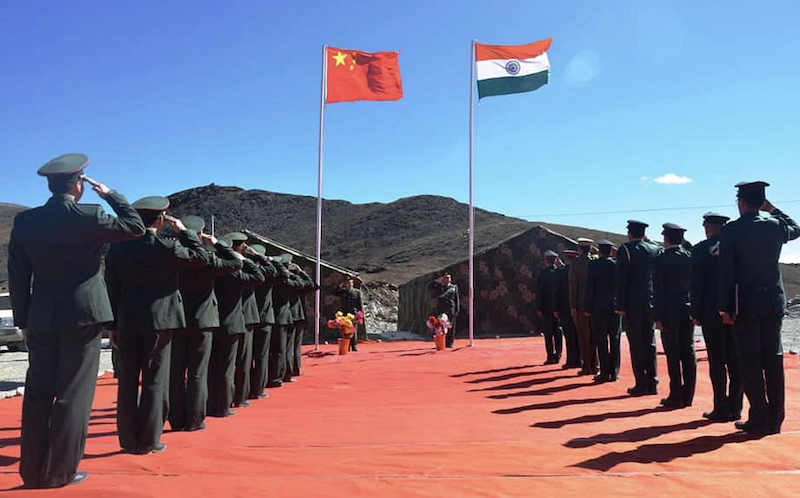
Indian Army and PLA soldiers during a meeting near the LAC in northern sector. (Photo via Twitter)
Meanwhile, China is fast-tracking its naval modernization. Satellite images of the Huludao shipyard, widely circulated in Western media earlier this year, showed the construction of a new Type 093B nuclear-powered submarine with vertical launch systems. In just three years, China has built seven of these. By 2030, it is expected to launch its stealthiest submarine yet—the Type 096, described by U.S. analysts as a potential “nightmare scenario.”
At sea, the power gap is stark. China’s navy is more than double the size of India’s—730 vessels compared to 295. India trails in nearly every ship category. Beijing operates dozens of mine countermeasure vessels; India has none. In the air, the gap is just as severe: 1,199 Chinese fighter jets against India’s 577. Such disparities are not easily bridged—especially by 2025.
Across land forces, too, China leads with a larger tank fleet, far more multiple launch rocket systems, and significantly more self-propelled artillery. India’s domestic defense industry struggles to close the gap, forcing the country to spend billions on foreign weapons procurement—while China continues to expand its indigenous production capacity.
Yet any assessment of this rivalry must not overlook Pakistan. Chinese support has significantly bolstered Pakistan’s defense capabilities. Since President Xi Jinping’s 2015 visit to Islamabad, military cooperation between the two countries has intensified. China is helping Pakistan acquire eight Hangor-class submarines, with four built in China and four constructed in Pakistan. Chinese-built fighter jets, warships, missile systems, and drones now form the backbone of Pakistan’s military modernization.
Furthermore, China and Pakistan have developed joint weapons systems that are increasingly gaining traction on international markets—unlike Indian-produced arms, which have found limited buyers, most notably Armenia. The Chinese-Pakistani MBT-2000 (Al-Khalid) tank is now in service in Morocco, Bangladesh, and Myanmar. The Baktar Shikan anti-tank missile system has been exported to the UAE, Thailand, and several African countries, with more deals in the pipeline.
This raises the fundamental question: What is India’s endgame? For a country with deep social fissures, a vast impoverished population, and mounting internal unrest, the push toward military confrontation seems counterintuitive—unless it is being nudged in that direction by outside forces. The true target may not be Pakistan, but China. And if this is indeed a prelude to a broader conflict, India may find itself playing a dangerous role not as protagonist, but as proxy.
The world should take note. A localized clash between India and Pakistan could spiral into something far larger and more destructive. Strategic restraint, not escalation, must guide the path forward. Otherwise, South Asia may become the flashpoint for a global conflagration it never intended to ignite.
(If you possess specialized knowledge and wish to contribute, please reach out to us at opinions@news.az).


Similar news