Could BRICS become an alternative to Western dominance?


Editor's note: Moses Becker is a special commentator on political issues for News.Az, a PhD in political science and an expert on interethnic and interreligious relations. The article expresses the personal opinion of the author and may not coincide with the view of News.Az.
Chinese leader Mao Zedong once proclaimed, "The East wind will prevail over the West wind." Observing today’s events, it seems the words of the “Great Helmsman” were prophetic. Following the dissolution of the Warsaw Pact and the collapse of the USSR, it appeared that the West had achieved a final victory, with no turning back. For a time, the Russian Federation aligned itself with the course set by the United States and its NATO partners, but this did not last. Given the mentality and traditions of Asian and Southern Hemisphere nations, a rapprochement began among Russia, China, India, and Brazil. In 2006, these nations founded BRIC, which, after the addition of South Africa, became known as BRICS.As of 2024, BRICS includes China (GDP: $17.9 trillion), India ($3.3 trillion), Russia ($2.15 trillion), Brazil ($1.9 trillion), UAE ($0.51 trillion), Egypt ($0.47 trillion), South Africa ($0.40 trillion), Iran ($0.40 trillion), and Ethiopia ($0.16 trillion). Despite tensions between India and China, as well as Ethiopia and Egypt, their economies are drawing closer, which could help ease political frictions. In essence, BRICS serves as a counterweight to the political and economic power of the Western bloc, including its particular interpretations of democracy and liberal values. The organization comprises four of the world's 11 largest economies—China, India, Russia, and Brazil, with China and Russia holding seats on the UN Security Council.
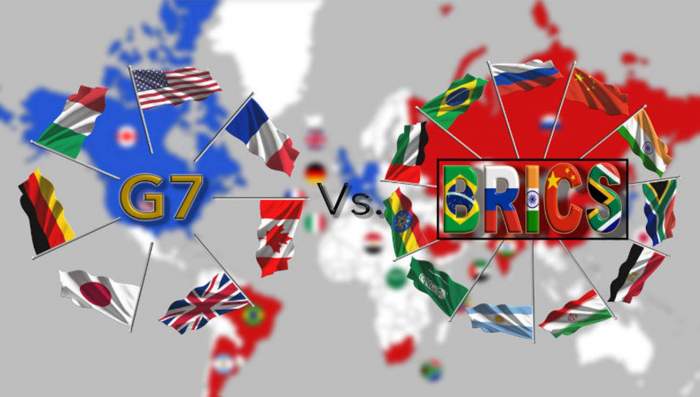
BRICS nations account for more than 3.5 billion people or 45% of the world’s population, while the G7 represents only 715 million. The combined GDP of BRICS exceeds $27 trillion, comprising a quarter of global GDP ($105 trillion). Though the G7 still contributes a larger share (43%) to the world economy, BRICS’s appeal lies in its principle of non-interference in each other's internal affairs and its respect for the values and traditions of each member.
In terms of purchasing power parity, BRICS countries are expected to reach a 36.7% share by the end of 2024, while the G7 barely approaches 30%. The average economic growth rate for BRICS states in 2024-2025 is forecasted at 3.8%, surpassing the projected global GDP growth of 3.2-3.3%. Under such conditions, BRICS has become an attractive coalition for nations seeking independence and development without interference.
It is no surprise that countries at various stages of economic and political development—such as Algeria, Bangladesh, Bahrain, Belarus, Bolivia, Venezuela, Vietnam, Cuba, Honduras, Kazakhstan, Kuwait, Morocco, Nigeria, Saudi Arabia, Senegal, Thailand, and Turkey—are eager to join BRICS. In September, Turkey submitted its application, disillusioned with the EU accession process. However, India temporarily blocked Turkey’s bid due to its close ties with Pakistan.
Experts interviewed by The Washington Post believe that BRICS’s appeal largely stems from China’s economic power and the failures of the West. The BRICS nations encompass 48.5 million square kilometers or 36% of the world’s land area, whereas the G7 controls only half that expanse. BRICS also leads in natural resources, managing 45% of the world’s oil reserves and holding significant reserves of freshwater and agricultural land.
BRICS countries are discussing the possibility of a unified currency as an alternative to the dollar and euro, although for now, transactions are planned in national currencies. At Russian President Vladimir Putin's suggestion, BRICS is considering the creation of an investment platform to support member economies, an arbitration investment center, and a special consultation mechanism on WTO issues to establish fairer global economic rules. Additional proposals include a grain exchange, an alliance in artificial intelligence, a precious metals and diamonds platform, carbon market collaboration, climate research, a logistics platform, and an interstate platform for fair competition.
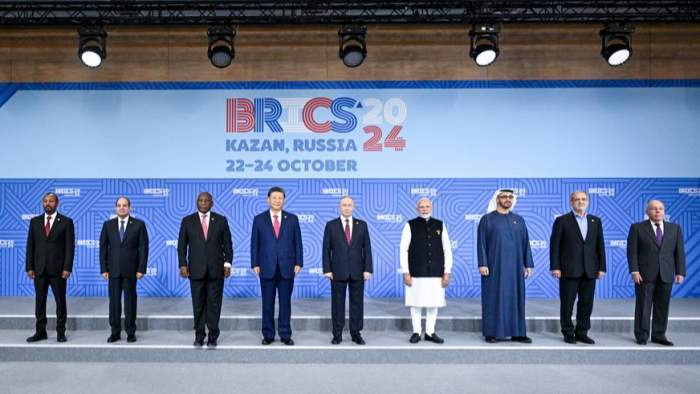
The outcomes of the summit reveal BRICS as a promising alternative for nations striving for independent economic development, free from Western unipolar influence. The deepening of cooperation within BRICS forms the foundation for a fairer world order that takes into account the interests of all participants, not just the leading global powers. Unlike the G7, which aims to preserve the status quo, BRICS offers a model based on respect for national interests, internal priorities, and the cultural distinctiveness of its members.
This strategic orientation towards self-reliance, industrial and scientific-technological development, and economic interdependence has become attractive to numerous countries around the world. Already, BRICS stands not only as an economic bloc but as a symbol of the aspiration for multipolarity, where each nation can have its voice heard and its resources and potential utilized for the collective benefit.
In this context, the experiences of China, India, and Russia—countries demonstrating rapid technological and educational advancement—serve as an example for other nations that want to avoid becoming mere raw material suppliers for more developed economies. The accumulation of knowledge, resources, and expertise within BRICS enables its members to counter globalization’s challenges effectively and to create innovative solutions in the interests of their populations.
Thus, BRICS offers an alternative path—one of integration and cooperation, where every nation finds its place and can count on the support of its partners. This is a path toward stability and prosperity, sustainable development, and expanded global influence for the coalition. Time will tell how successful this alternative course will prove, but it is already evident: BRICS is transforming into a powerful force capable of reshaping the global balance of power and laying the groundwork for a more balanced world order.
(If you possess specialized knowledge and wish to contribute, please reach out to us at opinions@news.az).


Similar news