Crisis of democracy in France: Macron rejects the results of the snap elections


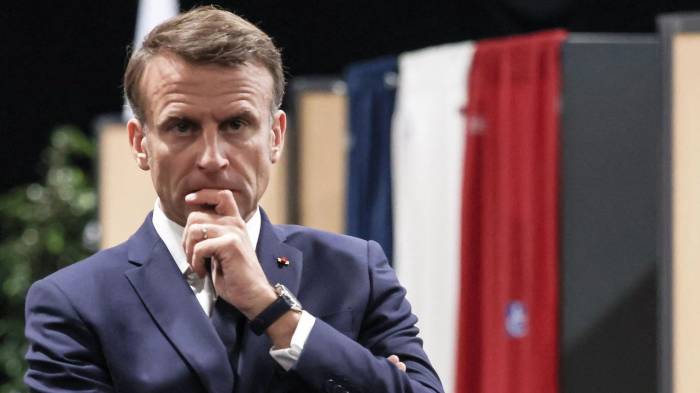
After the European Parliament election results in June 2024, facing a resounding defeat of his centre-right liberal party, La République En Marche! (often abbreviated as LREM), and the centrist governing coalition, "Ensemble!" (“Together!”), President Emmanuel Macron called for a snap election for the French Parliament. He justified this by stating that the balance of power and the voters’ will were no longer represented in the French National Assembly. In practice, he wanted to block the far-right party Rassemblement National (RN or National Rally in English), the big winner of the European elections, and unite the centre-right, centre, and left parties behind him to become more powerful, govern and approve laws more comfortably, and present himself as the national saviour against the menace of the far-right in the country. It should be noted that there was no constitutional obligation to call for early elections; it was merely a move to centralize Macron’s power to become France’s indispensable man.
The results of the snap elections were not as expected. In the first round, the RN was the big winner. In the second round, following a collective effort to prevent the RN from taking the position of Prime Minister, the winning block was the New Popular Front (the Left), which secured 182 seats in the National Assembly. Macron’s group was positioned in second place with 168 seats and the far-right, the National Rally (RN) in third with 143 seats.
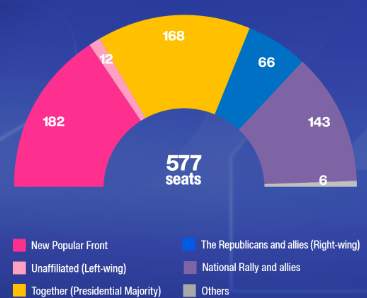
French Parliamentary Elections Results, 7 July 2024.
As in many European elections, no single political bloc secured a majority to govern, creating the need to form a broader coalition. Consequently, President Macron may have to appoint a Prime Minister and ministers from different political families to ensure effective governance and representation of diverse interests in the government formed from the winning majority, as is the rule in European democracies. In France, this is called cohabitation.
Cohabitation again
Cohabitation is a concept familiar in French politics. Political cohabitation in France refers to a situation where the President and the Prime Minister come from different political parties. This arrangement typically occurs when the party of the President does not hold a majority in the National Assembly after legislative elections.
First cohabitation (1986-1988): François Mitterrand, a member of the Socialist Party (PS), was elected President in 1981. However, in the 1986 elections, the right-wing parties (particularly the Rally for the Republic, or RPR, led by Jacques Chirac) won a majority in the National Assembly. As a result, Mitterrand appointed Jacques Chirac as Prime Minister. This period lasted until 1988 and was marked by significant political tension between the Socialist President and his conservative Prime Minister.
Second cohabitation (1997-2002): Lionel Jospin from the Socialist Party (PS) became Prime Minister after the Socialists gained a majority in the National Assembly, despite Jacques Chirac being the President at the time. Chirac had been elected in 1995, representing the RPR. This arrangement lasted until 2002, when Jospin's government was succeeded by Chirac's next term following the presidential elections.
Macron’s cohabitation refusal and damages to democracy in France
This third instance of cohabitation should again be in place, but the current president, Emmanuel Macron, refuses to accept the election results of the left bloc, the New Popular Front (NFP), which is formed by La France Insoumise (Unbowed France or LFI), the Socialist Party, the French Communist Party, and the Greens. Within the coalition, La France Insoumise was the party that won the most seats in the National Assembly.
In a blatant lack of democratic spirit, Macron accepts only his version of cohabitation, not the one mandated by the voters. The winning coalition, NFP, has agreed on a name and has presented Macron with their choice for Prime Minister: Lucie Castets, a 37-year-old economist and head of the financial area at Paris City Hall.
Macron refused to nominate the winning coalition's choice for Prime Minister, arguing that he prioritizes stability and fears a vote of no confidence in the following days. In response, LFI leader Jean-Luc Mélenchon stated: "The popular and political response must be swift and firm," calling for demonstrations urging the president to "respect democracy" and announcing that they would present a motion of impeachment against Macron.
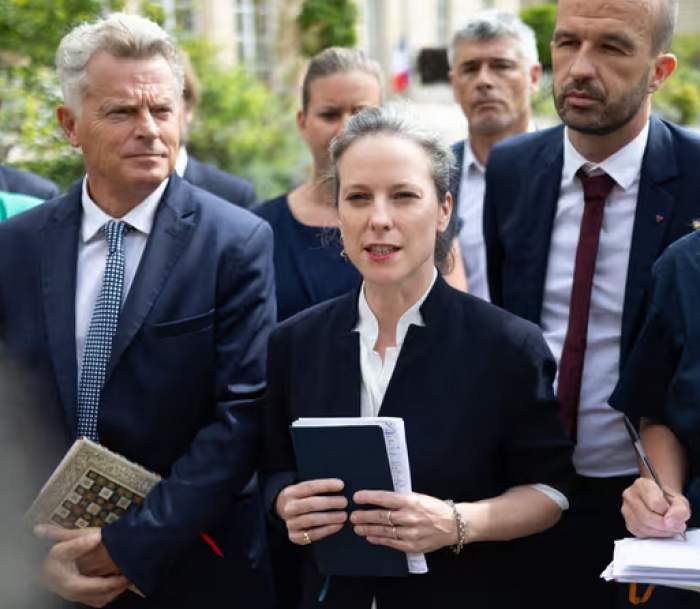
The would-be Prime Minister Lucie Castets
In a statement, Mélenchon was categorical: "The President of the Republic does not recognize the result of universal suffrage, which placed the New Popular Front at the top of the polls."
What is behind Macron’s refusal?
Critics say that the reason behind his refusal, contrary to democratic practices, is the fear that a government from the Left and having ministers from La France Insoumise would cancel part of his neoliberal reforms, such as the increase in the retirement age and the budget cuts in health. There is also a fear that taxes on the rich and fortunes would be reinstated. Moreover, the main criticism of Macron’s government is that he governs mainly for the rich and businessmen. It is said, according to an internal palace source (in this case, revealed by the boyfriend of his step-daughter), that Macron used to phone every morning to take advice from Rothschild, the banker and his former employer.
What does Macron’s behaviour represent to European democracy?
In a press conference, the leader of the winning coalition, Jean-Luc Mélenchon, accused French President Emmanuel Macron of attempting to undermine democracy. Mélenchon raised several criticisms towards President Macron:
Concern over constitutional authority : Mélenchon raised concerns about President Macron potentially abusing his power by using constitutional articles that allow him to act without a parliamentary majority, which he perceives as undermining democratic principles.
Perception of authoritarianism : He argued that there is a growing trend of authoritarianism within Western democracies, suggesting that political dynamics have shifted away from democratic norms, particularly among liberal parties that may prioritize efficiency over democratic legitimacy.
Critique of the political environment: Mélenchon discussed the dangerous political climate that can arise when governments are perceived to operate without regard to public consent, leading to disillusionment and potential unrest among citizens.
Comparison with International trends : He drew parallels with other countries, such as Hungary and Italy, where leaders have transitioned from democratic to authoritarian practices, warning that similar patterns could emerge in France if Macron's actions are unchecked.
Urgency for civic engagement: Through his comments, Mélenchon emphasizes the importance of public involvement and the necessity for citizens to hold their leaders accountable to ensure that democracy is not merely a formality but a functioning reality.
Mélenchon articulates a clear message: without proper checks on power and adherence to democratic norms, the political landscape can deteriorate, ultimately harming the very fabric of democracy in France.
In turn, Macron has been successful in his strategy to centralize attention and media coverage on himself, gaining the support of the powerful French industry federation, MEDEF, to block the rise of the Left to power. However, among the French public, Macron faces a record low in popularity. According to Politico, his approval rating stands at 28%, while 68% reject his government. This disapproval is on a downward trend as the political crisis deepens. The scale of the protests organized by the Left for September will serve as a good indicator of how the public positions itself regarding Macron’s perceived “white coup.”
European heads of state and political leaders tend to avoid commenting on or interfering in French domestic affairs. However, Macron is losing confidence among his peers, as he is seen as someone with a larger agenda focused on himself rather than the country. In France, the president is widely referred to as “le petit roi Macron” (“the small king Macron”).
Finally, it is noteworthy that mainstream media does not provide fair coverage when compared to similar situations in 'illiberal democracies' or 'autocratic regimes,' or outside the 'West.' In the case of France, the narrative focuses on a political crisis, instead of highlighting the president’s refusal to accept the results of the anticipated elections, which did not meet his expectations. For the mainstream media, Macron’s rejection of the people's will does not seem to pose a problem for the principle of democracy. A double standard is evident in this context.
In the next article, I will explore the fading leadership of Macron in the European political scene.
(If you possess specialized knowledge and wish to contribute, please reach out to us at opinions@news.az).


Similar news