Geopolitical shifts in the Middle East: Türkiye and Israel’s emerging strategies - INTERVIEW


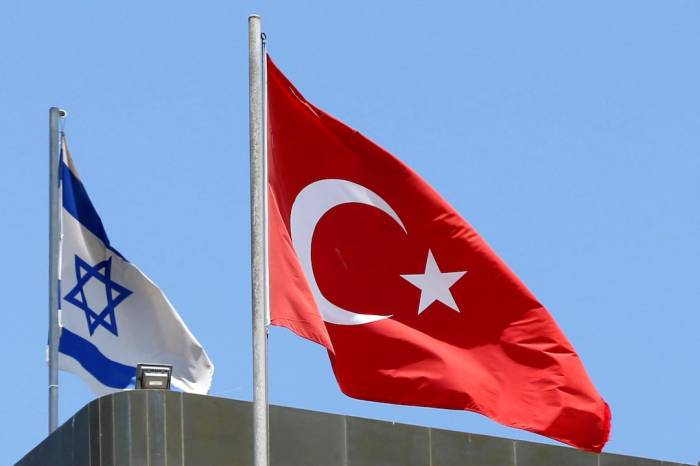
A Turkish flag flutters atop the Turkish embassy as an Israeli flag is seen nearby, in Tel Aviv, Israel June 26, 2016. REUTERS/Baz Ratner/File Photo Purchase Licensing Rights
News.Az presents an interview with Gerald M. Steinberg , a professor of politics at Bar Ilan University, is an Israeli academic, political scientist, and political activist.

Steinberg said the letter inviting him to the debate had 'no mention of Palestinian terrorist atrocities' (Photo: Gerald M. Steinberg)
-Do you have any concerns that external forces might attempt to sow discord between the two nations? What steps should be taken to further strengthen bilateral ties?
-As you mentioned, there are strong connections between Israel and Azerbaijan. For instance, I understand there are now about 11 weekly flights planned between Tel Aviv and Baku, reflecting the close ties between the two countries. Before the war, flights were almost daily, and I've personally been on them. These routes are frequented by businessmen, high-tech professionals, and security personnel. There are also well-documented reports of arms and military technology cooperation.
Both Israel and Azerbaijan face significant security challenges. Azerbaijan contends with ongoing conflict with Armenia, although there are reports of gradual progress toward an agreement. Meanwhile, Israel faces threats from Palestinian groups in Gaza, Hamas, and Iranian proxies like Hezbollah in Lebanon. Additionally, Iran's aggression and subversive activities remain a mutual concern, given its efforts to undermine both governments' security and stability.
Efforts to disrupt cooperation between Israel and Azerbaijan undoubtedly exist, often driven by forces that seek to weaken our respective regions. However, the shared interests and robust connections between the two nations provide resilience against such attempts.
- Do you think Israel will increase military pressure on Iran after the fall of Bashar Assad’s regime in Syria, and what factors could influence Israel’s decision?
- The current period is highly unstable and uncertain, particularly regarding Syria. The rapid fall of the Assad regime within weeks has altered the geopolitical landscape. Russia, which had invested heavily in supporting Assad, is now negotiating with the new leadership while attempting to retain its influence.
For Iran, this is a major setback. Iran had established significant control over Syria through the Assad regime, using it as a base for its Revolutionary Guards and Hezbollah operations. The collapse of this influence chain significantly weakens Iran. Furthermore, Israel’s recent military actions have inflicted serious damage on Iran’s air and missile defense capabilities, leaving them in a highly vulnerable state. Financial strains from funding proxies and an internal energy crisis have compounded these challenges.
Israel's primary concern remains Iran’s nuclear program. A nuclear-armed Iran would destabilize the entire region, creating an existential threat not just for Israel but for all neighboring countries. While Iran is reportedly close to having enough fissile material for one or two nuclear weapons, developing a deliverable nuclear missile is a complex process requiring months, if not years, of preparation and testing.
Israeli military actions, including recent strikes on Iranian facilities, have reportedly set back Iran’s nuclear weapons development. While the threat is not immediate, it remains a top priority for Israel. The policies of the U.S. administration, whether under President Biden or any potential successors, will also play a critical role in shaping Israel’s strategy toward Iran.
-There are rumors circulating that, following the fall of Bashar Assad's regime in Syria and the military operations conducted by the Israeli government against Lebanese Hezbollah and Hamas in Gaza, Iran might be next on the list. Could a return of Donald Trump to power in the United States lead to a declaration of war on Iran? How serious is the possibility of the overthrow of the mullahs’ regime in Tehran under U.S. leadership, and what mechanisms could be involved?
-Predicting the future is challenging, especially in such volatile circumstances. Only a few months ago, the idea of the Assad regime collapsing and the al-Nusra group seizing control in Syria, with Türkiye assuming a major role, seemed improbable. Yet, these events unfolded rapidly, showcasing the unpredictability of the region.
Under the Trump administration, several factors might influence U.S. policy toward Iran. Trump has previously appointed officials with a hawkish stance on Iran, such as his Secretary of State and National Security Advisor. These individuals consistently emphasized halting Iran’s nuclear program and advocated for a more aggressive approach, suggesting that a firmer stance against Iran could be expected.
At the same time, Trump has expressed a desire to reduce the U.S.’s global military commitments, often labeled as isolationism. This was evident during Biden’s withdrawal from Afghanistan for similar reasons. However, Trump’s decisive actions in the past—such as the assassination of Iranian General Qassem Soleimani—highlight his willingness to act boldly when necessary.
Deterrence appears to be the initial strategy. The U.S. maintains a significant military presence in the Persian Gulf region, with naval forces and troops stationed in key areas like Saudi Arabia and Syria. Advanced bombers such as the B-52, B-1, and B-2 are on standby, underscoring the U.S.’s readiness for military action if required. These deployments send a strong message to Iran about the potential consequences of further provocations.
Historically, Iran has adopted a more conciliatory posture under pressure. For instance, after the U.S. invasion of Iraq and the removal of Saddam Hussein, Iran temporarily froze its nuclear program and signaled a willingness to negotiate. A similar scenario could occur now, with Iran engaging diplomatically with Europe while avoiding direct confrontation with the U.S.
-Given Turkish President Erdogan’s acknowledgment of supporting groups involved in the withdrawal of Assad's regime, what role do you foresee for Türkiye in the Middle East following Assad’s fall? Can Türkiye strengthen its position in the region, and what scenarios might shape its policy?
-Türkiye has played a pivotal role in the events leading to Assad’s removal, with President Erdogan openly acknowledging support for groups active in this process. This transparency highlights Türkiye’sstrategic ambitions and growing influence in the region.
Following the collapse of the Assad regime, Türkiye is poised to expand its role in the Middle East. Erdogan’s government has consistently pursued policies that assert Türkiye’s leadership in regional affairs, aligning its actions with broader geopolitical objectives. Erdogan’s recent interactions with Donald Trump, who praised him as a “strong leader” pursuing a “wise policy,” further underscore Türkiye’s position as a key player.
Türkiye’s future role will likely depend on several factors: 1) collaboration with regional powers: Türkiye may align its interests with Israel and Gulf states to counterbalance Iranian influence; 2) managing Syrian Ssability: With its proximity to Syria, Türkiye is well-positioned to shape post-Assad governance and leverage its support for opposition groups; 3) economic and strategic gains: By consolidating control over critical areas, Türkiye can enhance its economic and political foothold in the region. While challenges remain, such as balancing relations with the U.S. and Russia, Türkiye’s proactive approach solidifies its role as a central force in shaping the Middle East's future.
-Türkiye has emerged as one of the two major powers in the region, particularly in the eastern Mediterranean, with significant involvement in events in Syria. How do you see Türkiye's role in the Middle East after the fall of Assad's regime?
- Türkiye has indeed solidified its role as a dominant regional power, particularly in the aftermath of the Assad regime’s collapse. It has closely allied with and supported the dominant forces in Syria. However, Türkiye also faces challenges, particularly with Kurdish groups, which remain a contentious issue requiring careful management or potential military confrontation. This will not be an easy task.
Türkiye’s strategic importance is clear. As a NATO member, its influence extends beyond the region. Despite occasional tensions within the alliance, Türkiye’s NATO membership underscores its pivotal role in shaping regional stability. Israel, as a NATO partner, has also cooperated with Türkiye in addressing shared security concerns, such as preventing extremist groups like ISIS and al-Qaeda from gaining a foothold in Syria.
The international community, including the U.S. and Europe, recognizes Türkiye’s key position. NATO’s framework, combined with Türkiye’s leadership in the region, helps limit the influence of external actors like Russia and Iran, which might otherwise seek to exploit the situation by supporting armed groups to disrupt stability.
The future of Syria, however, depends on the new leadership’s approach. If Syria pursues stability, Türkiye will likely play a central role in facilitating it. Conversely, if instability persists or extremist ideologies take root, the challenges for Türkiye and the broader region will intensify. Nonetheless, Türkiye, under Erdogan’s leadership, is in the driver’s seat and will play a decisive role in shaping the region’s future.
- You mentioned that Türkiye and Israel are two significant powers in the Middle East. How do you assess the potential for improving relations between the two countries, particularly given the changing geopolitical landscape?
-The history of Türkiye-Israel relations is complex, marked by periods of both intense cooperation and significant tension. In the 1980s and 1990s, the two nations enjoyed strong strategic collaboration, driven by shared concerns over threats from radical Islamist groups and regional instability. Joint military exercises, technological exchanges, and strategic maneuvers characterized this period, benefiting both nations.
However, relations began to deteriorate around 15 to 18 years ago. Türkiye’s growing support for the Palestinian cause, particularly Hamas, heightened tensions. Symbolic incidents, such as airspace restrictions for Israeli officials, underscored the strained relationship. Yet, even during these periods of discord, economic and technological cooperation largely continued.
Recent years have seen signs of a thaw. The need to address shared challenges in Syria and counterbalance Iran’s regional influence has brought Türkiye and Israel closer together. While visible diplomatic ties may improve gradually, I anticipate that strategic, less-publicized cooperation will deepen, particularly in areas critical to regional stability.
Economic ties and mutual security interests provide a strong foundation for this cooperation. Türkiye’s complex relationship with Iran, which includes both competition and occasional alignment, also influences its interactions with Israel. As Iran continues to assert its influence in the region, Türkiye and Israel are likely to find common ground in countering this shared challenge.
While rapid transformations in Ankara-Jerusalem relations are unlikely, the trajectory suggests cautious optimism. Strategic collaboration, particularly in Syria, will likely serve as a cornerstone of their evolving relationship.


Similar news