Middle East on the brink of a new era


Editor's note: Moses Becker is a special commentator on political issues for News.Az, a PhD in political science and an expert on interethnic and interreligious relations. The article expresses the personal opinion of the author and may not coincide with the view of News.Az.
The division of Syria, the outlines of which began to emerge as early as 2011, is becoming an unpredictable reality. Its primary beneficiaries so far appear to be President Erdoğan, for whom this is another step toward fulfilling his long-standing dream of reviving the Ottoman project, and Israel, which has secured the strategically important Mount Hermon, offering a vantage point overlooking the suburbs of Damascus. The biggest loser is Iran, which has not only lost Syria but also the extensive network of Shiite terrorist proxies it had painstakingly built over years.
The ongoing division of Syria signifies the collapse of the principle of inviolable borders—a concept that began to fracture following the disintegration of the USSR and Yugoslavia and culminated in NATO’s dismemberment of Serbia. Now, this phenomenon has reached the Middle East. The fact that the events in Syria were not spontaneous is evidenced by one key detail: shortly before the overthrow of Assad, Major General Roman Gofman, Military Secretary to the Israeli Prime Minister, visited Moscow. After his visit, the Israel Defense Forces effortlessly occupied the Golan Heights positions previously controlled by Russian observers. Unconfirmed reports suggest that simultaneously, the head of Israeli intelligence, David Barnea, visited Ankara. Through coordinated efforts, the division of Syria has been executed but remains incomplete. For now, each participant in the process has retained their respective interests: Russia has preserved its bases in Khmeimim and Tartus, while Türkiye has gained freedom of action against the Kurds with the support of the Free Syrian Army.
A pressing question is whether the U.S. will grant carte blanche to Türkiye’s proxies or, fearing Ankara's growing influence, will intensify support for the Syrian Kurdish Self-Defense Forces (YPG) with arms and defensive equipment. Time will tell. Already, the U.S. is constructing a military base near the city of Kobani in northern Syria as part of its support for Kurdish armed groups. According to several sources, the U.S. has vacated a base in neighboring Iraq, redirecting concrete blocks and other materials to Ayn al-Arab, or Kobani. Additionally, 13 U.S.-flagged trucks carrying materials for concrete structures have arrived in the area. Simultaneously, the U.S. has deployed dozens of Bradley IFVs, air defense systems, and armored vehicles to assist the Kurds.
Syria today is effectively divided among several quasi-state entities, whose boundaries resemble those established under the French Mandate in the first half of the 20th century. Predicting further developments is nearly impossible.
Recently, Israel struck military factories and a research center in Aleppo, Syria. On January 3, the Sham FM radio station reported, "The Israeli attack targeted defense laboratories and a research center near the city of al-Safira in eastern Aleppo." Following Iran's effective defeat , Israeli leadership is increasingly considering neutralizing Türkiye's sharply rising influence in the region. Meanwhile, in eastern Türkiye, Kurds, having regrouped, are advancing on Manbij. Their armed formations have firmly entrenched themselves in the eastern part of the city.
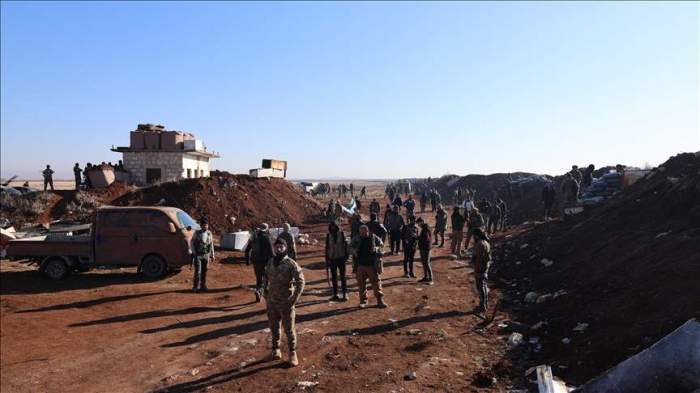
It should be noted that militants from the Syrian National Army (SNA) have been unable to take control of Kurdish neighborhoods in Aleppo, which might compel Ankara to intervene directly in the conflict. Moreover, it is becoming increasingly evident that Türkiye, gradually becoming entangled in the war against the Kurds, is quickly losing control over the Hay’at Tahrir al-Sham (HTS) group, which Saudi Arabia is actively attempting to bring under its influence.
For Syria, as an Arab country, Saudi Arabia, the UAE, Kuwait, and Egypt are more understandable and acceptable "partners" with whom it has no major disagreements or contested issues, unlike Türkiye, with which tensions abound. President Erdoğan's statements regarding certain Syrian territories have already caused shock and justified concern among the new Syrian leadership. Furthermore, such remarks have alarmed Arab nations, who still remember the era of Ottoman rule. Meanwhile, the leaders of "New Syria" have already conducted productive negotiations with the Kurdish-led Syrian Democratic Forces (SDF) and gained their understanding. All of this runs counter to Türkiye's interests and undermines the Syrian National Army, which, according to HTS and the SDF, has no place in the country's new political structure.
The ongoing struggle is centered on controlling a massive transportation artery with access to the Mediterranean, which has historically facilitated active trade between East and West, North and South. Today, this logistical chain plays a crucial role in transporting hydrocarbons to Europe. This is likely why the region has recently seen an influx of political figures from various nations, including the foreign ministers of key EU countries like Annalena Baerbock of Germany and Jean Barreau of France.
The critical question now is whether Syria’s current leadership can create a unified "national state" in a country where deep divisions and mutual animosities persist. Whether an idea emerges that unites the nation and ensures that every individual feels protected and equal, regardless of language or religious affiliation, remains to be seen. The era of nation-state building and decolonization has ended.
If the core of the new Syrian leadership consists of Hay’at Tahrir al-Sham followers, Syria could end up being governed by Salafists who bear no ideological hostility toward Israel and the U.S. This raises the likelihood of Syria transforming into an "anti-Shiite state" hostile to Iran and the Lebanese Hezbollah movement—a trajectory that is already beginning to take shape.
One possible, though unlikely, scenario is the establishment of a U.S.-backed Federal Republic of Syria with broad local autonomy, but a unified army and parliament. The worst-case scenario, however, involves the country’s disintegration, leading to a prolonged and devastating civil war with parts of Syrian territory being absorbed by neighboring countries. In all scenarios, the Kurdish question remains the most challenging issue. This problem affects not only Syria but also, to an even greater extent, neighboring countries where significant Kurdish populations reside. Both Washington and other power centers are likely to leverage this issue for their own ends.
For Israel, the situation in Syria presents both opportunities and risks. On one hand, the collapse of the Assad regime creates overlapping interests with Türkiye; on the other hand, Ankara's growing power and President Erdoğan's hostile rhetoric compel Israel to support the Kurds and increase pressure on the U.S. to maintain its military presence in the region. Washington is currently fostering separatist sentiments among Syrian Kurds and integrating Iraqi Kurdistan into this process, with implications for both Iran and Türkiye.
According to the Lebanese publication Lebanon24, “Türkiye is now under pressure from the Arabs,” whose fear of Ankara's growing power rivals their past concerns about Iran. It is no coincidence that following the visit of Turkish Foreign Minister Hakan Fidan to Damascus, delegations from Jordan, Qatar, and Saudi Arabia also arrived in Syria. American strategic analyst Richard Weitz noted, "The goal of such visits is to limit Turkish influence in Syria, even though Ankara's interests may not always conflict with those of Arab countries." In other words, the battle for Syria has entered a new phase, and the post-Assad leadership faces the formidable task of preserving the nation’s unity, defending its sovereignty and territorial integrity, reconciling diverse sectarian groups, and ensuring economic prosperity and political stability.
(If you possess specialized knowledge and wish to contribute, please reach out to us at opinions@news.az).


Similar news