Pope Leo XIV: An inauguration centered on peace, unity, and global justice


Editor's note: Teymur Atayev is an Azerbaijani publicist, historian, political scientist, and host of the program "Aspects of Foreign Affairs" on the Azerbaijani CBC TV channel (broadcasts in Russian). The article expresses the personal opinion of the author and may not coincide with the view of News.Az.
On May 18, the Vatican held the official inauguration ceremony for the new Pope—Leo XIV. His brief inaugural Mass set the tone for his pontificate, reflecting the new head of the Catholic Church’s core spiritual and humanitarian priorities. In his address to the faithful, the Pope acknowledged the suffering of those affected by conflict, making particular reference to the starving in Gaza, those dying in Myanmar, and war-weary Ukraine, which, as he noted, “still longs for a just and lasting peace.”
Later, addressing more than 200,000 pilgrims gathered in St. Peter’s Square, Leo XIV emphasized two central aspects of Jesus Christ’s mission—Love and Unity. The Pope recalled the Gospel passage (Luke 5:1–11), in which Christ calls on his disciples to become “fishers of men.” This metaphor, he explained, represents not a call for domination or forced conversion, but a mission to bring people closer to God through compassion, peace, and faith. To “sail the sea of life,” the Pope said, is to move toward the embrace of the Creator.
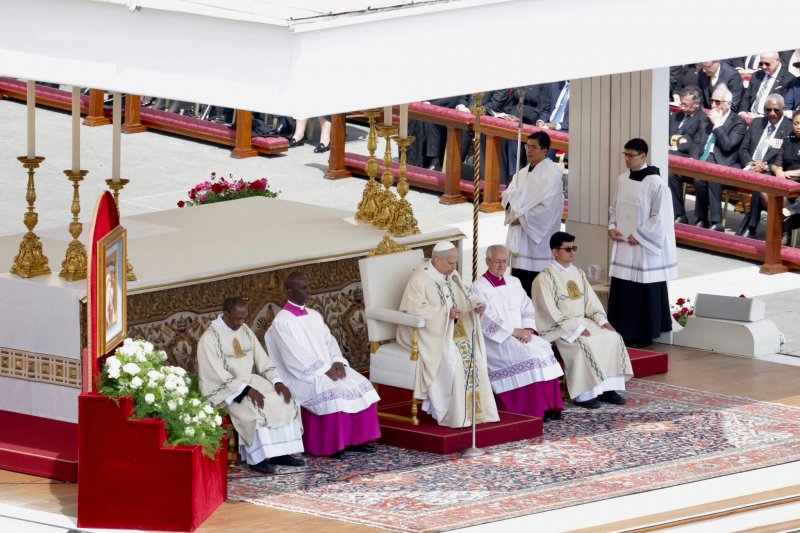 Pope Leo XIV acknowledged divisions among the faithful with a call for fraternal communion and unity in the homily at his inaugural Mass in St. Peter’s Square on May 18, 2025. Photo: Daniel Ibanez/CNA
He strongly underscored that the essence of Christian ministry does not lie in imposition, supremacy, or religious propaganda, but in selfless love. However, the modern world, he warned, is torn by conflicts and contradictions: hatred, violence, prejudice, fear of those who are different, and an economic model that exploits the Earth’s resources while marginalizing the poorest. In this context, Pope Leo XIV called on humanity to follow the path of love, openness, and dialogue—embracing those who belong to other religions, those searching for God, and all people of goodwill who seek peace and justice.
“We must not feel above the world,” he noted, adding that unity does not mean erasing differences. On the contrary, it is essential to value the unique life story of every individual, as well as the cultural and spiritual heritage of each people. In doing so, Leo XIV outlined the spiritual framework of his pontificate, placing special emphasis on the universality of the Christian message and its relevance amid global instability.
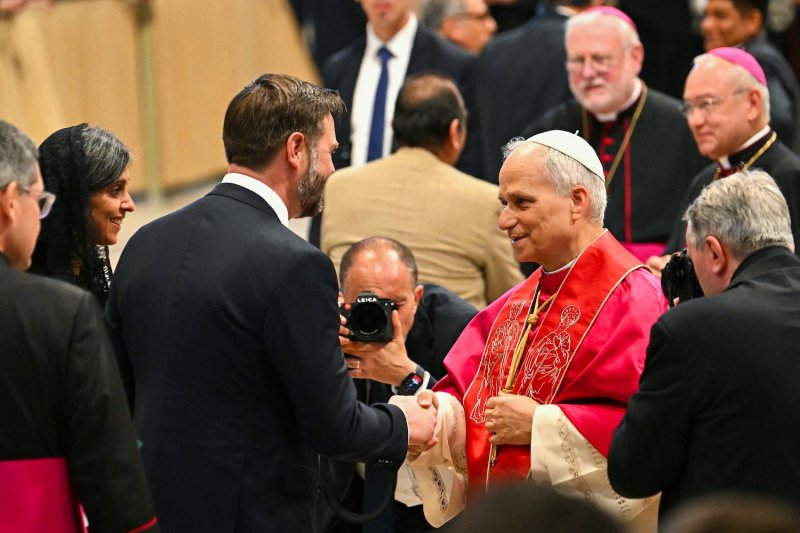 Pope Leo XIV talks to U.S. Vice President JD Vance and his wife Usha after a Holy Mass for the beginning of his pontificate, in St Peter's Basilica in The Vatican, May 18, 2025. Alberto Pizzoli/AFP via Getty Images
Meanwhile, the day of the inauguration made headlines not only as a momentous religious event but also as a politically charged occasion. The presence of world leaders—including U.S. Vice President J.D. Vance and Ukrainian President Volodymyr Zelensky—added significant international weight to the ceremony. Their handshake—the first since a public altercation at the White House in February—attracted particular attention.
Zelensky, who described his meeting with Vance and U.S. Secretary of State Marco Rubio as “positive,” noted that several key issues were discussed during their informal conversation—from the battlefield situation to the prospects for a future prisoner exchange. The Ukrainian leader expressed concern about the “unrealistic conditions” put forward by Russia during the Istanbul talks and once again emphasized the urgent need for a complete and unconditional ceasefire. He also thanked the American people for their “support and leadership in saving lives,” stressing the importance of maintaining pressure on Moscow. Washington characterized the meeting as “very productive.”
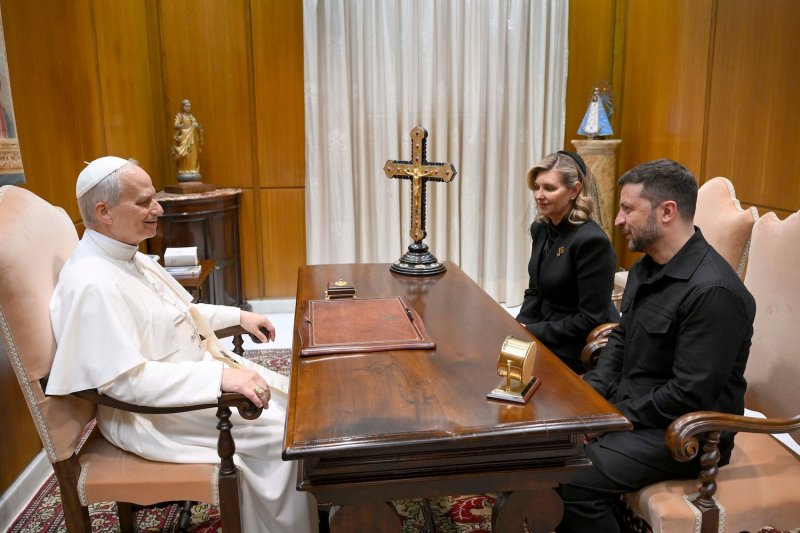 Pope Leo XIV meets with President of Ukraine, Volodymyr Zelenskyy and his wife Olena Zelenska at the end of the Inauguration Mass in St. Peter's Square, May 18, 2025 in Vatican City. Photo: Vatican Media
On the eve of the inauguration, Secretary Marco Rubio had voiced support for the Vatican as a potential neutral venue for peace talks between Kyiv and Moscow. This proposal resonated with Pope Leo XIV, who openly stated his readiness to personally contribute to efforts aimed at ending the war. During his private audience with the pontiff, Zelensky expressed gratitude for the Pope’s “clear and morally impeccable stance in support of a just and lasting peace” and declared his openness to “dialogue in any format that can yield real results.” As a token of appreciation, he presented Pope Leo with an icon of the Virgin Mary and Child, painted on a fragment of a shell casing from the outskirts of Izium. In a post on social media, Zelensky emphasized that “for millions around the world, the Pope is a symbol of hope for peace,” and that the moral authority and voice of the Holy See could play a crucial role in ending the war.
Thus, beyond its profound spiritual and symbolic significance, the inauguration of Pope Leo XIV also assumed a clearly political dimension. The Vatican reaffirmed its status not only as the spiritual center of the Catholic world but also as a major international actor capable of exerting moral influence on global affairs. While the meetings held on this day may not have resulted in a diplomatic breakthrough, their mere occurrence—particularly amid growing geopolitical tensions—signals the willingness of key global players to engage the Holy See in efforts to resolve crises.
The growing attention to the Pope’s words and gestures underscores a broader truth: in an era of escalating conflict, broken diplomatic channels, and eroding trust between nations, spiritual diplomacy may be the only truly universal language capable of bridging deep divides. At a time when traditional tools of international politics often fail, the role of a moral authority—grounded in centuries of spiritual tradition and a mission to serve humanity—becomes all the more vital.
Pope Leo XIV has made it clear that his pontificate will not be confined to internal church matters. It will be actively engaged in addressing the world’s most pressing challenges—from war and violence to poverty, environmental degradation, and spiritual alienation. If the Vatican succeeds in mediating even one of today’s major conflicts, its role in the 21st century may go far beyond the ceremonial or symbolic. It could emerge as a genuine moral and political beacon in a world still searching for stability amid global turmoil.
(If you possess specialized knowledge and wish to contribute, please reach out to us at opinions@news.az).


Similar news