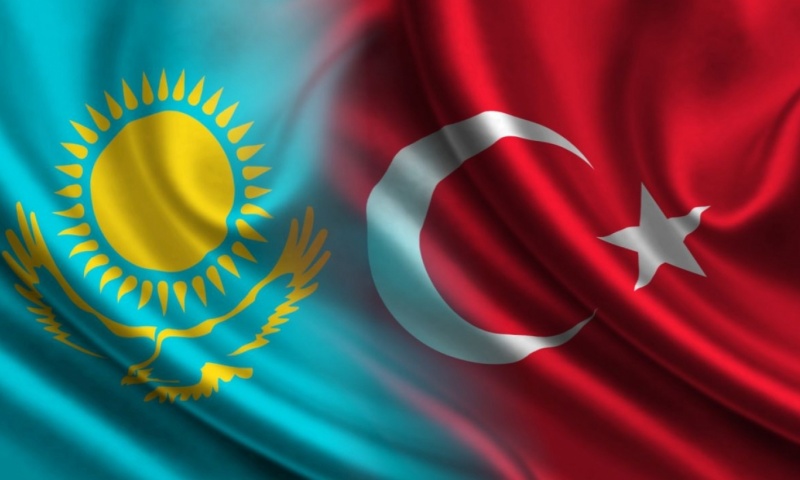
Türkiye and Kazakhstan’s cooperation elevates regional partnership to a strategic dimension


Editor’s note: Ahmet Sağlam is a specialist in business development, sales and marketing, B2B cooperation, and corporate communications. Most recently, he served as Business Development and International Relations Coordinator at the Hacettepe University Technology Development Zone. The views expressed in this article are those of the author and do not necessarily reflect the views of News.Az.
Turkish President Recep Tayyip Erdoğan paid an official visit to Astana, the capital of Kazakhstan, on 13 May 2026 to attend a meeting of the Türkiye–Kazakhstan High-Level Strategic Cooperation Council and the Informal Summit of the Organization of Turkic States.
From the moment Erdoğan’s aircraft entered Kazakh airspace until it landed at Astana Airport, it was escorted by fighter jets of the Air Defence Forces of the Republic of Kazakhstan. President Kassym-Jomart Tokayev welcomed Erdoğan with an official ceremony at Nursultan Nazarbayev International Airport. The greeting by children holding Turkish and Kazakh flags and welcoming President Erdoğan in both languages with the words “Welcome to the ancestral homeland” added a symbolic and emotional dimension to the ceremony.
The warm and brotherly diplomacy displayed by Presidents Tokayev and Erdoğan during the welcoming ceremony reflected the high level reached in the political, diplomatic and economic relations between the two countries, which are rooted in close fraternal ties.
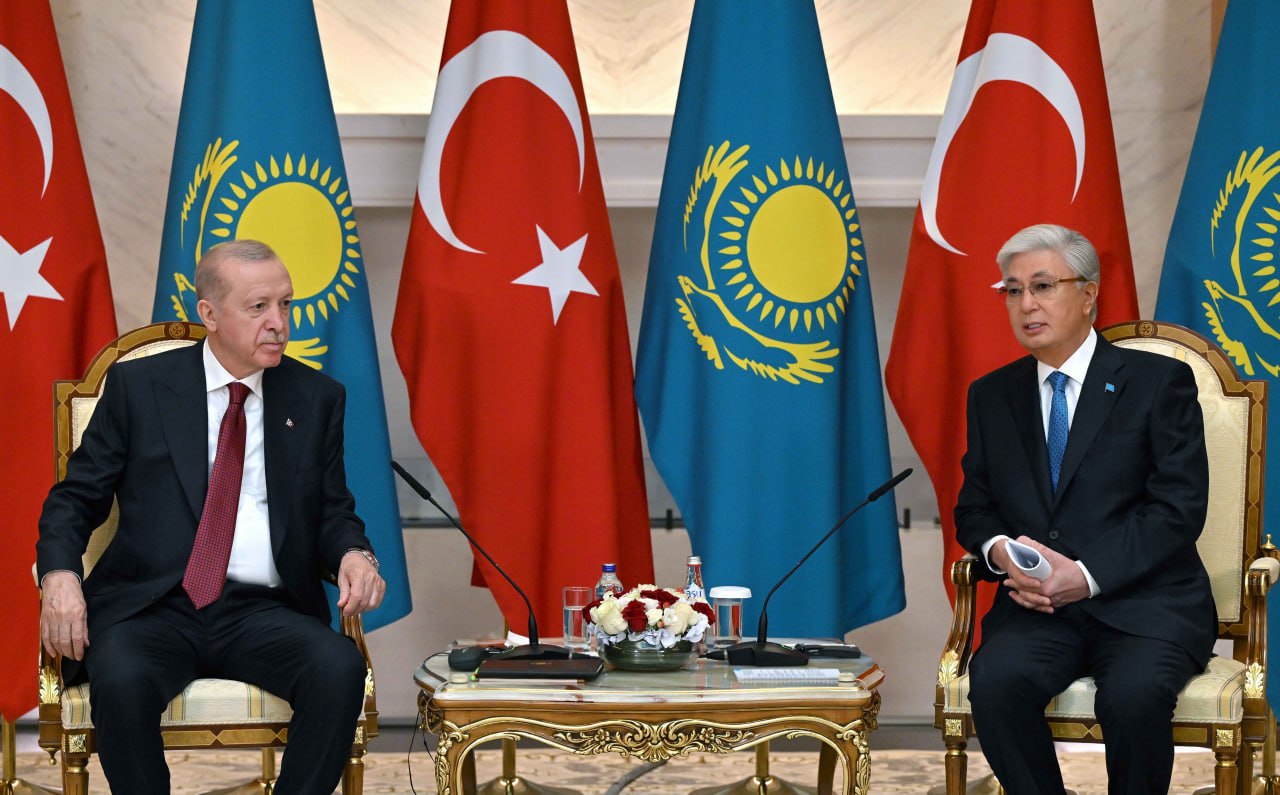
The following day, 14 May 2026, President Erdoğan was received by President Tokayev at the Independence Palace in Astana, where the two leaders held a private meeting. The parties also conducted the sixth meeting of the Türkiye–Kazakhstan High-Level Strategic Cooperation Council.
Source: Trend
During the meeting, the two sides comprehensively discussed cooperation in numerous areas, including trade, transport, energy, healthcare, mining, culture, education, technology and the defence industry.
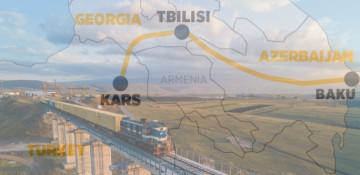
One of the main items on the agenda was the Trans-Caspian East–West Middle Corridor, which is regarded as the modern equivalent of the Silk Road. Given the emphasis both leaders placed on the Middle Corridor, it can be argued that the route is set to become not only a new artery for energy and trade in the Turkic world, but also across a vast region extending into Europe.
Türkiye’s emphasis on supporting the Middle Corridor not only as a cargo transportation route but also as a strategic energy corridor carrying resources westward further reinforces this assessment.
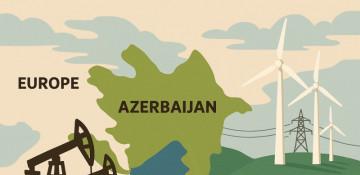
This approach can be interpreted as an effort to place the energy-producing states of the Turkic world, particularly Kazakhstan and Azerbaijan, in a more central position within the global energy supply chain, especially in relation to Europe.
As is well known, in previous years much of the energy production of Kazakhstan and Azerbaijan was marketed through Russia, significantly reducing the economic benefits these countries derived from their natural gas and other energy resources. However, thanks to major international projects such as the Trans-Caspian East–West Middle Corridor, Kazakhstan and Azerbaijan are expected to gain greater opportunities to transport their gas directly to Europe and other global markets.
As a result, Kazakhstan and Azerbaijan will not only increase the economic benefits generated by their energy sectors, but will also reduce their dependence on any single transit country, particularly Russia, for energy transportation. This represents an important strategic transformation for both countries.
The Middle Corridor stands out as one of the rare strategic cooperation projects capable of generating broad consensus across a vast geographical area stretching from the Turkic world to the European Union and from China to the United States.
At the same time, the Trans-Caspian East–West Middle Corridor will contribute to diversifying Europe’s energy supply chain, representing an important step towards reducing Europe’s dependence on a single source of natural gas.
Türkiye, meanwhile, is set to strengthen its position as a strategic logistics and trade hub by serving as a central transit route for energy and commerce and by facilitating the secure delivery of the Turkic world’s economic resources, particularly those of Kazakhstan and Azerbaijan, to Europe.
This approach was once again emphasised during the sixth meeting of the Türkiye–Kazakhstan High-Level Strategic Cooperation Council held in Astana.
At the same time, Armenian Prime Minister Nikol Pashinyan has recently made notable moves towards improving relations with Azerbaijan, Türkiye and the broader Turkic world. The Armenian leadership appears to recognise that the planned opening of the Zangezur Corridor could bring economic benefits and greater regional stability, and is seeking to ensure that Armenia also benefits from this transformation.
Indeed, the day before President Erdoğan’s visit to Kazakhstan, the Turkish Foreign Ministry announced that bureaucratic preparations for the launch of direct trade between Türkiye and Armenia had been completed.
Subsequently, during President Erdoğan’s visit to Kazakhstan, the joint emphasis placed by Türkiye and Kazakhstan on the importance of the Trans-Caspian East–West Middle Corridor demonstrated that a major economic and geopolitical transformation centred on a new Silk Road is gradually taking shape in the region.
This process, extending across sectors from energy to trade, increasingly resembles a broad geostrategic equation involving the Turkic world, Europe, China and even the United States, which reportedly views the Zangezur Corridor as part of the so-called “Trump Route”.

Source: Press TV
In this context, aside from climate change-related concerns, the Middle Corridor appears to be one of the few issues on which a broad international consensus has emerged at the global level.
Another notable point during the meeting of the Türkiye–Kazakhstan High-Level Strategic Cooperation Council was President Tokayev’s reference to President Erdoğan’s internationally promoted doctrine that “The world is bigger than five”, stressing that the idea has gained broad international support.
As is known, President Tokayev stated during the Antalya Diplomacy Forum that “the United Nations should not only be supported but also reformed”, demonstrating that under his leadership Kazakhstan’s foreign policy has adopted a more active and multilateral approach towards addressing inequalities within the international system.
Following the meeting, Tokayev presented Erdoğan with the Order of Khoja Ahmed Yasawi.
In addition, an opening ceremony was held for the Pir-i Turkistan Khoja Ahmed Yasawi Primary School, built by Kazakhstan in the Nurdağı district of Gaziantep following the devastating 6 February earthquake in Türkiye.
These developments can be seen as important demonstrations that the two brotherly countries continue to support one another in both prosperous and difficult times within the framework of fraternal solidarity.
In particular, the construction of the primary school may also be viewed as a powerful symbol that the bond between the two countries will continue to strengthen for future generations.
(If you possess specialized knowledge and wish to contribute, please reach out to us at opinions@news.az).


Similar news