What is happening in South Korea?


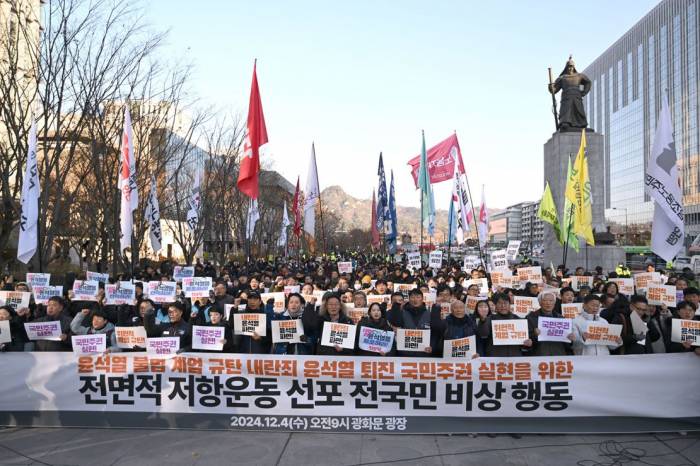
South Korean protesters holding a banner that reads "We condemn Yoon Suk Yeol's illegal martial law" during a rally at Gwanghwamun Square in Seoul on December 4. Photo: Jung Yeon-Je/AFP/Getty Images
By Samir Muradov
The world seems to have gone mad. That’s the impression one gets when scrolling through the news. While so-called "banana republics" lag behind in their pursuit of self-destruction, even developed nations are teetering on the brink.
The National Assembly, South Korea's parliament, strongly opposed the declaration. On the evening of December 3, 190 out of 300 lawmakers who managed to enter the barricaded assembly building voted to repeal martial law. According to the South Korean Constitution, the parliament has the authority to overturn such a decision with a majority vote. However, this vote took place after the military had already prohibited the functioning of the National Assembly and political parties. Meanwhile, President Yoon has yet to revoke his decision. In justifying martial law, Yoon cited the need to "eradicate forces supporting North Korea" and "uphold constitutional order."
The declaration of martial law appears to have caught everyone off guard, including South Koreans themselves and even the ruling People Power Party. Party leader Han Dong-hoon described the move as both unconstitutional and a mistake.
Despite initially agreeing to abide by the parliamentary vote, Yoon authorized the deployment of approximately 280 military personnel to the National Assembly on the night of December 4, ostensibly to enforce martial law measures. The regime restricts political activities, suspends the operation of political parties, and places all media and publishing under state control. Violators face searches, detention, or arrest without court warrants, with penalties potentially extending to capital punishment, according to Korean media.
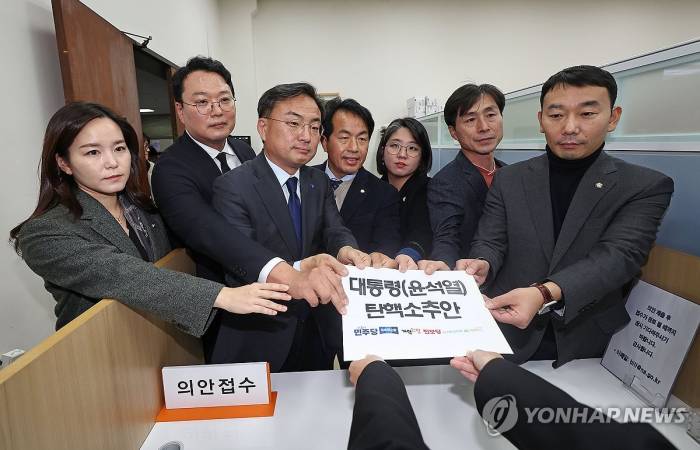
Lawmakers of the main opposition Democratic Party and other minor opposition parties submit a bill to impeach President Yoon Suk Yeol to the bills office at the National Assembly in Seoul on Dec. 4, 2024. Photo: Yonhap
Analysts have so far refrained from offering in-depth evaluations, as the situation remains murky. Initial reports suggest that the declaration followed a series of actions by the opposition Democratic Party, which is closely aligned with the U.S. Democratic Party. These included the passage of a reduced budget bill in a parliamentary committee and attempts to impeach the country’s state auditor and prosecutor general.
Economically, the martial law announcement has already had significant repercussions. South Korea's currency has plummeted to a yearly low, with 1,000 won now worth just 70 cents against the dollar.
It is worth noting that peaceful transfers of power have historically been rare in South Korea. The last instance of martial law was declared in 1979 following the assassination of then-dictator Park Chung-hee. However, this does not mean the intervening years have been serene. South Korea’s political history is marked by coups, corruption, and turmoil.
Here are some highlights from the country’s leadership history:
- Syngman Rhee (1948–1960): Ousted.
- Yun Po-sun (1960–1962): Ousted.
- Park Chung-hee (1962–1979): Assassinated.
- Choi Kyu-hah (1979–1980): Overthrown in a military coup.
- Chun Doo-hwan (1981–1988): Sentenced to death post-presidency.
- Roh Tae-woo (1988–1993): Sentenced to 22 years in prison post-presidency.
- Kim Young-sam (1993–1998): Imprisoned during his political career; secured the convictions of two predecessors while in office.
- Kim Dae-jung (1998–2003): Imprisoned, sentenced to death (later pardoned), and awarded the Nobel Peace Prize.
- Roh Moo-hyun (2003–2008): Impeached (later overturned); died by suicide while under investigation for corruption.
- Lee Myung-bak (2008–2013): Jailed for corruption post-presidency.
- Park Geun-hye (2013–2016): Impeached and sentenced to 24 years for corruption.
- Moon Jae-in (2017–2022): Completed his term without scandals or imprisonment, a rare exception.
It remains uncertain how Yoon Suk-yeol’s presidency will conclude. Many predict imprisonment for his role in the unfolding crisis. If so, Moon Jae-in might remain the sole president in South Korea’s modern history to retire peacefully.


Similar news