Why Syria just became the most important country in the Middle East


Editor’s note: Moses Becker is a special political commentator for News.Az, a PhD in political science, and an expert on interethnic and interreligious relations. The article reflects the author’s personal views and does not necessarily represent the position of News.Az.
For the first time since Syria declared independence, its president has been received by the leader of the United States, a symbolic milestone reflecting the role Washington envisions for Syria in the future architecture of the Middle East. On November 10, 2025, Donald Trump met at the White House with Syria’s interim president, Ahmed al-Sharaa, a man for whose capture as a terrorist the U.S. government had, until recently, offered a $10 million bounty. In an instant, a former extremist was recast as a respectable political figure.
No joint statements were issued after the meeting, and the two leaders did not appear together before reporters.
According to Reuters, al-Sharaa’s arrival at the White House was notably understated compared to typical state visits. He entered through a side entrance rather than the West Wing portico, where cameras are positioned and where foreign leaders are often greeted personally by the U.S. president. He exited the same way.
The symbolism was clear, yet the meeting did take place, and for Syria it marked a turning point. From diplomatic isolation, the country is now transitioning into a significant regional actor. For Washington, the goal is not only to strengthen U.S. influence but also to limit the geopolitical weight of other external players.
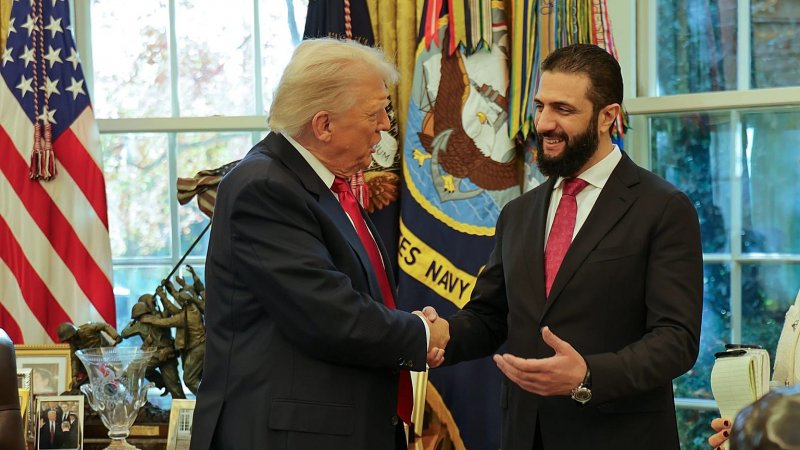 Photo: AP
The significance of the event is underscored by the fact that the last high-ranking Syrian official to visit the White House did so in December 1999, when Syrian Foreign Minister Farouk al-Sharaa participated in peace talks with Israel.
Over the following quarter century, Syria moved from Assad-era rule, marked by civil war, repression, and global isolation, to the collapse of the regime. After the takeover of Damascus by Hay’at Tahrir al-Sham (HTS) and Bashar al-Assad’s flight to Moscow, interim leader and HTS chief Ahmed al-Sharaa began attempting to restore ties with governments that had avoided Damascus for years.
For a long time, al-Sharaa was subject to UN sanctions as a member of HTS, the Syrian branch of al-Qaeda. Only recently, under U.S. pressure, the other 14 UN Security Council members agreed to lift those sanctions. Now, the United States, and particularly President Donald Trump, openly supports the former jihadist.
Here, the familiar geopolitical formula applies: “The enemy of my enemy is my friend.” Since al-Sharaa severed ties with Iran, began combatting Hezbollah, and blocked weapons smuggling routes from Iran to Lebanon, the White House has begun viewing him as a viable strategic partner.
“He’s young, attractive, very strong — a fighter. He has every chance of keeping the situation under control,” Trump told journalists aboard Air Force One after their first informal meeting in Riyadh in May.
Speaking at a security conference in Bahrain, U.S. Special Envoy for Syria Tom Barrack said that during al-Sharaa’s visit to Washington, a formal agreement was expected to be signed on Syria’s accession to the 88-nation coalition against ISIS.
Syrian Foreign Minister Asaad al-Shaibani confirmed this agenda:
“Today we are fighting the Islamic State. Any effort in this direction requires international support.”
He added that the leaders would also discuss sanctions relief, most likely referring to the Caesar Syria Civilian Protection Act.
Named after a Syrian military photographer who smuggled out thousands of images of tortured detainees, the Caesar Act imposed sweeping restrictions on the Syrian economy.
While full repeal requires a congressional vote, shortly after the White House meeting the U.S. Treasury suspended enforcement of sanctions for 180 days — a strong indication that a full rollback may follow.
Influential Republican Senator Lindsey Graham said that before voting to fully lift sanctions, he wanted to see Syria officially join the anti-ISIS coalition and make progress toward a new security framework with Israel.
Trump later stated that the United States would do everything possible to ensure Syria’s success:
“We want Syria to become a very successful country, and I think this leader can achieve that. He gets along very well with Türkiye — with President Erdogan, who is a great leader. Erdogan strongly supports what is happening in Syria… Syria is an important part of the Middle East. It feels like everything is going very well. We’re also working with Israel to normalize relations — with Syria and with everyone, and it’s going amazingly.”
Al-Sharaa said the continued U.S. military presence in Syria was “justified.” While Trump’s remarks emphasized Türkiye, analysts believe Washington’s preferred partners for a restructured Syrian alignment will likely include Saudi Arabia, the UAE, Bahrain, and, eventually, Israel.
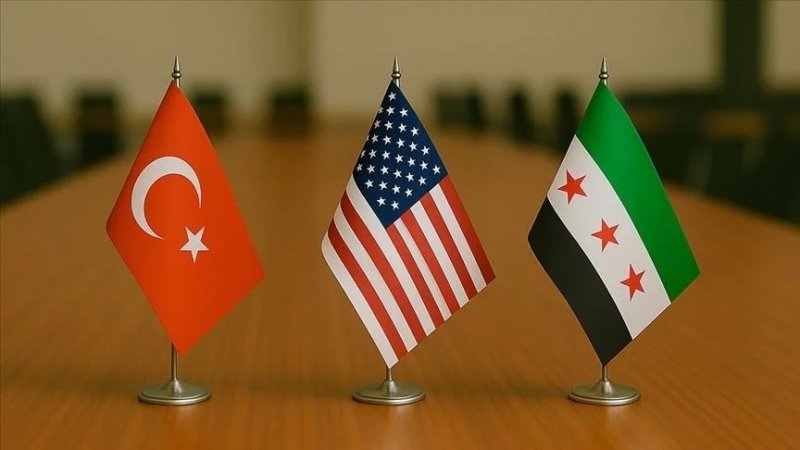 Photo: Anadolu Agency
Syria is not yet ready to join the U.S.-brokered Abraham Accords, but it appears prepared to end confrontation and establish a ceasefire — with U.S. mediation expected to play a decisive role.
According to U.S. officials speaking on background, the Syrian delegation presented a detailed roadmap for participation in counterterrorism operations against ISIS.
On the eve of the White House visit, al-Sharaa also met with Chairman of the House Foreign Affairs Committee Brian Mast.
“We were once enemies,” Mast said. “I asked him directly: why are we no longer at war? His answer was clear — he wants to break with the past and become a reliable ally of the United States.”
Experts briefing Bloomberg noted that the emerging military and intelligence cooperation could reshape the geopolitical map of the Middle East.
The United States is currently mediating negotiations on a potential security pact between Syria and Israel. According to President Trump, “major progress” has already been achieved — a development he described as essential for peace and stability in a region where a new political reality is being built before the world’s eyes.
(If you possess specialized knowledge and wish to contribute, please reach out to us at opinions@news.az).


Similar news