AI chip demand drives South Korea's export growth


Outbound shipments totaled $85.89 billion last month, marking a 48 percent increase year-on-year, according to data compiled by the Ministry of Trade, Industry and Resources, News.Az reports, citing Yonhap.
The April figure represents the second-highest monthly export total in the country’s history, following the all-time record of $86.6 billion recorded in March.
Imports increased 16.7 percent year-on-year to $62.11 billion, resulting in a trade surplus of $23.77 billion.
RECOMMENDED STORIES
April also marked the second consecutive month in which South Korea recorded a monthly trade surplus exceeding $20 billion.
The ministry largely attributed the sharp rise in exports to a semiconductor supercycle.
Chip exports reached $31.9 billion, surging 173.5 percent from a year earlier and setting the highest-ever figure for any April. This increase was driven by sustained demand for artificial intelligence (AI) semiconductors and continued growth in memory chip prices.
Exports of petroleum products jumped 39.9 percent year-on-year to $5.11 billion, despite a decline in shipment volumes, as global oil prices rose due to the ongoing conflict in the Middle East, the ministry said.
In detail, outbound volumes of gasoline, diesel, and kerosene fell by 43 percent, 23.2 percent, and 99.9 percent, respectively, after the Seoul government imposed export restrictions in mid-March to stabilize the domestic fuel market.
Computer exports soared 515.8 percent to $4.08 billion, marking the highest monthly figure ever, as global demand for solid-state drives expanded alongside growth in the AI sector.
Exports of electrical equipment, cosmetics, and agro-fisheries products rose 7.6 percent, 33.4 percent, and 8.8 percent respectively, reaching $1.57 billion, $1.37 billion, and $1.22 billion. All three categories recorded their highest-ever April figures.
In contrast, auto exports fell 5.5 percent to $6.17 billion in April, partly due to shipping disruptions caused by the Middle East crisis and the expansion of production by Korean carmakers in the United States in response to U.S. tariff policies, according to the ministry.
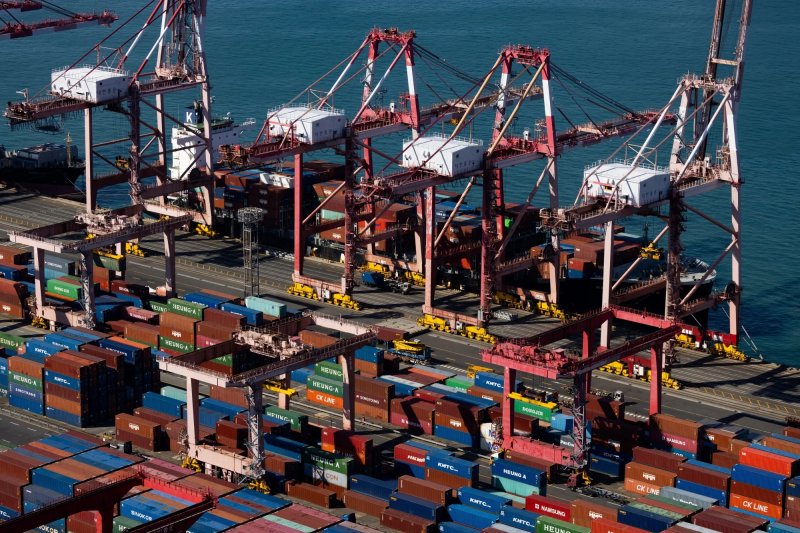
A port in Pyeongtaek, about 60 kilometers south of Seoul, on April 1, 2026, showed stacked containers and active export operations, Yonhap reported.
By destination, exports to China surged 62.5 percent year-on-year to $17.7 billion in April, rising for the sixth consecutive month, driven by strong demand for semiconductors and IT products.
Exports to the United States increased 54 percent to $16.33 billion, with gains in semiconductors and computers offsetting declines in automobiles and machinery shipments.
Shipments to the Association of Southeast Asian Nations (ASEAN) jumped 64 percent to $15.41 billion, while exports to the European Union rose 8.5 percent to $7.19 billion.
Exports to the Middle East, however, dropped 25.1 percent year-on-year to $1.27 billion amid the prolonged conflict between the United States and Iran, the ministry said.
“South Korea saw its monthly exports surpass the $80 billion mark, along with a trade surplus exceeding $20 billion, for the second straight month for the first time in history in April, even amid the persisting conflict in the Middle East,” Industry Minister Kim Jung-kwan said in a press release.
Kim credited the performance to South Korean companies’ ongoing efforts to diversify supply chains and pledged continued government support to reduce burdens on exporters and strengthen competitiveness amid persistent global trade uncertainties.
A port in the southeastern city of Busan, shown on March 31, 2026, illustrated heavy container activity reflecting strong trade flows, Yonhap reported.
By Nijat Babayev


Similar news