Azerbaijan and Armenia’s historic peace agreement: A new era for the South Caucasus


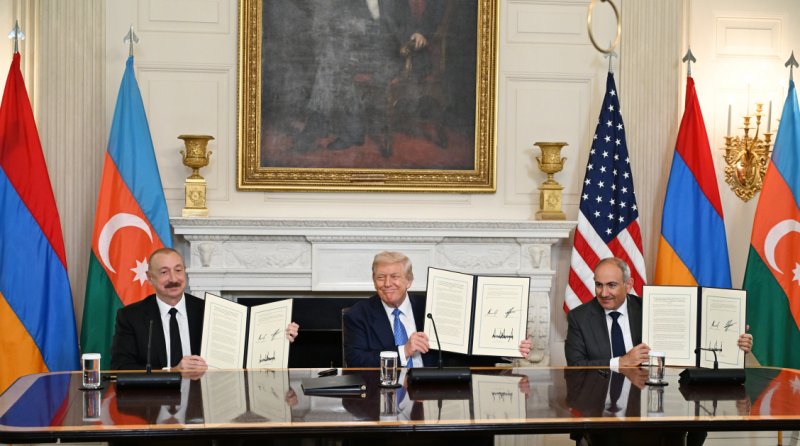
On August 8, 2025, the peace agreement signed in Washington between Azerbaijan and Armenia marked a turning point in the history of the South Caucasus. For more than three decades, the conflict between the two nations had defined the region’s political landscape, destabilized its development, and hindered prospects for integration with the broader global economy. Now, this landmark document not only closes the chapter on one of the most enduring disputes of the post-Soviet space but also sets the foundation for a new regional order based on stability, cooperation, and forward-looking development.
The essence of the Washington agreement goes far beyond a simple cessation of hostilities. While its immediate purpose was to halt the risk of further escalation and armed confrontation, its broader vision lies in creating sustainable peace, trust, and economic interdependence. For the first time, both sides have committed to building a future not through military strength, but through diplomatic dialogue and mutually beneficial partnerships. At the heart of the agreement is Armenia’s official recognition of Azerbaijan’s territorial integrity. This was a long-awaited and essential step that formally ended all territorial claims and transformed Azerbaijan’s battlefield victories into binding international reality. For the Azerbaijani people, it represents a guarantee of lasting security and sovereignty; for the state, it solidifies its status under international law and opens the door to deeper engagement with global powers.
The role of the United States as mediator and guarantor of the peace deal is no less significant. Washington’s involvement not only underscored the geopolitical importance of the South Caucasus but also highlighted Azerbaijan’s ability to secure the support of one of the world’s most powerful actors. The repeal of the long-standing Section 907 amendment, which had limited U.S. assistance to Azerbaijan since the 1990s, symbolized a profound shift in American policy. By facilitating the negotiations, the United States has effectively acknowledged Azerbaijan’s central role in shaping the new order in the South Caucasus. This recognition boosts Baku’s standing on the international stage and enhances its ability to attract foreign investment, secure defense guarantees, and expand its diplomatic influence across Eurasia.
Equally transformative are the economic provisions of the agreement. Azerbaijan has long positioned itself as a vital transit country, linking East and West through energy pipelines, railways, and transport corridors. With peace secured, Baku is accelerating its efforts to expand these networks, reinforcing its status as the region’s key logistical hub. One of the flagship initiatives is the so-called “Trump Route” (TRIPP), a project that aims to establish a robust east–west transport artery connecting the Caspian basin with Europe. Such initiatives are expected to drive foreign investment into Azerbaijan’s infrastructure sector, diversify its economy beyond hydrocarbons, and strengthen its role as a gateway between Asia and Europe.
Particularly symbolic is the restoration of land connectivity with Nakhchivan. For decades, the enclave had lived under economic isolation due to blockades and strained regional dynamics. The new corridor linking Nakhchivan to Azerbaijan’s mainland represents not only a strategic domestic achievement but also a geopolitical breakthrough. It connects the broader Turkic world, linking Azerbaijan more closely with Türkiye and Central Asia, and reinforces Baku’s ambition of becoming a bridge across multiple regions. Beyond economic gains, the agreement addresses the security environment of the South Caucasus. Both sides have pledged not to use force and to prevent the activities of third-party militaries in their territories. This clause is particularly important as it removes the risk of external actors exploiting regional instability for their own interests. By neutralizing the possibility of foreign-backed provocations, the agreement creates space for genuine reconciliation and confidence-building between the two neighbors.
The disbanding of the OSCE Minsk Group, once tasked with mediating the conflict but long criticized for ineffectiveness and bias, further reflects the new reality. With this outdated format dissolved, Azerbaijan has successfully eliminated an institution that had become a tool of inertia and diaspora-driven lobbying, replacing it with direct negotiations backed by international legitimacy. The Washington peace agreement conclusively secured Azerbaijan’s territorial integrity, compelling Armenia to renounce its claims to Karabakh. For decades, the issue had remained unresolved in international forums, fostering instability and fueling armed confrontations. Now, through a combination of military victories and astute diplomacy, Azerbaijan has achieved a legally binding resolution that leaves no ambiguity. This outcome is not merely a victory for Azerbaijan; it is also a powerful precedent in international relations. It demonstrates how conflicts that once appeared frozen and insoluble can be resolved through a mix of firm national strategy, international mediation, and the readiness to embrace a forward-looking vision.
The implications of this agreement extend far beyond the bilateral relationship between Baku and Yerevan. For the South Caucasus as a whole, it creates a framework for stability that can unlock vast economic potential. For regional players such as Türkiye, Iran, Russia, and the European Union, the emergence of a peaceful and cooperative Caucasus reshapes strategic calculations, opening new trade routes and reducing the risk of confrontation. The Turkic states, in particular, view the new corridor through Nakhchivan as a geopolitical breakthrough. It strengthens connectivity within the Turkic world and enhances Azerbaijan’s role in the Organization of Turkic States. At the same time, the EU and China will also benefit from enhanced overland routes across Eurasia, with Azerbaijan at the center of emerging transport and energy corridors. The peace agreement also redefines Armenia’s future. While the country faces the challenge of reconciling with its loss of territorial ambitions, it also gains the opportunity to participate in regional projects, rebuild trust with its neighbors, and move toward economic revitalization.
None of these achievements would have been possible without the strategic leadership of President Ilham Aliyev. Under his guidance, Azerbaijan has not only restored its sovereignty but also shaped the broader regional agenda. The Washington peace agreement represents the culmination of a carefully calibrated policy that combines military readiness, diplomatic initiative, and economic vision. Aliyev’s doctrine has been clear: Azerbaijan will never compromise on its territorial integrity, but it is ready to embrace peace once justice is restored. The August 8 agreement embodies this principle, turning years of struggle into a platform for future stability.
The signing of the peace agreement does not mean that challenges will disappear overnight. Deep-seated mistrust, the scars of war, and the slow process of economic integration will all require time and commitment. Yet the foundations have now been laid for a South Caucasus defined not by conflict but by cooperation. For Azerbaijan, the benefits are clear: strengthened sovereignty, elevated international status, expanded economic opportunities, and recognition as the initiator of peace. For Armenia, the agreement represents both an adjustment and a chance for renewal. For the broader region, it offers a vision of a future where infrastructure, trade, and shared prosperity replace violence and division.
Ultimately, the peace agreement of August 8, 2025, stands as a landmark achievement in international diplomacy and a historic triumph for Azerbaijan. It has transformed the South Caucasus from a zone of instability into an emerging center of cooperation, connectivity, and development. More importantly, it has provided a model for how nations can move beyond conflict to build a shared future grounded in stability, respect, and mutual progress.
By Rovshan Sayyaroglu
The material was prepared with the financial support of the Media Development Agency of the Republic of Azerbaijan.


Similar news