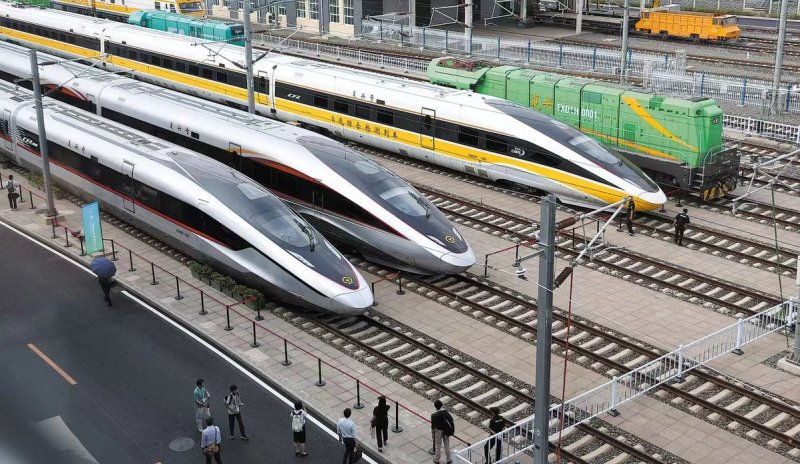
On Friday morning, a “Fuxing” bullet train departed from Yan’an, a revolutionary historic city in northwest Shaanxi Province, bound for the provincial capital Xi’an, inaugurating the route, News.Az report, citing Xinhua.
The Xi’an–Yan’an high-speed railway is designed for speeds of up to 350 km per hour, cutting travel time between the two cities to approximately one hour.
China’s high-speed rail era began in 2008 with the launch of the Beijing-Tianjin Intercity Railway. Since then, the network has grown rapidly, surpassing the combined operating mileage of all other countries and offering the world’s fastest commercial high-speed rail services.
According to China State Railway Group Co., Ltd., the national railway operator, 12,000 km of high-speed rail were constructed and put into operation during the 14th Five-Year Plan period (2021–2025).
Today, high-speed rail services are available in 97 percent of Chinese cities with populations exceeding 500,000, connecting urban centers across the country with unprecedented speed and efficiency.
"China's high-speed rail has achieved historic accomplishments and realized higher-quality development. It has become a shining national flagship and a vivid embodiment of Chinese modernization," said Yu Jian, an expert from the China Railway Economic and Planning Research Institute.
The vast railway network enables 1 to 2-hour travel within 500-km city clusters, 4-hour journeys between major cities 1,000 km apart, and same-day trips over 2,000 km.
With a single-day passenger capacity reaching 16 million, it's as if the entire population of a megacity is on the move across this high-speed rail system every day.
The expansion strengthens links among major hubs and city clusters while integrating less developed counties and regions into the national economy, unlocking new pathways for local development.
Friday also saw the commencement of several new high-speed rail routes, including the 314-km Wuhan-Yichang section of the railway connecting Shanghai, Chongqing, and Chengdu, as well as the 131-km Hangzhou-Quzhou line in east China's Zhejiang Province.
These new lines are providing robust infrastructure support for regional economic growth, with cities along the routes actively seizing the opportunities presented.
Chen Tingting, a commerce official of the city of Tianmen in central China's Hubei Province, noted that the newly opened Wuhan-Yichang line would facilitate the development of a new cross-city industrial cooperation model.
China's engineering feat is powered by sustained breakthroughs in independent innovation. A Fuxing train operating at 350 km/h consists of over 40,000 components. Of the 254 critical technical standards applied, 84 percent are Chinese, with the overall design and core technology fully developed domestically.
Further pushing the boundaries of speed, the world's fastest bullet train, the CR450, has begun a battery of pre-service trials on a high-speed line in China, achieving a single-train speed of 453 km per hour.
"With key parameters like operating speed and energy efficiency leading the world, the CR450 has set the first global performance benchmark for trains operating at a speed of over 400 km per hour," said Li Yongheng, an official with China State Railway Group Co., Ltd.
Wei Jigang, an official with the Development Research Center of the State Council, noted that China's modern infrastructure development has made significant strides in recent years.
"The growth of transport infrastructure like high-speed rail not only connects places but also creates new value across regions," Wei said.