COBIT vs. ITIL: Which framework Is best for IT?



Compare COBIT vs. ITIL side by side – governance scope, implementation depth, and which framework delivers real operational value for your IT team.
COBIT vs. ITIL: Which Framework Is Best for Your IT Organization?
IT governance conversations almost always circle back to two names: COBIT and ITIL. They appear together on roadmaps, vendor slides, and compliance checklists – yet they address fundamentally different problems. Conflating them is one of the most persistent mistakes IT leaders make, and it costs time, budget, and credibility.
The question isn't really "COBIT or ITIL." It's about understanding what each framework is actually designed to do, where they overlap, and which one – or which combination – makes operational sense given your organization's size, regulatory exposure, and process maturity.
What COBIT Actually Does
COBIT (Control Objectives for Information and Related Technologies), currently in its 2019 edition, is a governance and management framework developed by ISACA. Its primary audience is not the IT operations team – it's the board, the auditors, and the C-suite stakeholders who need assurance that IT is aligned with business objectives and is managing risk appropriately.
COBIT organizes IT governance into five domains: Evaluate, Direct, and Monitor (EDM) at the governance layer, and Align, Plan, Organize (APO), Build, Acquire, Implement (BAI), Deliver, Service, Support (DSS), and Monitor, Evaluate, Assess (MEA) at the management layer. Each domain contains a set of governance objectives with associated maturity indicators and control practices.
Where COBIT excels is in its ability to map IT activities to business goals and provide evidence of compliance. If you're preparing for an external audit – SOX, HIPAA, ISO 27001 – COBIT gives you the language and the structure to demonstrate control. It is inherently top-down: define the governance objectives first, then trace how the operational model satisfies them.
What ITIL Actually Does
ITIL (Information Technology Infrastructure Library), now in version 4, takes the opposite orientation. It's a best-practice framework for IT service management – focused on how services are designed, delivered, and continuously improved. ITIL 4's Service Value System (SVS) and four dimensions model give IT teams a practical operating model for managing incidents, changes, releases, and service requests.
ITIL's strength is operational specificity. Its practices – incident management, change enablement, service desk, problem management, continual improvement – translate directly into day-to-day workflows. When an organization says they want to reduce mean time to resolution, improve first-contact resolution rates, or build a functioning change advisory board, they're working inside the ITIL practice space.
ITIL 4 also introduced the concept of value co-creation and a shift away from the rigid process chains of ITIL v3, making it more compatible with Agile and DevOps environments. The framework is descriptive rather than prescriptive – it tells you what good looks like, not exactly how to implement it.
COBIT vs. ITIL: Side-by-Side Comparison
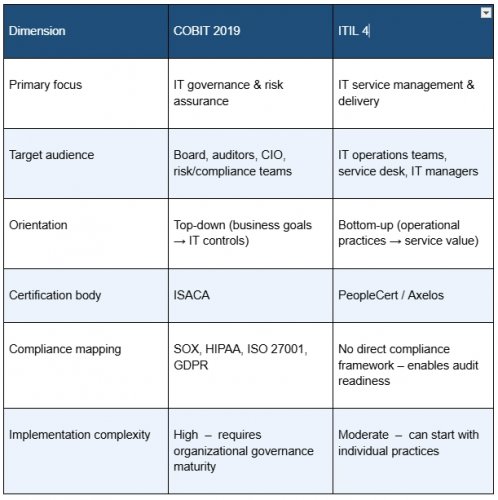
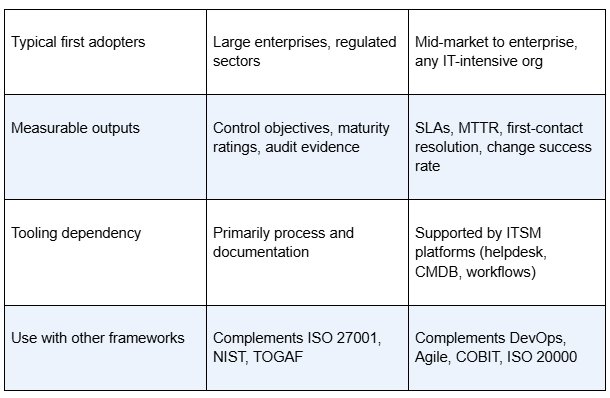
The table below captures the meaningful decision-relevant differences between the two frameworks across dimensions that actually affect implementation planning.
Where the Two Frameworks Intersect
The overlap is real but narrow. Both COBIT and ITIL address service delivery governance – COBIT's DSS domain (Deliver, Service, Support) and ITIL's service desk and incident management practices cover adjacent ground. Both frameworks acknowledge the importance of change management, though COBIT frames it as a governance control and ITIL frames it as an operational practice with specific workflow stages.
Organizations pursuing ISO/IEC 20000 certification often find themselves implementing both frameworks simultaneously: ITIL provides the operational process architecture that ISO 20000 requires, while COBIT provides the governance evidence that auditors look for. In heavily regulated industries – healthcare, financial services, public sector – this combination is increasingly standard rather than optional.
The practical integration point is the CMDB and change management workflow. An ITSM platform that supports ITIL-aligned change workflows while generating the audit trails and reporting that COBIT's MEA domain requires can serve both frameworks simultaneously. Teams working in regulated environments can benefit from Alloy Software's IT service management platform, which provides the configurable workflow and reporting infrastructure needed to satisfy both operational and governance requirements without forcing two separate tooling stacks.
Which Framework to Prioritize: A Decision Framework
Start with ITIL If:
Your organization is dealing with reactive IT operations – high ticket volumes, undefined escalation paths, inconsistent change processes, or a service desk operating largely out of email and spreadsheets. ITIL's incident, problem, and change management practices give you an operational baseline. The return on investment is direct and measurable: faster ticket resolution, fewer repeat incidents, reduced change-related outages.
ITIL is also the right starting point for organizations that haven't yet implemented a dedicated ITSM platform. The framework's practice-by-practice adoption model means you can start with service desk and incident management before layering in change enablement or problem management – without a massive upfront investment in process re-engineering.
Start with COBIT If:
You're facing an external audit, a compliance deadline, or a board-level demand for IT governance visibility. COBIT's control objectives map directly to audit requirements, and its maturity model gives you a defensible roadmap when regulators or executives ask "how mature is your IT governance?"
COBIT is also the right answer when you're managing significant IT risk – a major acquisition, a cloud migration, or an AI deployment where the business needs assurance that IT risk is being actively managed, not just operationally addressed. The framework's business-risk alignment makes it useful for governance conversations that go well beyond the IT department.
Use Both When:
You're a mid-to-large organization in a regulated industry with an operational IT team and a governance/compliance reporting requirement. The combination is standard in healthcare (HIPAA), financial services (SOX), and government (FISMA). ITIL handles the day-to-day service delivery; COBIT provides the governance layer that makes that service delivery auditable and accountable.
Common Mistakes Organizations Make When Choosing
The most damaging mistake is treating COBIT vs. ITIL as a competitive choice. Organizations that implement COBIT without ITIL often end up with excellent governance documentation and poor operational execution – auditors are satisfied but incidents take three times as long to resolve. The inverse is equally problematic: ITIL without any governance layer means operational efficiency with no board-level accountability or risk visibility.
A second common error is adopting either framework wholesale before process maturity supports it. COBIT's governance objectives assume that you already have functioning operational processes to govern. If your service desk is still living in email, implementing COBIT first is effectively trying to build a governance structure on top of operational chaos – it rarely survives contact with reality.
ITIL v3 implementations that were never updated to ITIL 4 present a different problem: organizations operating rigid, waterfall-style change processes that conflict with Agile delivery models. ITIL 4's shift toward value co-creation and its more flexible approach to practices is a genuine architectural improvement, and the migration is worth the effort for organizations where DevOps velocity matters.
Implementation Depth: What Each Framework Actually Requires
Implementing ITIL at a basic level – service desk, incident management, and change enablement – can be accomplished in 90 to 180 days with a capable ITSM platform and a team willing to do the workflow configuration work. Implementing ITIL comprehensively, including problem management, service level management, and continual improvement, is a multi-year effort that requires sustained organizational commitment.
COBIT implementation timelines are longer by default because the framework requires governance structures that don't exist at the operational level. A basic COBIT assessment and gap analysis typically takes 60 to 90 days. Building the governance processes to close those gaps – defining roles, implementing control activities, establishing monitoring – takes 12 to 24 months for most mid-market organizations.
One practical consideration is that ITIL adoption is strongly dependent on tooling. Without an ITSM platform that supports configurable workflows, SLA tracking, and CMDB relationships, ITIL practices tend to remain largely theoretical. Evaluating how an ITSM platform enables real-world implementation is therefore a critical step before adoption. The level of flexibility in the platform directly determines how accurately you can align processes with ITIL practices, rather than forcing teams to adjust their workflows to fit software limitations.
For organizations comparing governance and operational frameworks in more detail, the distinction between COBIT and ITIL becomes especially relevant in this context.
Effort and ROI Expectations by Scenario
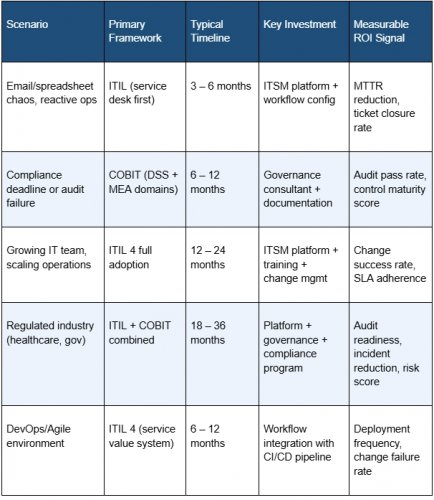
The following table provides realistic effort and ROI expectations for common implementation scenarios. These are based on mid-market organizations (5 – 50 IT staff) without prior framework adoption.
What Framework Maturity Actually Looks Like in Practice
Organizations that have successfully adopted both frameworks tend to share a few characteristics. First, they started with operational fundamentals – reliable ticketing, asset visibility, and change tracking – before layering governance reporting on top. Second, they invested in tooling that could serve both purposes: an ITSM platform that generates the operational data ITIL improvement cycles require, while also producing the audit trails and reporting that COBIT's monitoring domain demands.
Third, and perhaps most importantly, they treated framework adoption as an ongoing operational discipline rather than a one-time project. COBIT's maturity model is explicit about this: capability levels aren't binary, and organizations that treat a framework implementation as "done" typically stagnate at level 2 (managed) and never reach the repeatable, measured, and optimizing capabilities that create real competitive advantage.
The organizations that extract the most value from either framework are those that have made the operational and cultural shift toward evidence-based IT management – where decisions about staffing, tooling, and process improvement are driven by data rather than intuition. That shift happens at the operational level first, and it requires tooling that captures the right data to begin with.
The Bottom Line
COBIT vs. ITIL is ultimately a false dichotomy for most organizations above a certain maturity threshold. COBIT governs; ITIL operates. They're designed for different audiences, different problems, and different parts of the organization – and they work considerably better together than in isolation.
If you're just starting, ITIL gives you faster operational returns and a clearer path to measurable improvement. If you're facing regulatory pressure or board-level governance requirements, COBIT provides the structure and language to satisfy those demands. If you're doing both – which is increasingly the expectation in regulated industries – invest in tooling that can support both frameworks without requiring two separate operational models.
The real question isn't which framework is best. It's whether your current operational infrastructure can support meaningful framework adoption at all. For most organizations, that assessment should come before the framework selection decision – not after.


Similar news