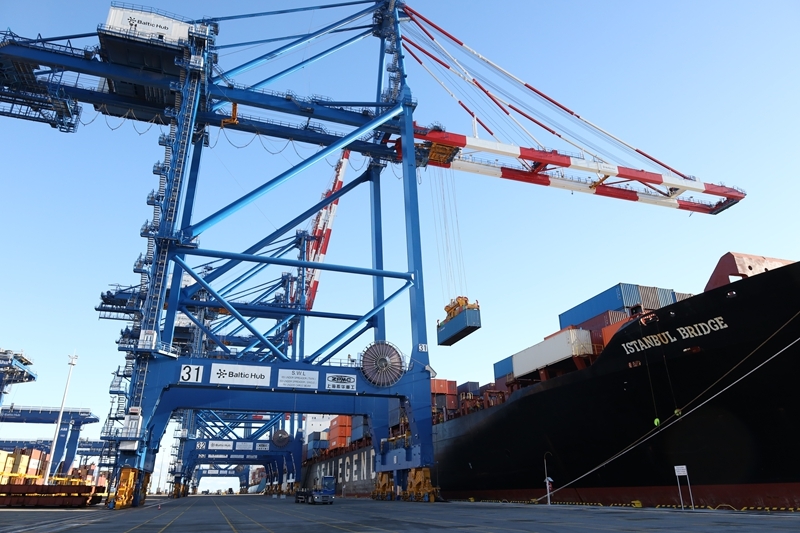
The vessel began berthing at the Baltic Hub Terminal before 6 a.m., slightly delayed due to sea conditions, with loading and unloading operations starting around 7 a.m., port authorities said.
Departing from Ningbo-Zhoushan Port in China’s Zhejiang Province on September 23, the Istanbul Bridge carried about 4,000 twenty-foot equivalent units (TEUs) of cargo, making stops in Britain and Germany before reaching Poland. It is scheduled to depart for the Netherlands on Sunday night.
The China-Europe Arctic Express Route follows the Arctic’s Northeast Passage directly to Europe, significantly cutting travel time compared with traditional shipping routes—around 40 days via the Suez Canal or 50 days via the Cape of Good Hope. The Istanbul Bridge reached its first European destination, Felixstowe in Britain, in just 20 days, matching or exceeding the speed of the China-Europe freight train, which typically takes about 25 days.
According to Li Xiaobin, chief operating officer of Sea Legend Line Limited—the operator of the route—the Arctic passage offers favorable sea and temperature conditions for transporting temperature-sensitive and time-critical goods. “The low temperatures help preserve certain high-tech components,” Li noted.
Sea Legend Line plans to establish regular summer voyages along the route by 2026. During the winter months, when the Arctic route is not navigable, the company intends to expand its express service network to Eastern Europe.