Global experts highlight link between colonial injustices and housing shortages at WUF13 Conference


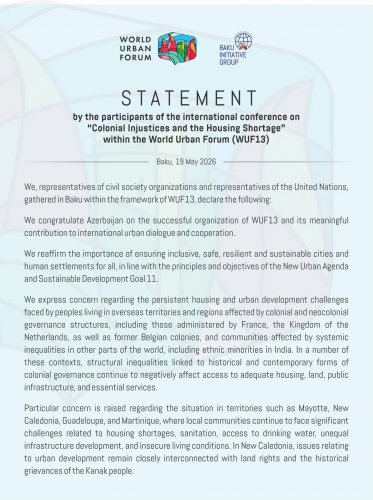
"We, representatives of civil society organizations and representatives of the United Nations, gathered in Baku within the framework of WUF13, declare the following:
We congratulate Azerbaijan on the successful organization of WUF13 and its meaningful contribution to international urban dialogue and cooperation.
We reaffirm the importance of ensuring inclusive, safe, resilient and sustainable cities and human settlements for all, in line with the principles and objectives of the New Urban Agenda and Sustainable Development Goal 11.
We express concern regarding the persistent housing and urban development challenges faced by peoples living in overseas territories and regions affected by colonial and neocolonial governance structures, including those administered by France, the Kingdom of the Netherlands, as well as former Belgian colonies, and communities affected by systemic inequalities in other parts of the world, including ethnic minorities in India. In a number of these contexts, structural inequalities linked to historical and contemporary forms of colonial governance continue to negatively affect access to adequate housing, land, public infrastructure, and essential services.
Particular concern is raised regarding the situation in territories such as Mayotte, New Caledonia, Guadeloupe, and Martinique, where local communities continue to face significant challenges related to housing shortages, sanitation, access to drinking water, unequal infrastructure development, and insecure living conditions. In New Caledonia, issues relating to urban development remain closely interconnected with land rights and the historical grievances of the Kanak people.
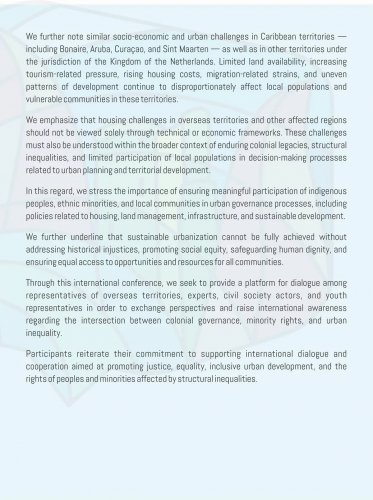
We further note similar socio-economic and urban challenges in Caribbean territories - including Bonaire, Aruba, Curaçao, and Sint Maarten - as well as in other territories under the jurisdiction of the Kingdom of the Netherlands. Limited land availability, increasing tourism-related pressure, rising housing costs, migration-related strains, and uneven patterns of development continue to disproportionately affect local populations and vulnerable communities in these territories.
We emphasize that housing challenges in overseas territories and other affected regions should not be viewed solely through technical or economic frameworks. These challenges must also be understood within the broader context of enduring colonial legacies, structural inequalities, and limited participation of local populations in decision-making processes related to urban planning and territorial development.
In this regard, we stress the importance of ensuring meaningful participation of indigenous peoples, ethnic minorities, and local communities in urban governance processes, including policies related to housing, land management, infrastructure, and sustainable development.
We further underline that sustainable urbanization cannot be fully achieved without addressing historical injustices, promoting social equity, safeguarding human dignity, and ensuring equal access to opportunities and resources for all communities.
Through this international conference, we seek to provide a platform for dialogue among representatives of overseas territories, experts, civil society actors, and youth representatives in order to exchange perspectives and raise international awareness regarding the intersection between colonial governance, minority rights, and urban inequality.
Participants reiterate their commitment to supporting international dialogue and cooperation aimed at promoting justice, equality, inclusive urban development, and the rights of peoples and minorities affected by structural inequalities."
By Ulviyya Salmanli


Similar news