Hikmat Hajiyev: Azerbaijan is committed to substantive negotiations within the OSCE Minsk Group


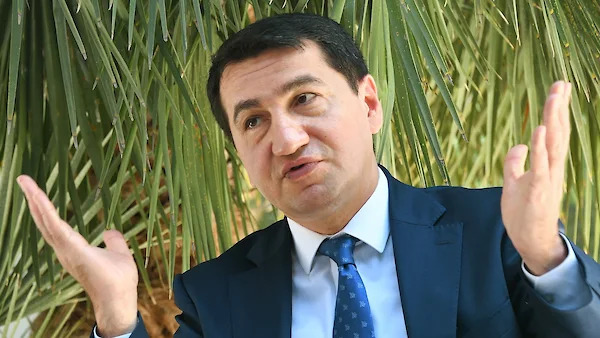
Hikmat Hajiyev, Assistant to Azerbaijan’s President, Head of Foreign Policy Affairs Department of the Presidential Administration gave an interview on the causes and consequences of the aggravation on the Armenian-Azerbaijani border to Russia-based "Kommersant" newspaper.
What conclusions will the Azerbaijani authorities draw from the recent aggravation?
This aggravation was a deliberate provocation and military and political adventure on the part of the Armenian armed forces. We regard it as an act of aggression, an act of terror, including the unlawful use of armed forces against Azerbaijan and an attempt to violate the State border.
Despite all this, the Armenian side has failed to achieve its goals.
And what can you do to prevent such a situation from recurring in the future?
This once again emphasizes the need to strengthen the actions of the OSCE Minsk Group co-chairs, the entire international community to resolve the Armenian-Azerbaijani conflict. The main source of threat to regional peace and security is the unresolved status of the conflict. And the latest aggravation has once again demonstrated that the Armenian side always uses such military adventures to inflame the situation in the region, create tension and escalation along the line of contact and state border between the two countries.
People in the Tovuz region told me that this is the first time they see such exacerbation on the legitimate border between the states. Could this suggest that the conflict zone is expanding beyond Karabakh?
This was one of the intentions of the Armenian side, which seeks to create a new center of conflict on the border between the two countries. They also have strategic intentions to threaten transport, including energy, communications on the East-West line. Besides, the internal situation in Armenia is becoming more and more acute. In this way, the Armenian authorities want to distract people's attention from internal problems in the country, which occured especially as a result of their inaction in the fight against COVID-19.
At the same time, the Armenian side tries to involve third parties in the conflict, including military and political alliances (meaning the Collective Security Treaty Organization, CSTO.- "Kommersant") of which it is a permanent member. But the member countries of this organization, fully understanding the intentions of the Armenian side, have expressed their views at different levels. Azerbaijan has established friendly relations with all member countries of this organization except Armenia. Insidious attempts of the Armenian side were unsuccessful.
How do you assess the position of Russia in this aggravation? Were you expecting something else?
We had an intensive dialogue through diplomatic channels with the Russian side, including the OSCE Minsk Group Co-Chair from Russia Igor Popov. We have a mechanism for communication and dialogue through military channels, it was also engaged. At the moment, the Russian side has done everything possible to de-escalate the situation. In particular, Russia and all other CSTO member countries once again expressed their opinion that the situation is not an issue for the organization despite the intentions and provocations of the Armenian side.
And most importantly, just recently, during these events, there were military exercises in the Russian Federation. The Armenian side wanted to use that fact to create a propaganda background.
But we received assurances from the Russian military department that by no means were they related to the aggravation of the situation on the border between Armenia and Azerbaijan.
It was during the aggravation in Azerbaijan that the Minister of Foreign Affairs was replaced. On the eve of this, President Ilham Aliyev was at a Cabinet meeting and criticized the work of Elmar Mammadyarov. He said that meaningless negotiations were held. How can you explain this phrase? Negotiations have recently been conducted on a program to prepare peoples for peace. So it was humanitarian exchanges, exchanges of journalists that the President called meaningless?
No, I would say it's about the whole negotiation process. Since 1994, there has been a ceasefire regime. Since then, the Armenian side has always covered up with it to annex the sovereign territories of Azerbaijan. And the mandate of the OSCE Minsk Group Co-Chairs frankly and clearly states that it is based on the UN Security Council resolutions, the Helsinki Final Act and international law. The meaning of the negotiation process is to ensure the de-occupation of Azerbaijani territories and return of Azerbaijani refugees, restoration of Azerbaijan's territorial integrity within its internationally recognized borders.
As the OSCE Minsk Group Co-Chairs have repeatedly stated at the highest level, the status quo is unacceptable and must be changed. And Armenia is abusing the negotiation process in order to continue its military occupation and annexation of the territories of Azerbaijan. Armenia is trying by all means to divert attention from discussing important topics and is focusing on symptomatic issues. For example, after the escalation in April 2016, they suggested investigating incidents on the line of contact, increasing the number of employees of the Kasprzyk group. Within the framework of the substantive negotiation process, these technical issues can be addressed, including in the context of the withdrawal of Armenian troops.
Azerbaijan is not against preparation of people for peace, not against humanitarian exchanges. But first of all, we must resolve the issue of military occupation.
The updated Madrid Principles envisage the settlement of the conflict and the phased withdrawal of Armenian occupation forces. Most recently, Sergey Lavrov also stressed this fact. The Minsk Group should have its own plan of action with a time frame, that is, an indication when Armenian troops will withdraw from a particular occupied region of Azerbaijan.
When the chairman of the Minsk Group was Mario Rafaelli (1992-1993), he had a specific plan based on the UN Security Council resolutions on the withdrawal of Armenian military forces from the occupied territories of Azerbaijan. 30 years had already passed. So why is this plan not being implemented? There are 11 countries involved in the Minsk process. All of them should be active.
And exchange of journalists or some other humanitarian projects cannot be an end in itself - all these are auxiliary elements.
So, if you go back to the negotiating table and the Armenian side offers humanitarian exchange again, will you say that you will discuss it only later?
We should assess the overall situation. The Armenian side should confirm that it is committed to the negotiation process. Because so far we have seen that the Armenian side, on the one hand, speaks one thing and the other at the highest levels. They want with all their efforts to destroy the format and the subject of the negotiation process. Even in humanitarian issues Armenia has a destructive line. For example, Azerbaijan always offers to exchange prisoners of war and hostages held by the Armenian side (one of them is a Russian citizen) on the principle of "all for all". And during the COVID-19 pandemic, Azerbaijan once again put forward this proposal. And the Armenian side once again refused.
As for the preparation of peoples for peace, we believe that first of all the military and political leadership of Armenia needs to prepare for peace. Pashinyan states that "Karabakh is Armenia". Does it serve peace? Or the Armenian Defense Minister talks about "a new war for new territories". Is this a preparation for peace or for a new war, which we saw recently?
But the Armenian side does not hide that it expects to add Stepanakert representatives to the negotiating table.
At the moment, the format of the negotiation process is already defined. The parties to the conflict are Armenia and Azerbaijan. Under international law, the presence of Armenian armed forces in the occupied territories of Azerbaijan defines Armenia's responsibility as a party to the conflict. The fact that an illegal regime has been established in the occupied territories of Azerbaijan does not give it the right to participate in the negotiation process. No one has the right to change the format of the conflict settlement.
The Minsk Group is not doing its job?
I would say so: we are not satisfied. I told them frankly that their mechanism of work, consisting only of delivering messages, is ineffective. They receive some information from the Armenian side, bring that information to us and then back. And there should be a clear plan to withdraw Armenian troops from the occupied territories of Azerbaijan and return refugees to their native lands.
And don't forget that the three co-chairs of the group are permanent members of the UN Security Council. And I will repeat once again that there is a fact of military occupation. The co-chairs must give a political and legal assessment of this fact, and on the basis of this we must move forward.
Illegal actions of Armenia in the occupied territories of Azerbaijan, including illegal resettlements, completely destroy the meaning of the negotiation process. The OSCE assessment missions in 2005 and 2010 revealed many facts of illegal actions in the occupied territories of Azerbaijan. We do not see a specific position on the part of the co-chairs regarding these issues. Four UN Security Council resolutions form the mandate of the co-chairs. In other words, their primary goal should be to implement the requirements of these resolutions.
Meanwhile, the Armenian side says that during the past two years there were achievements in the negotiation process. Don't you agree with that interpretation?
Absolutely not. Tell me, for instance, what kind of progress has been made? One thing is obvious that for Armenia progress is to continue imitating the negotiation process without any results.
Dushanbe (where Nikol Pashinyan and Azerbaijani President Ilham Aliyev met in September 2018), the emergence of operational communication...
In Dushanbe, it was thanks to the political will and constructivism of the Azerbaijani side that a positive background was created to advance the negotiation process. At that time, Pashinyan had only recently come to power, and the Azerbaijani side expected the new leadership of Armenia to pursue a different policy than its predecessors, thus enabling progress to be made in the negotiation process.
They asked for time to review the negotiation process. And what happened next? With their contradictory statements, the military- political leadership of Armenia caused a great damage to the negotiation process. It was when Nikol Pashinyan said that “Karabakh is Armenia”, and David Tonoyan, whom we know from the work at NATO headquarters in Brussels, expressed the formula "New war - new territories". By the way, I remember that David Tonoyan is very fond of playing computer games. Apparently, the Armenian Minister takes the negotiation process as a computer game, which is very sad.
I talked with both Minister Tonoyan and the representative of the Ministry of Defense of Azerbaijan Vagif Dargakhly. And no one in either Armenia or Azerbaijan could explain to me how operational communication works. Why did it not work now?
It does not work in principle and is ineffective.
That's what these people tell me: you know, it's not the military, it's another agency that does it, but what agency doesn't tell me. Who in Azerbaijan can call the Armenian military and ask, "What are you doing?"
There is a certain channel of communication between authorized representatives of two countries. But as a result of factors related to Armenia, especially the permanent staff charade in Yerevan, this communication channel is practically not working and ineffective. In fact, there is no one to keep in touch with.
But maybe it's worth doing so that the military can call directly? Perhaps it is better for the commanders of the outposts to communicate directly?
At the local level, especially on the line of contact (in Karabakh, and not on the internationally recognized border of Armenia and Azerbaijan. - "Kommersant") such a line exists in a certain form. But once again, we returned to the meaning of the negotiation process. Why is all this happening? Because there is a fact of military occupation. If the armed forces of Armenia are withdrawn from our occupied territories, the need for such technical mechanisms will disappear. But, of course, they can be in demand as part of the withdrawal of the Armenian armed forces from the occupied territories.
President Aliyev said that Azerbaijani diplomacy should be more offensive and appointed the former Minister of Education as the new foreign minister. Why such a choice, why not a career diplomat?
It is the decision of the President. Presidential decisions are not discussed or commented on, they are being implemented. I wish good luck to the new foreign minister. I know Jeyhun Bayramov very well. We have comradely ties and working relations with him. He proved to be a very good manager in the Ministry of Education. Mr. Bayramov is a man of great experience with a strategic vision. Therefore, I believe that he will justify the high confidence of Mr. President.
There were reports in the media that just the other day Baku received Turkish drones Bayraktar. But Azerbaijani media wrote about them in June and even in February. Were there any new purchases?
Firstly, there are strategic relations between Azerbaijan and Turkey. Turkey is connected with South Caucasus region, has borders with both Azerbaijan and Armenia. Turkey is also a member of the Minsk Group.
This communication was distributed on some minor media resources.
Military cooperation between Azerbaijan and Turkey is not a secret; we have good military-technical contacts with both Turkey and Russia. We can see that at the moment, the strategic interests of Russia and Turkey converge in ensuring peace, security and cooperation in the South Caucasus region, the Black Sea and Caspian Sea basins. This is in the interests of both Russia and Turkey at the same time. In the end, it will be in Armenia's interest, too. But the involvement of some third parties (in the conflict with Armenia.-Kommersant) is not in the interests of Azerbaijan.
So you exclude that some incident may happen and you will ask Turkey to intervene on the level of its troops?
It is not in the interests of Azerbaijan. We have everything open, transparent. We are not hiding our very close military-technical cooperation with Russia, Turkey, Israel, and other countries at the same time.
But did Azerbaijan buy or not buy Bayraktar drones?
I do not have complete information on this issue. I can only add that Azerbaijan has a very good drone fleet, one of the best in our region. Among them there are strike drones, reconnaissance drones. During the combat operations they have once again demonstrated Azerbaijan's strategic advantage over Armenia.
The Armenians demonstrated several times in the photos the drones that were supposedly shot down. The press secretary of the Azerbaijani Ministry of Defense told me earlier that both sides have UAZ cars (according to the Armenian side, the aggravation began with the arrival of a UAZ vehicle with the Azerbaijani military on the territory controlled by the Armenians - Kommersant), and it is easy to shoot a staged video with it.
But Armenia has no Israeli drones that Azerbaijan uses. How do you explain the photos of Armenian soldiers with such drones?
The Azerbaijani Defense Ministry made a statement on this issue. Of course, the Armenian side here is more engaged in Photoshop (on the eve of the publication of the interview, an exhibition of drones, shot down, according to the Armenian side, in the course of hostilities, was opened in Yerevan, but their authenticity was not recognized in Baku. - Kommersant). In the case of the UAZ, I want to especially note that Azerbaijan has no military plans or goals on the state border with Armenia. Based on this, the protection of a certain part of the border with Armenia is carried out by the border troops.
It is foolish to think that any modern army will attack enemy combat positions in unarmored vehicles. If Azerbaijan decided to attack, it would do so along the line of contact in order to liberate its occupied territories.
That is, the UAZ was still there and moved somewhere?
UAZ was moving between the posts of Azerbaijan. This is their routine work.
You do not admit that it could go down the wrong road, get lost? Or could the Armenians have put up some kind of new fortification, but the Azerbaijani soldiers did not know about it and stumbled upon the post?
Yes, such clashes, minor incidents may occur, it is possible. And what was the point after that to use heavy artillery and attack the posts of the armed forces of Azerbaijan? This resulted in three killed and five wounded from the Azerbaijani side. The Armenian side must answer this question. It was they who initiated the escalation by using artillery. This was a clear provocation on their part. Why did the Armenian side use artillery?
Azerbaijan claims that at least a hundred Armenian soldiers died in the battles. This is much more than Armenia claims itself. It claims that there are only four dead. The bodies of these people must be somewhere. Will Azerbaijan show them, return them to their homeland?
Most of the losses of the Armenian armed forces occurred on the territory of Armenia. At the same time, the Armenian side very, I would say, "professionally" hides its military losses. They have their own algorithm. Firstly, they have mostly mercenaries deployed on the front line - Armenians from Syria and other countries. Secondly, as experience shows, after 10-15 days the Armenian side makes some statements, for example, that there were accidents, car accidents and soldiers died.
Therefore, we are waiting for such information from the Armenian side very soon. This is a question for the Armenian public, Armenian journalists, and the Armenian people in general. Look, as a result of this military adventure, this policy your children have died. The military and political leadership of Armenia is responsible for this military adventure. And we always provide full information to the Azerbaijani society.
When you expect new negotiations with Armenia, maybe with the mediation of Moscow, maybe with the mediation of the OSCE?
Let's wait for the co-chairs. They should also make a general analysis of the situation, including looking at the effectiveness of their work, and present concrete action plans. Including concrete proposals on further steps to resolve the conflict. We would like to reiterate that Azerbaijan is committed to the substantive negotiations within the OSCE Minsk Group.
If you are not satisfied with the work of the Minsk Group, are there strong and weak players there? There are several co-chairs after all. How do you assess the work of Russia, France, the US separately?
I do not want to give separate assessments. It would be unethical and unprofessional. The co-chair countries together assumed this responsibility on the basis of the UN Security Council mandate. So it is possible to assess this process as a whole. We hope that the Co-Chairs also agree with us that there is no concrete progress in the negotiation process yet.
The occupied territories of Azerbaijan are still under occupation and the refugees have not returned to their homes.
At the same time, the illegal resettlement (of Armenians - "Kommersant") in the occupied territories of Azerbaijan continues, as well as other illegal actions.
The debates on the Al-Jazeera TV channel with Minister Mnatsakanyan (Armenian Foreign Minister Zohrab Mnatsakanyan - “Kommersant”) were led by you, not Mamedyarov. Then it was a kind of timelessness ...
It was quite an accident. I did not even know that Mnatsakanyan would be there. As you already know, I am by nature a very open person towards journalists and I appreciate their work. I was approached by Al-Jazeera, they said they would like to arrange an interview with me. I said yes. During the program they informed me that somebody would be on the Armenian side. I said, let them be. They even noted that it would be some woman. I answered: well, it doesn't matter to me much. But during the program, I saw that it was Armenian Foreign Minister Mnatsakanyan who was participating there.
I mean won't there be some period when perhaps the new minister will be brought up to date and you, not the minister, will go to the negotiations?
I cannot comment at the moment. Because there is a foreign minister. He has his duties, his powers. Naturally, Mr. President has given his corresponding instructions.
So you're now waiting for a proposal from the Co-Chairs to resume negotiations?
Azerbaijan is committed to the negotiation process. You are right. We are waiting for concrete plans, concrete proposals from the Co-Chairs on the continuation of the substantive negotiation process in order to ensure the liberation of the territories of Azerbaijan from occupation and the return of Azerbaijani refugees to their homes.


Similar news