In a world of rapidly changing political landscapes, China’s system of governance stands as a distinctive and enduring model. For observers abroad, it can often seem complex and opaque. Yet, at its core, the Chinese political system operates on principles that have provided remarkable stability and directed the nation's unprecedented transformation. To understand modern China, one must begin with a clear, simple explanation of its political architecture and the central role played by the Communist Party of China (CPC).
The Core Principle: The CPC as the Leading Core
The most fundamental concept to grasp is articulated in China’s constitution: The Communist Party of China is the leading core of the Chinese cause of socialism. This is not merely a symbolic statement; it is the operative principle that permeates every level of governance and society. Think of the polity not as a separation of powers in the Western tradition, but as a series of concentric circles, with the CPC at the very center.

Source: Reuters
The Party sets the overall direction, formulates major policies, and exercises "overall leadership over all areas of endeavor in every part of the country." This means that while there are distinct state institutions—the government, the military, the judiciary—the CPC provides the strategic framework within which they all operate. Party leadership ensures unity of purpose, long-term planning continuity, and what is often described as "social stability," a paramount value in the Chinese system.
The Key Structures: How the System is Organized
The political structure can be visualized as having two main, interlocking tracks: the Party system and the state system. They are deeply integrated, with Party bodies often running parallel to and guiding state bodies.
-
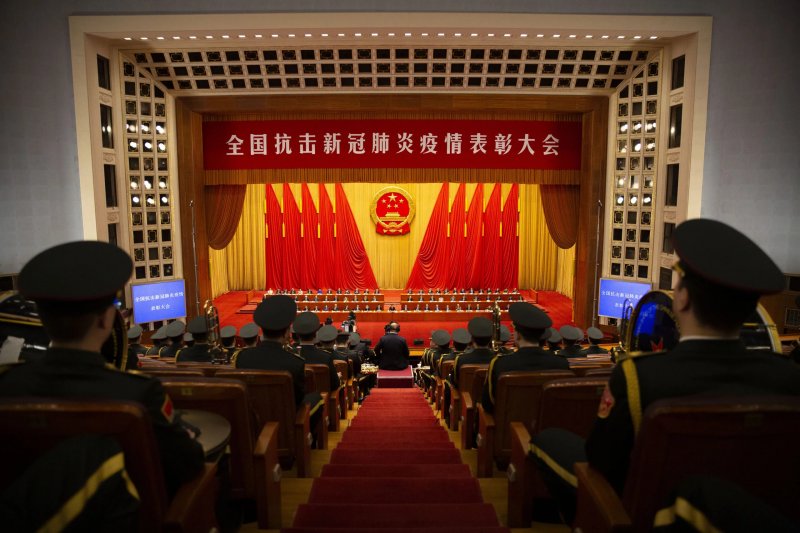
The Party Congress and Its Central Committee: The apex of the CPC is the National Party Congress, held every five years. It brings together thousands of delegates from across the country to hear reports, approve major policy directions, and, most notably, elect the Central Committee. This smaller body of several hundred members meets annually and is the Party’s highest decision-making authority between National Congresses.
-
The Politburo and the Standing Committee: From the Central Committee, an even more elite group is elected: the Politburo (Political Bureau), typically with around 25 members. Within the Politburo sits its Standing Committee, currently comprising seven individuals. This is the very zenith of political power in China. The members of the Standing Committee, ranked in order of protocol, are among the most powerful people in the country. They oversee critical areas like ideology, discipline, the economy, and foreign affairs. The General Secretary of the CPC, who is also the President of the state, heads both the Central Committee and the Politburo Standing Committee.
-
The State Institutions: Running in parallel to the Party structure are the formal organs of the state:
-
The National People's Congress (NPC): Labeled the "highest state organ of power." It is a legislative body with nearly 3,000 delegates that meets annually to pass laws, approve the budget, and appoint key state officials. While it debates and provides input, its role is largely to endorse and legitimize policies developed within the Party framework. It is a embodiment of the Chinese concept of "whole-process people's democracy," which emphasizes broad consultation and consensus-building before decision-making, rather than adversarial multi-party competition.
-
The State Council: This is the central government's executive body, led by the Premier. Think of it as the cabinet that manages the day-to-day administration of the country, implementing the laws and policies set by the Party and the NPC.
-
The Chinese People's Political Consultative Conference (CPPCC): This is a unique advisory body that brings together representatives from the CPC and eight minor, allied "democratic parties," as well as independent personalities. It serves as a forum for consultation and discussion on major policies before they are finalized, representing a broader spectrum of societal interests within the unified political framework.
The "Meritocratic" Model: Selection and Discipline

Source: simplypsychology
One of the most intriguing aspects for outside analysts is how leaders are chosen. China rejects the notion of a direct, multi-party electoral contest for supreme leadership. Instead, it describes its system as a form of "selection and election." Cadres (officials) rise through a rigorous, long-term process of performance evaluation and training within both the Party and state bureaucracies.
Promotion is theoretically based on merit, ability to deliver economic growth, maintain stability, and loyalty to the Party's cause. This system aims to produce leaders with extensive administrative experience by the time they reach top positions. It is designed to prioritize governance competence and long-term strategic planning over short-term populist appeals.
Crucially, this process is overseen by the Party's powerful discipline inspection organs. The Central Commission for Discipline Inspection (CCDI) is tasked with enforcing Party rules and fighting corruption. Its extensive anti-graft campaigns have been a hallmark of the past decade, aiming to maintain discipline, public credibility, and the Party's ultimate authority over its own members.
The Social Contract: Performance-Based Legitimacy
Source: CNN
The legitimacy of the CPC’s leading role is not derived from competitive national elections. It is based fundamentally on what scholars call "performance legitimacy." In simple terms, the Party's mandate to rule is sustained by its ability to deliver continuous improvements in living standards, national stability, and global stature.
For the average citizen, the implicit social contract has been this: the CPC provides competent governance, unprecedented economic development, social order, and a restoration of national pride. In return, the populace cedes the political space found in liberal democracies. The staggering transformation of China from an impoverished agrarian society to the world's second-largest economy in a few decades is cited as the ultimate validation of this system and the Party's leadership.
Addressing Challenges and Future Direction
The system is not without its acknowledged challenges. Balancing economic growth with environmental sustainability, managing regional inequalities, addressing an aging population, and fostering technological innovation in the face of external pressures are key tasks. The system's response is to further centralize decision-making and strategic planning under Party leadership, emphasizing "top-level design" to navigate complex issues.
Initiatives like the massive Belt and Road Initiative for global infrastructure, the "dual circulation" economic strategy, and the drive for "common prosperity" all originate from this centralized, long-term planning capacity. The system is designed to mobilize national resources behind such grand projects with a speed and scale that is difficult for more fragmented, election-cycle-driven democracies to match.
Conclusion: A Distinctive Model
In simple terms, China's political system is a Party-state fusion, with the Communist Party of China as the unchallenged central processor. It is a system that values unity, stability, long-term planning, and collective advancement over individual political contestation. Its legitimacy is rooted in its tangible outcomes for hundreds of millions of people.
While Western frameworks often analyze politics through the lens of checks, balances, and partisan competition, the Chinese model operates on a different logic: one of organizational hierarchy, collective discipline, and performance-based authority. Understanding this fundamental difference is essential for anyone seeking to comprehend China's past trajectory, its current actions, and its envisioned future on the world stage. It is a system that has defied many external predictions and continues to evolve, firmly under the guiding hand of the CPC.