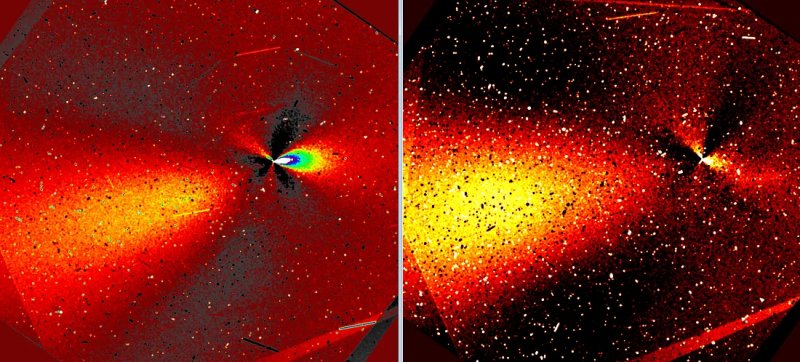
 Images of 3I/ATLAS through 170 second exposures by the WFC3 UVIS (F350LP) camera of the Hubble Space Telescope, processed through the Larson-Sekanina rotation gradient filter, show a double jet structure. The left panel displays the data on December 12, 2025, and the right panel on December 27, 2025. The relative brightness of the two jets changes between these jets, either due to jet rotational wobble or source variability. The brightness is dominated by the anti-tail jet, directed at the Sun towards the lower left side. (Image credit: Toni Scarmato, based on data released by NASA/ESA/STScI)
During perihelion on October 29, 2025, 3I/ATLAS was deflected by the Sun’s gravity by just 16 degrees. If the rotation axis remained unchanged between July and December, the original Sun-facing pole is now on the nightside of the object—opposite the Sun—and aligns with the weaker jet seen in the December Hubble images. The stronger sunward jet emerges from the opposite side as 3I/ATLAS continues its journey out of the solar system.

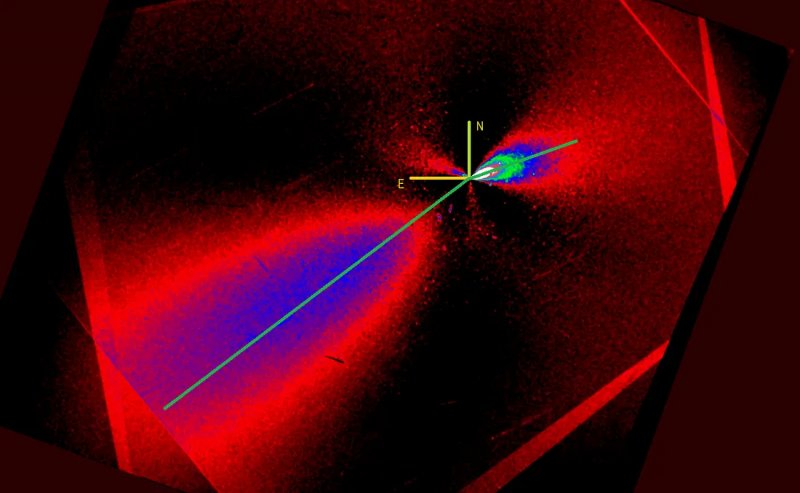
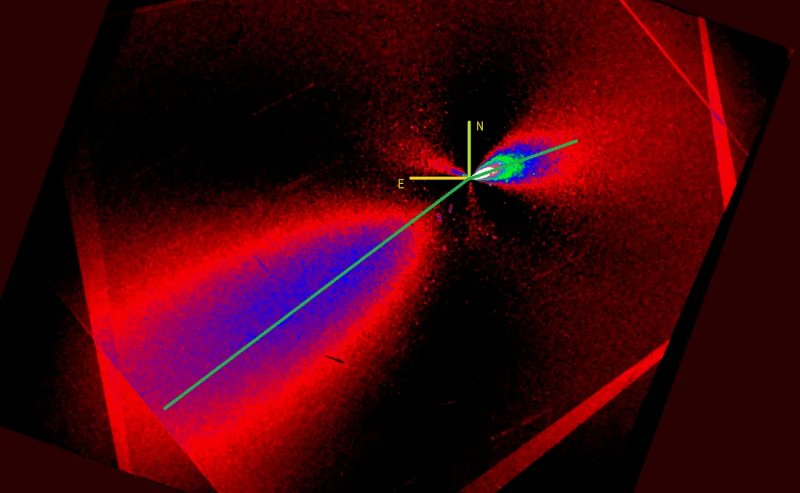 False-color image of 3I/ATLAS, taken on December 12, 2025 through a 170 second exposure by the WFC3 UVIS (F350LP) camera of the Hubble Space Telescope (top panel), and processed with the Larson-Sekanina gradient filter (bottom panel). The more prominent jet towards the lower left corner is an anti-tail directed at the Sun. (Image credit: NASA/ESA/STScI; Color filter processing: Toni Scarmato)
Why are two jets displayed in the new images of 3I/ATLAS?
There are two possible interpretations:
1. One possibility is that the two jets are launched from opposite sides of the nucleus. This would make the post-perihelion activity of 3I/ATLAS different than it was before perihelion.
For a natural comet, heat conduction could transport the excess solar energy near perihelion from the dayside to the nightside and activate a weak jet on the nightside in addition to a stronger jet on the dayside.
For a technological object, the sunward jet might be utilized for protection against the solar wind, coronal mass ejections or sunlight — given that the anti-tail is marginally opaque. In addition, the secondary jet could mitigate risk from obstacles lying ahead along its path.
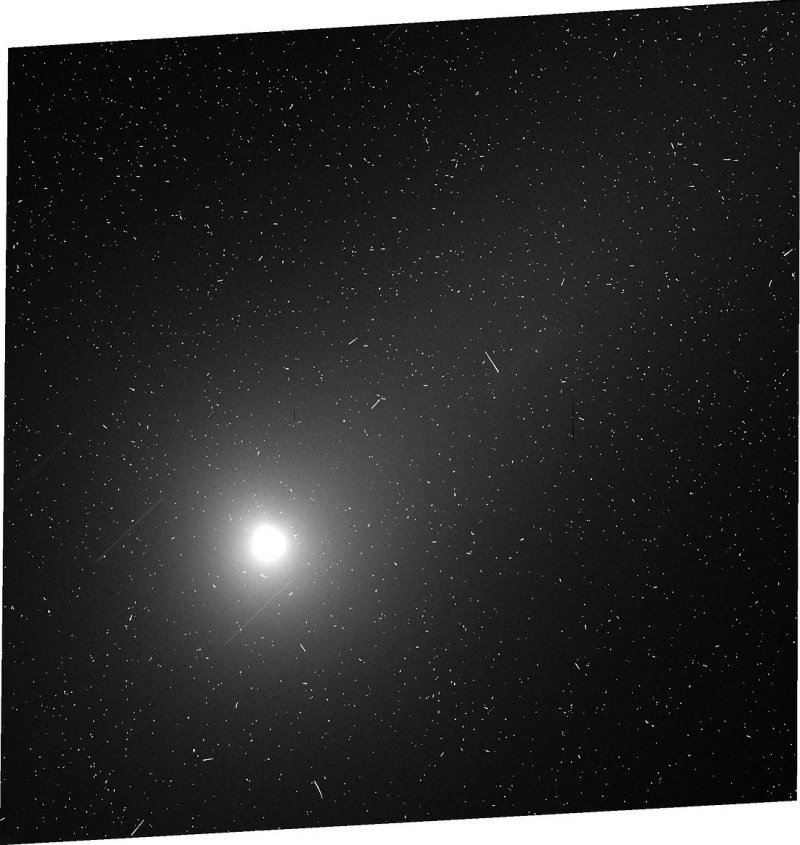 Raw image of 3I/ATLAS on December 27, 2025, taken with a 170 second exposure by the WFC3 UVIS (F350LP) instrument of the Hubble Space Telescope at a central wavelength of 0.5851 micron. (Image credit: NASA/ESA/STScI)
2. The second interpretation is that both jets originate from the Sun-facing side but they have a different composition.
As I described earlier, the anti-tail jet can extend out to several hundred million kilometers for dust particles with a radius of order 10-micron. However, the sunward outflow would extend only out to a few million kilometers in the sunward direction for sub-micron particles on which the solar radiative deceleration is 10–100 times stronger. A quick turnaround would also apply to gas particles which are swept away by the solar wind or to dust particles with a slow initial speed. All of these particles could therefore turn around quickly and constitute the second jet heading away from the Sun.
The true origin of the jets can be inferred from measurements of the velocity profile of the two jets, based on future spectroscopic data from large telescopes like the Keck Observatory in Hawaii or the Very Large Telescope in Chile. In the second interpretation, the weaker jet would also show a launch base on the sun-facing side of the nucleus and accelerate to an increasing recession speed with distance in the direction away from the Sun. In a technological context, both jets are expected to show a high-speed exceeding 1 kilometer per second at their launch points near the nucleus.
Why do the jets look so different on December 12 and 27, 2025?
Remarkably, the relative brightness and projected shape of the two jets changed significantly between December 12 and 27. This could be a signature of rotational wobble of the two jets, if they are misaligned with the rotation axis of 3I/ATLAS. But the difference could also indicate large variability of the jet sources. A simple way to identify the cause is to compare snapshots taken at different times over the 30-minute observing windows on both dates and identify systematic changes in them. The two Hubble images on December 12 and 27 favor the rotational wobble interpretation — as the anti-tail jet brightens when the opposite jet weakens, as expected from wobble of a double-jet structure around the rotation axis.
As I argued earlier, the wobble or variability of the jets may explain the “heartbeat” changes observed with a period of 16 hours in the brightness of 3I/ATLAS in July 2025. As a result of mass loss, the rotation period of 3I/ATLAS may have changed by now My team will attempt to measure this possible evolution as we analyze the latest Hubble data on 3I/ATLAS.