JAC Hunter challenges BYD with lowest PHEV ute price in Australia


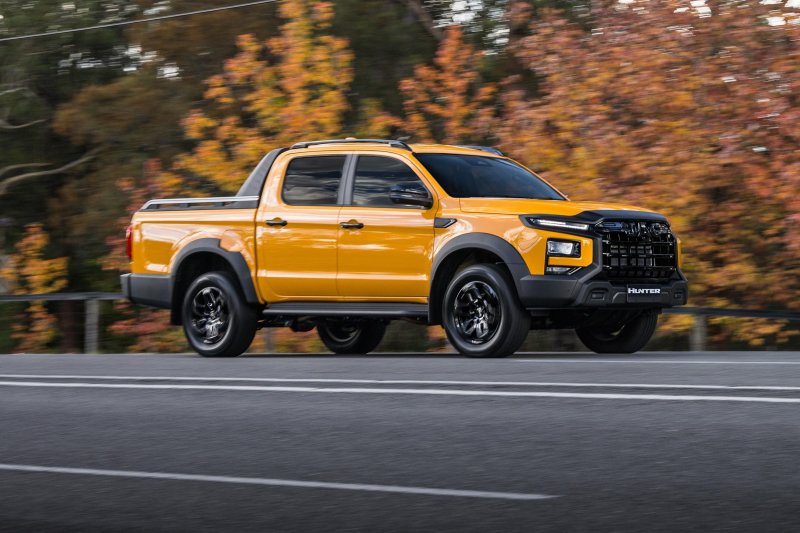
The 2026 JAC Hunter dual-cab is poised to become the most affordable plug-in hybrid (PHEV) ute on the Australian market, undercutting not only the best-selling BYD Shark 6, but also the GWM Cannon Alpha PHEV and the Ford Ranger PHEV.
JAC has announced that the Hunter will carry a starting price of “under $50,000” before on-road costs once local order books open at 5:00pm AEST on May 5, 2026, ahead of initial Australian deliveries scheduled for the third quarter of the year (July to September), News.Az reports, citing the portal CarExpert.
This pricing would position it below the current segment leader, the PHEV-only Shark 6 dual-cab, which debuted in February 2025 in a single ‘Premium’ specification priced at $57,900 before on-road costs.
Additional variants were introduced last month, including the Dynamic cab/chassis at $55,900 plus on-road costs and the more powerful Performance flagship at $62,900 plus ORCs.
RECOMMENDED STORIES
The Hunter will also come in below the GWM Cannon Alpha PHEV, currently priced from $54,490 drive-away for the base Lux variant.
Meanwhile, the four-grade Ford Ranger PHEV range remains the most expensive in the segment, even after recent price reductions of around $10,000 for outgoing 2026 model-year vehicles, with pricing now starting from $62,000 drive-away.
“Our focus was simple: deliver a truly work-ready ute with class-leading power, serious towing capability and outstanding efficiency, without the premium price tag,” said JAC Motors Australia managing director Ahmed Mahmoud in an official statement.
As part of an introductory offer, the first 1,000 customers who reserve a Hunter PHEV will receive either a home charging unit or a $500 voucher for genuine JAC accessories.
The Hunter PHEV will become the second JAC model available in Australian dealerships, joining the diesel-powered T9 dual-cab ute. The new model has already undergone local powertrain validation and chassis testing.
While full specifications have yet to be confirmed, including the number of variants that will be offered, the Hunter PHEV is expected to feature a 2.0-litre turbocharged four-cylinder petrol engine paired with dual electric motors, delivering a combined output of 360kW.
This output exceeds that of the BYD Shark 6 Performance by 10kW, while the Cannon Alpha PHEV produces up to 300kW and the Ranger PHEV delivers a combined 207kW.
Torque figures for the Hunter have not yet been officially confirmed, although international versions are capable of producing up to 1000Nm, surpassing its current PHEV rivals, with the Cannon Alpha coming closest at 750Nm.
The vehicle is equipped with a 31.2kWh lithium iron phosphate (LFP) battery, which is claimed to provide a total driving range of 1005km and combined fuel consumption of 1.6L/100km, slightly outperforming the Cannon Alpha, which features a larger engine and body.
The Hunter’s electric-only driving range is expected to exceed 100km. By comparison, the Cannon Alpha offers 98km (WLTP), the Shark 6 delivers 100km, and the Ranger provides just 49km (both figures based on NEDC testing).
JAC also states that the Hunter will offer a benchmark 3500kg braked towing capacity, along with a payload of 915kg, and will be equipped with both front and rear differential locks.
However, the Hunter’s position as Australia’s most affordable PHEV ute may be short-lived. The upcoming Chery KP31 dual-cab, expected to be the first diesel PHEV ute introduced to the Australian market, is scheduled to arrive in local showrooms later this year, followed by a petrol PHEV variant in 2027.
By Nijat Babayev


Similar news