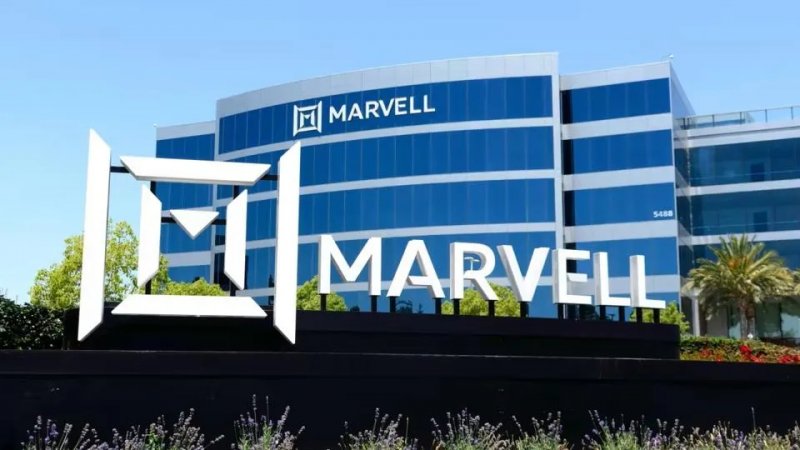
Following the news and its quarterly earnings report, Marvell’s shares rose nearly 10% in premarket trading on Wednesday, News.Az reports, citing Reuters.
The generative AI boom has accelerated chipmakers’ development processes, as companies compete to design the fastest and most energy-efficient chips for advanced data centers.
Marvell, along with rival Broadcom (AVGO), assists cloud-computing companies in creating custom chips tailored to their specific data center needs—a business that has expanded significantly amid rising AI demand.
The company expects roughly $10 billion in total revenue for its next fiscal year, including a 25% jump in data center revenue, Marvell CEO Matt Murphy said. It does not expect any major quarterly swings in its custom chip revenue next year.
Marvell expects its revenue from its custom chip business to grow 20% next year, CEO Matt Murphy said in a conference call. The Santa Clara, California-based company helps Amazon (AMZN) and Microsoft (MSFT) build their in-house AI chips, according to JP Morgan analyst Harlan Sur.
The Celestial deal would allow Marvell to tap into the startup's work on photonics, which uses light rather than electrical signals to create connections between AI chips and memory chips, an area in which it competes with Broadcom and the world's most valuable company, Nvidia.
The Celestial tech will be used in Marvell's next-generation photonics-related infrastructure products, which will contribute to a new $10 billion market for Marvell, Murphy told Reuters.
“We’re going to have a silicon photonics powerhouse at Marvell when this is all done,” he said.
Big cloud computing companies will begin installing photonics tech in 2027 or 2028 for large-scale applications, Murphy said. Eventually, he said, it will become widely adopted.
Under terms of the deal, Celestial AI will receive $1 billion in cash and 27.2 million shares of Marvell common stock worth $2.25 billion.
Marvell said it expects meaningful revenue contributions from Celestial AI beginning in the second half of fiscal 2028, reaching $500 million in annualized run rate in the fourth quarter of fiscal 2028 and doubling to a run rate of $1 billion by the fourth quarter of fiscal 2029.
The deal is expected to close in the first quarter of calendar year 2026.