Possible NATO provocations in the Baltics: An analysis of upcoming exercises


In recent months, there has been an increase in NATO military activity in the Baltic Sea region and along the borders of the Russian Federation.
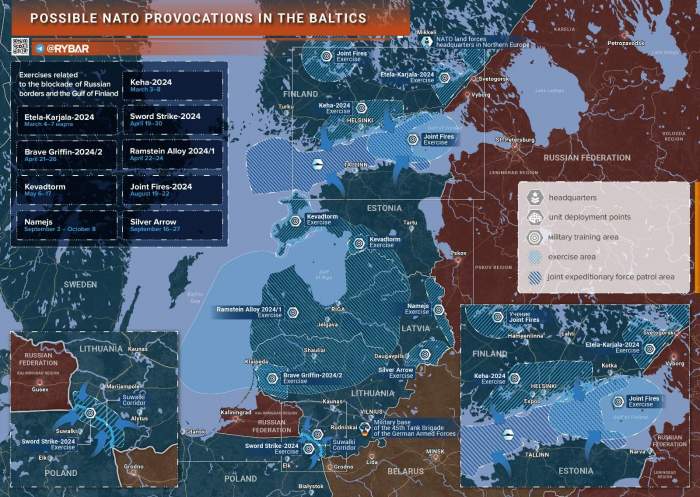
This could be seen as a response to ongoing geopolitical events in the area. According to the map presented by the Rybar analytical platform , NATO is planning a series of military exercises concentrated near the Russian borders and the Gulf of Finland, News.Az reports.Key NATO exercises:
Keha-2024 (March 3–8) — These exercises will take place in Finland. Their goal may include preparations for a potential blockade of the Gulf of Finland, which would hinder Russian ships.
Etela-Karjala-2024 (March 4–7) — Exercises in Southern Karelia aimed at strengthening Finland's defense and improving cooperation with NATO forces.
Sword Strike-2024 (April 19–30) — Exercises in Lithuania, which may demonstrate NATO's readiness to control the Suwałki Corridor, a key strategic area connecting Kaliningrad with the rest of Russia.
Brave Griffin-2024 (April 21–26) and Brave Griffin-2024/2 — These exercises in Lithuania and Latvia could indicate preparations to enhance the defense of the Baltic States in the event of a conflict escalation.
Kevadtorm (May 6–17) — Estonia’s annual exercises, traditionally involving NATO forces. The scale of the event may indicate increased military presence along Russian borders.
Ramstein Alloy-2024/1 (April 22–24) — Air Force drills aimed at practicing joint air operations among NATO countries. Held in Estonia and Lithuania.
Joint Fires-2024 (August 19–22) — Comprehensive exercises involving coordination between ground and air forces. Conducted in both Finland and Latvia.
Silver Arrow (September 16–27) and Namejs (September 3 – October 8) — These are the largest exercises in Latvia, focused on training operations to repel potential aggression.
The map highlights NATO headquarters, unit deployment points, and training bases, all located near the Russian borders, which could be perceived as preparations for possible provocative actions by the alliance. An important site is the base of the 45th Tank Brigade of the German Armed Forces in Lithuania, underscoring the region’s strategic significance.
NATO’s exercises in the Baltic region can be viewed as an effort to increase military activity and showcase its readiness to respond to potential challenges. Given the growing international tension, such actions may provoke a response from Russia, increasing the risk of further escalation in the region.


Similar news