SpaceX launches Crew-12 mission to ISS - VIDEO


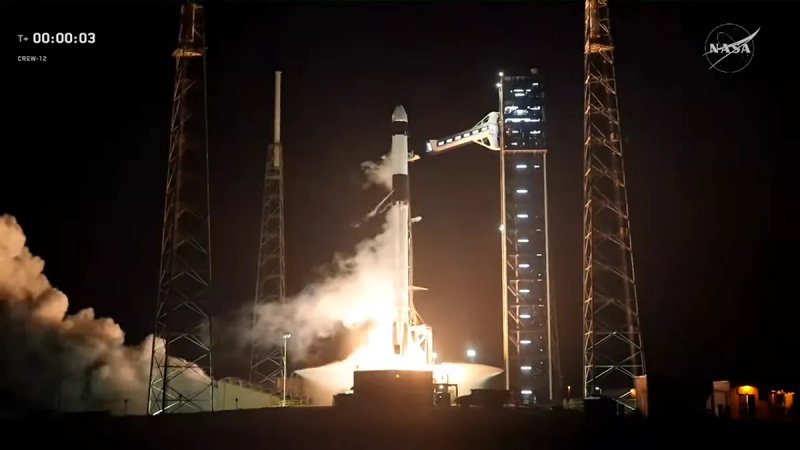
A rocket from SpaceX blasted off from Florida early Friday carrying two U.S. astronauts, a French astronaut and a Russian cosmonaut on an eight-month science mission to the International Space Station.
The two-stage Falcon 9 rocket, topped with the autonomously operated Crew Dragon capsule “Freedom,” lifted off from Cape Canaveral Space Force Station at approximately 5:15 a.m. EST (1015 GMT), News.Az reports, citing Reuters.
A live NASA-SpaceX webcast showed the 25-story launch vehicle ascending as its nine Merlin engines ignited, consuming about 700,000 gallons of fuel per second and illuminating the predawn sky with a fiery plume.
RECOMMENDED STORIES
About nine minutes after liftoff, the Falcon 9’s upper stage accelerated beyond 17,000 miles per hour (27,360 kph), propelling Crew Dragon into orbit. Meanwhile, the reusable first-stage booster returned safely to Earth, landing at a designated pad at Cape Canaveral.
The four-member team is scheduled to arrive at the space station Saturday afternoon following a 34-hour journey, docking with the orbiting laboratory roughly 250 miles (420 km) above Earth.
Watch the moment Maine astronaut Jessica Meir and three others on NASA's SpaceX Crew-12 mission launched into space from Cape Canaveral, Florida.
— WMTW TV (@WMTWTV) February 13, 2026
Learn more about Meir, a Caribou native who is commander of this mission: https://t.co/zJHgYYtI4x pic.twitter.com/cCVxVcbPyf
Designated Crew-12, the mission marks the 12th long-duration ISS crew rotation launched by SpaceX for NASA since the company, founded in 2002 by Elon Musk, began transporting American astronauts to orbit in May 2020.
The mission is led by NASA astronaut Jessica Meir, 48, a marine biologist making her second trip to the ISS. Nearly seven years ago, she and fellow astronaut Christina Koch completed the first all-female spacewalk in history. “Thank you team, that was quite a ride,” Meir radioed to SpaceX mission control near Los Angeles. “Crew-12 is grateful and ready for the journey ahead. We're on our way.”
Joining Meir are Jack Hathaway, 43, a former U.S. Navy fighter pilot on his first spaceflight; European Space Agency astronaut Sophie Adenot, 43, a French helicopter pilot; and Russian cosmonaut Andrey Fedyaev, a former military pilot embarking on his second ISS mission.
Once aboard the station, the crew will conduct a broad range of scientific, medical and technical research in microgravity. Planned experiments include studies of pneumonia-causing bacteria aimed at improving treatments on Earth, as well as research into plant growth and nitrogen-fixing microbes to enhance food production in space.
Much of the research supports future exploration goals under NASA’s Artemis program, which aims to return astronauts to the moon and eventually send crews to Mars. The upcoming Artemis II mission — a 10-day test flight around the moon — is expected to launch as early as next month.
Crew-12 will join three current ISS residents: NASA astronaut Chris Williams and Roscosmos cosmonauts Sergey Kud-Sverchkov and Sergei Mikaev.
Four Crew-11 astronauts, who had been expected to remain aboard until Crew-12’s arrival, returned to Earth several weeks early after one member required a rare medical evacuation in mid-January due to a serious but undisclosed health condition.
The ISS, spanning the length of a football field, remains the largest human-made structure in space. It has been continuously operated by a U.S.-Russian-led partnership that includes Canada, Japan and 11 European nations. The first modules were launched more than 25 years ago as part of a multinational effort to foster cooperation between Washington and Moscow following the Cold War.
NASA has said it plans to keep the space station in operation through the end of 2030.
By Nijat Babayev


Similar news