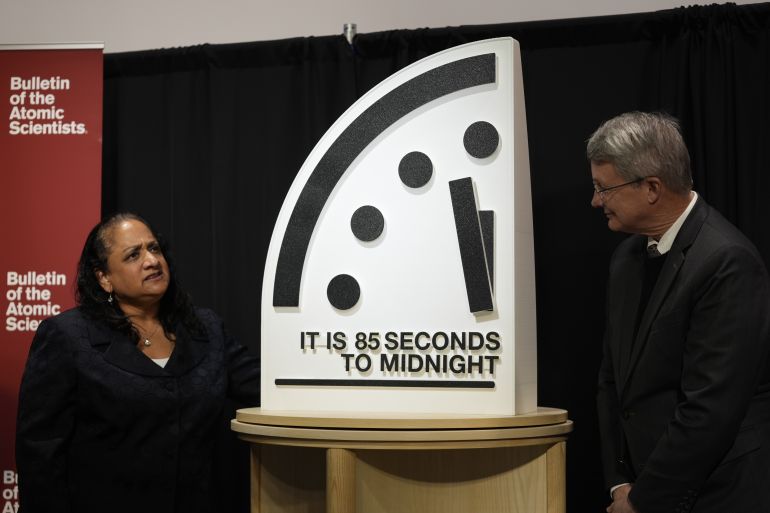
In its annual assessment released on Tuesday, the Bulletin of the Atomic Scientists, a not-for-profit organisation founded by Albert Einstein and other scientists, said international cooperation is deteriorating on nuclear weapons, climate change, and biotechnology, while artificial intelligence is creating new and potentially dangerous threats, News.Az reports, citing Al Jazeera.
“The Doomsday Clock’s message cannot be clearer. Catastrophic risks are on the rise, cooperation is on the decline, and we are running out of time,” said Alexandra Bell, president and chief executive officer of the Bulletin.
“Change is both necessary and possible, but the global community must demand swift action from their leaders,” Bell added.
In a more detailed explanation for moving the clock closer to midnight, the Bulletin said it was deeply concerned that major powers, including Russia, China, and the United States, were becoming “increasingly aggressive, adversarial, and nationalistic”.
According to the assessment, “hard-won global understandings are collapsing,” while a “winner-takes-all great power competition” is emerging in their place.
The Bulletin cited several conflicts in 2025 as contributing factors, including Russia’s war in Ukraine, clashes between India and Pakistan that erupted in May, and attacks carried out by the United States and Israel against Iran in June.
On the climate emergency, the organisation said national and international responses have ranged from “wholly insufficient to profoundly destructive”. It noted that none of the three most recent United Nations climate summits placed emphasis on phasing out fossil fuels or monitoring carbon dioxide emissions.
The assessment also criticised US President Donald Trump, saying he has “essentially declared war on renewable energy and sensible climate policies, relentlessly gutting national efforts to combat climate change”.
At the same time, the Bulletin highlighted more positive developments, noting that renewable energy — particularly wind and solar — recorded strong growth in both capacity and generation in 2024. It added that renewable and nuclear power together surpassed 40 percent of global electricity generation for the first time, underscoring that progress remains possible despite mounting global risks.