The organ grinders, the street artists who represent Mexican culture and survive modernity


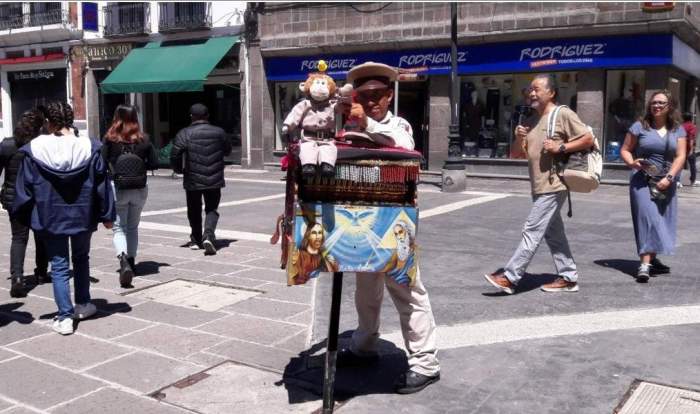
The musician Efraín Guevara playing his organ that has Christian representation and up it the colors of the Mexican flag. Photo: Pedro López Hernández.
The music from the street organ and the presence of the performer is one of the most nostalgic scenes and currently, something in extinction.
MEXICO. The organ grinders (also known as cylinders), are one of the most notable performers in the Mexican cities. The rank organists arrived in Mexico from Germany, during the mandate of the president Porfirio Díaz, approximately at the end of the 19th century.The first street musicians played songs with European characteristics, like the polkas, and in the beginning, they performed in circuses and ballrooms or in salons where aristocrats gathered. With the passage of the time, the organ grinders adopted notable characteristics, including their musical repertoire, since among the melodies they play are boleros and even 'Las mañanitas' (a common song in Mexico that is chanted during birthdays), although this varies depending on the instrument.
The uniform worn by the musicians is due to Pancho Villa, leader of the Mexican Revolution, as it is said that during his battles he was accompanied by an organ grinder to encourage the battalion, and his clothing was similar to that of today, with a touch reminiscent of the Villa’s army. The notable aspect is that, although many organs used come from Germany, others have been adapted with aspects of Mexican culture as decorative motifs. Another adaptation was that of the monkey, which was in charge of collecting money from passers-by, but currently this is replaced by a teddy or stuffed animal.
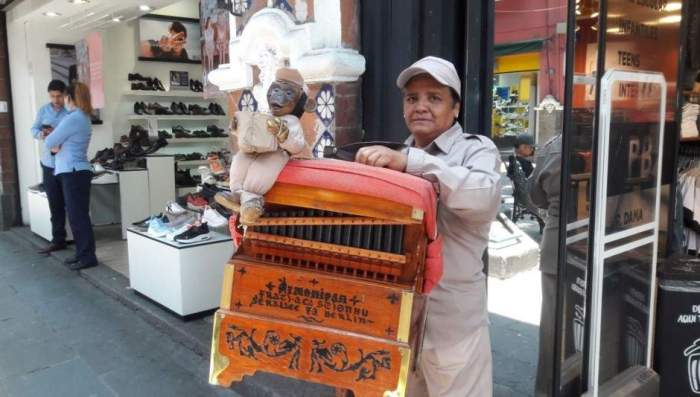
Susana is a woman organist who has been practicing this profession for 45 years. Her instrument is German. Photo: Pedro López Hernández.
Since they were not allowed to enter places like restaurants, organ grinders settled on the streets and today, this is their place, even in avenues, main squares and parks. Although their popularity increased during the last century, to the point that they became a reference of the Mexican culture, nowadays there are few people interested in practicing the trade and even some passersby confess to feeling irritated by the repetitive sounds.
In fact, street organ players carry heavy portable wooden instruments and certain bronze pieces, sometimes from square to square or through the streets. The characteristic sounds are produced because the device contains a cylinder with eight songs and these are played when the crank is turned.
Although the origin of the musical instruments is German, the European country stopped manufacturing them on a massive scale since the last century. In fact, in Mexico the tradition has had the greatest presence, but the repair of the instruments must be done in Chile, since that country is where there are still specialists in the analysis of problems and solutions.
The aforementioned profession survives, but the organ grinders mention that it is not possible to dedicate them completely to it, since they have sought another source of income. In fact, there are organizations and associations formed by them, among which is 'Organilleros de México', with the purpose of preserving this tradition.
Not everything is color and light, as there are also people who deceive with fake instruments and their repertoire is a recording. To detect if it is a real cylinder player, it is necessary to pay attention, because if he or she stops moving the crank or pauses, the music slowly fades away, which means it is real.
Neither the years, nor the weather, nor the lack of interest, stop these street musicians who still want to delight the public.
By Pedro López Hernández


Similar news