Top European countries with the highest rates of poverty



By News.Az
In 2023, 94.6 million people in the EU, or just over 21% of the population, were at risk of poverty or social exclusion. This means they were living in households facing at least one of the following risks: income poverty, severe material and social deprivation, and/or residing in a household with very low work intensity, where adults work less than 20% of their potential throughout the year. According to Eurostat, this figure remained relatively stable compared to the previous year, when 95.3 million people, or 22% of the population, were affected, News.Az reports citing Statista .The share of people at risk of poverty or social exclusion varies significantly across EU member states. In 2023, Romania had the highest proportion at 32%, followed by Bulgaria (30%), Spain (26.5%), and Greece (26.1%). On the other end of the spectrum, the lowest shares were recorded in the Czech Republic (12%), Slovenia (13.7%), and Finland (15.8%).
Economic inequality is a key driver of poverty in the EU. In countries with high unemployment rates, such as Romania and Bulgaria, a significant portion of the population lacks access to stable income sources. Additionally, inadequate labor market support and low wages exacerbate the situation. Even in countries with lower unemployment rates, such as Greece and Spain, access to quality jobs remains limited, and the prolonged economic downturn following the 2008 financial crisis continues to impact the well-being of the population.
Social protection and government support are crucial in determining poverty levels. Countries with robust social protection systems, such as Finland and the Czech Republic, have significantly lower levels of poverty and social exclusion. Government programs in these countries provide citizens with access to healthcare, education, and social benefits, mitigating the effects of economic hardship. Conversely, in countries where social support is less developed, the population is more vulnerable to poverty.
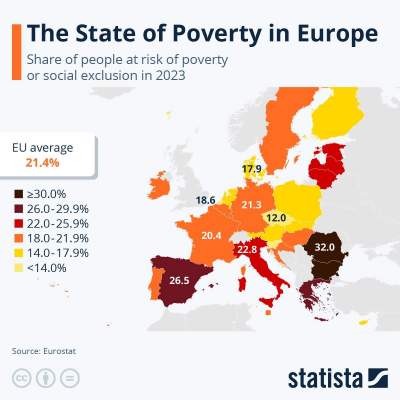
Demographic factors also play a significant role. In countries with rapidly aging populations, such as Greece, the economic burden on the working-age population increases, leading to a rise in poverty levels. Migration patterns are also relevant. Countries that receive large numbers of migrants, such as Spain and Italy, face challenges in integrating new residents, which can strain resources and exacerbate social tensions, ultimately increasing poverty levels.
Regional disparities within countries are another significant factor. In nations with pronounced economic imbalances between regions, such as Italy or Romania, poverty and social exclusion are often more prevalent in rural and remote areas, where access to jobs, education, and healthcare is limited. These disparities widen the gap between affluent and impoverished regions, contributing to social isolation.
The COVID-19 pandemic has further aggravated socio-economic challenges across the EU. Business closures, rising unemployment, and declining household incomes have increased the number of people experiencing material and social deprivation. Although the pandemic affected all countries, its impact was especially severe in those with less resilient economies.
To address the high levels of poverty and social exclusion in the EU, a multi-faceted approach is required. Strengthening social protection systems, increasing employment opportunities, improving working conditions, and implementing targeted policies to reduce regional and social disparities are all essential steps in tackling these issues.


Similar news