Tower screamed ‘STOP!’ Seconds too late: Deadly runway horror in New York leaves pilots killed - VIDEO


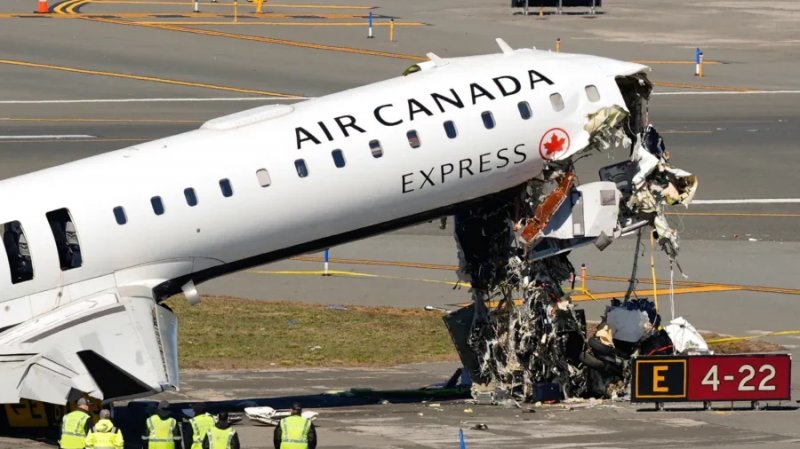
A catastrophic aviation accident unfolded late on March 23, 2026, at LaGuardia Airport in New York, when a landing passenger jet collided with a fire truck on the runway in a chain of events now under intense investigation.
The aircraft, a Jazz-operated Bombardier CRJ-900 flying as Air Canada flight AC8646 from Montreal to New York, was carrying 72 passengers and four crew members, News.Az reports, citing The Aviation Herald.
It had been cleared to land on runway 04 and was moments from completing a routine arrival when disaster struck.
At the same time, emergency crews were responding to a separate incident involving a United Airlines aircraft that had reported a dangerous odor onboard. A fire truck — identified as “Fire #1” — requested permission to cross the active runway. Air traffic control granted clearance.
As the CRJ-900 touched down at 23:36 local time, the control tower suddenly realized the imminent danger and urgently radioed: “Stop! Stop! Fire #1 Stop!” But it was too late.
The aircraft, rolling out at landing speed, slammed into the fire truck. The impact sent the jet skidding violently off the runway, finally coming to a halt more than 130 meters away.
The consequences were devastating.
Both pilots — the captain and first officer — were killed in the crash. Two firefighters on the truck suffered serious injuries. Among the passengers, nine were critically injured and 32 sustained minor injuries, turning what should have been a routine landing into a mass-casualty emergency.
The airport was immediately shut down, with operations suspended for hours as emergency crews flooded the scene and investigators began their work.
The National Transportation Safety Board (NTSB) quickly deployed a team to investigate the crash. Within hours, both the cockpit voice recorder (CVR) and flight data recorder (FDR) were recovered and sent to Washington for analysis.
Preliminary findings paint a chilling picture of the final moments.
Data from the cockpit voice recorder reveals that the flight was stable and fully configured for landing. The crew had completed all checklists and confirmed a steady approach. Just seconds before touchdown, the ground proximity warning system announced decreasing altitude: “100 feet… 50 feet… 30 feet…”
Meanwhile, on the ground, the fatal sequence unfolded. The fire truck requested to cross the runway and received clearance just 20 seconds before impact. At nine seconds before the end of the recording, the tower shouted “STOP.”
At eight seconds, the aircraft touched down.
Six seconds before the end, control of the aircraft was transferred between the pilots — likely a last-second attempt to react.
Four seconds later, the collision occurred.
Investigators are now focusing on multiple critical failures — including communication overlap, the absence of a transponder on the fire truck, and the limited staffing in the control tower at the time of the incident.
Only two controllers were reportedly managing all operations at the airport during the midnight shift — a standard but now heavily scrutinized procedure.
Equally alarming, the airport’s advanced ground radar system (ASDE-X), designed to prevent exactly such collisions, did not issue any warning before the crash. Runway status lights were reportedly functioning, but failed to prevent the fatal incursion.
The separate United Airlines incident that triggered the emergency response adds another layer of complexity. The aircraft had aborted takeoff twice due to reports of fumes or smoke onboard, prompting the deployment of multiple emergency vehicles — including the fire truck involved in the collision.
As investigators continue to piece together the sequence of events, one question looms large: how could multiple safety systems — human and technological — fail in the span of just seconds?
For now, the tragedy at LaGuardia stands as one of the most shocking runway disasters in recent years — a stark reminder of how quickly routine operations can turn deadly when timing, communication, and coordination break down.
https://news.az/news/nigerian-aviation-fuel-crisis-deepens-as-keyamos-emergency-talks-end-in-stalemate
By Leyla Şirinova


Similar news