Uber, Lucid tap Houston as next robotaxi market amid Waymo, Tesla rivalry


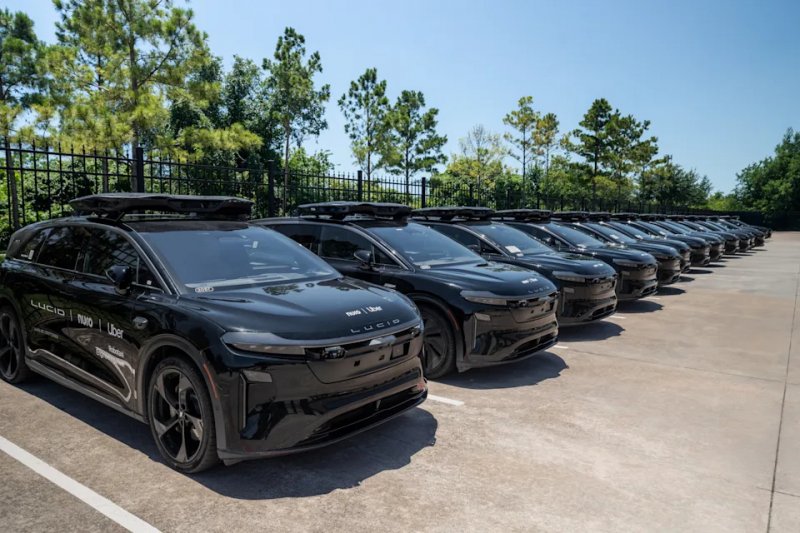
Uber (UBER) and Lucid (LCID) are expanding their robotaxi partnership, announcing Houston as the second planned market for an autonomous ride-hailing service they are developing with self-driving startup Nuro, News.Az reports, citing Yahoo Finance.
The announcement comes weeks after Lucid named Silvio Napoli as its incoming chief executive and secured $750 million in fresh capital — including $550 million from an affiliate of Saudi Arabia’s Public Investment Fund (PIF) and $200 million from an Uber subsidiary — highlighting the deepening ties between the PIF-backed companies as they advance their autonomous vehicle ambitions.
Houston will follow the program’s first launch market in the San Francisco Bay Area, where Uber still intends to begin commercial operations later this year. The Texas rollout is scheduled for mid-2027, with dozens of additional cities expected to follow in the years ahead.
RECOMMENDED STORIES
Autonomous on-road testing is already underway in Houston. Uber said its robotaxi engineering fleet now spans nearly 100 vehicles across California and Texas, running around the clock.
Separately, Uber has secured a 50,000-square-foot facility and a dedicated charging pitstop in Houston to serve as the program's operational depot, handling charging, maintenance, repairs, and cleaning. It will draw more than 4 megawatts of power and house 40 fast chargers and 15 maintenance bays, with groundbreaking planned for early 2027.
Under Uber Autonomous Solutions, the fleet-management unit it unveiled in February, the company has pulled infrastructure and logistics in-house. It is a part of the business that Alphabet's (GOOGL) Waymo and Tesla (TSLA) also have to solve.
The robotaxi version of the Lucid Gravity SUV used for the service carries a next-generation sensor array, with high-resolution cameras, solid-state lidar, and radar for 360-degree perception, topped by a purpose-built roof halo designed to maximize visibility. Pending final validation, production is expected to begin at Lucid's Arizona factory later this year.
The partnership, first struck in July 2025, calls for Uber to deploy 35,000 or more Lucid vehicles — the Gravity plus a future midsize model — equipped with the Nuro Driver over six years. The program cleared a few important regulatory milestones: Nuro won a California Public Utilities Commission (CPUC) pilot permit in early May, and a state DMV driverless testing permit in April, and Uber, Nuro, and Lucid employees have been taking test rides on the platform since April.
The developments come at a crucial time for both Uber and Lucid. While Uber chugs along as a logistics and demand-matching giant for mobility, Lucid is suffering from cash burn and a stock down by around 60% over the past year.
Lucid has leaned repeatedly on PIF funding — the latest $750 million is a much-needed lifeline. A robotaxi program that only generates revenue at scale in 2027 and beyond does little for Lucid in the here and now, though it does provide some catalysts for the future.
But news on the robotaxi front is welcome in the heated space. Uber and Lucid's robotaxi gambit follows a formula used by rival Waymo to some success — turning permits, infrastructure depots, and premium driverless SUVs into a service that scales across dozens of markets before rivals, namely Tesla, can catch up.
By Nijat Babayev


Similar news