Vance leaves Islamabad without Iran deal - VIDEO


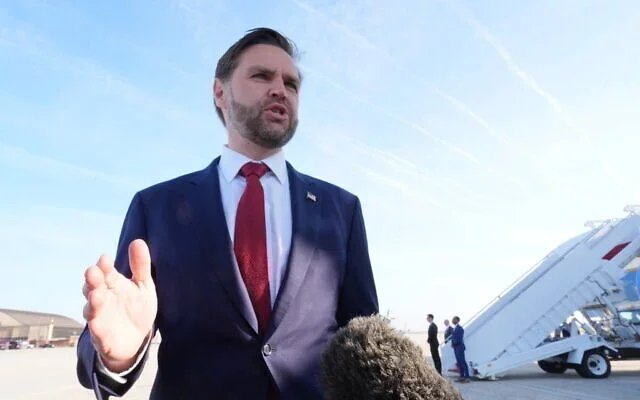
US Vice President JD Vance departed Pakistan on Sunday, according to a pool report, soon after saying that talks with Iran had failed to reach an agreement.
The US vice president’s departure came almost an hour after he addressed a press conference at the site of the trilateral ‘Islamabad talks’, mediated by Pakistan, which culminated almost 21 hours hours after they began on Saturday afternoon.“We have been at it now for 21 hours, and we have had a number of substantive discussions, that’s the good news,” said Vance. “The bad news is that we have not reached an agreement,” he added, News.Az reports, citing Dawn.com.
“We have made very clear what our red lines are, what things we are willing to accommodate them on and what things we are not willing to accommodate them on,” said the US vice president, adding that the Iranian delegation had “chosen not to accept our terms”.Vance began the press conference by appreciating Prime Minister Shehbaz Sharif and Chief of Defence Forces and Chief of Army Staff Field Marshal Asim Munir, saying that they were “incredible hosts”.
RECOMMENDED STORIES
He also clarified that “whatever shortcomings were in the negotiations were not because of Pakistanis, who did an amazing jobs and really tried to help us and the Iranians bridge the gap and get to a deal”.When the US vice president was asked to elaborate on what had the Iranians rejected, he began by saying: “I won’t go into all the details because I don’t want to negotiate in public after we have negotiated for 21 hours in private. But the simple fact is that we need to see an affirmative commitment that they will not seek a nuclear weapons and that they will not seek the tools that would enable them to quickly achieve a nuclear weapon.”
That, he said, was the “core goal of the US president, and that’s what we have tried to achieve through these negotiations”.Vance added that while Iran’s nuclear enrichment facilities had been “destroyed”, the “simple question is: do we see a fundamental commitment of will for the Iranians not to develop a nuclear weapon, not just now, not just two years from now, but for the long term?”
“We haven’t seen that yet, we hope that we will,” he said.
Vance was also asked whether Iranian frozen assets were discussed during the negotiations.
“We talked about all those issues, and we talked about a number of issues beyond that. And so, certainly those things came up. But again, we just could not get to a situation where the Iranians were willing to accept our terms.”
He added that he believed the US delegates were “quite flexible” and “accommodating”.
US President Donald Trump, he said, had told the delegates that they need to “come here in good faith and make your best effort to get a deal”.
“We did that. And unfortunately, we were unable to make any headway,” Vance said.(Lastly, the US vice president was asked how frequently had the American delegates been communicating with Trump throughout the negotiations.
Vance said they had been talking to Trump consistently, besides other top US officials.
“We were constantly communicating with the team because we were negotiating in good faith. And we leave here with a very simple proposal: a method of understanding that is our final and best offer. We will see if the Iranians accept it,” he said.
Meanwhile, the spokesperson for Iran’s Ministry of Foreign Affairs, Esmaeil Baqaei, wrote on X that it “was a busy and long day for the delegation of the Islamic Republic of Iran in Islamabad”, during which “numerous messages and texts have been exchanged between the two sides.”“In the past 24 hours, discussions were held on various dimensions of the main negotiation topics, including the Strait of Hormuz, the nuclear issue, war reparations, lifting of sanctions, and the complete end to the war against Iran and in the region,” he wrote.
“The success of this diplomatic process depends on the seriousness and good faith of the opposing side, refraining from excessive demands and unlawful requests, and the acceptance of Iran’s legitimate rights and interests.”
Baqaei also expressed appreciation to the “government and the warm-hearted and noble people of the Islamic Republic of Pakistan for hosting the negotiations and their benevolent efforts in advancing this process”.
The trilateral talks, which commenced on Saturday afternoon, saw the the US and Iranian delegations engage in discussions over three sessions, with teams of experts from the two parties exchanging written texts after each session.
The Iranian government said in a post on X that the talks were held at the “expert-level stage as economic, military, legal, and nuclear committees joined”.
“Negotiations continue at the Serena Hotel to finalise technical details,” it had added.The talks took place during a two-week ceasefire in the US-Israeli war against Iran that began with US-Israeli attacks on February 28. The conflict, which spread across the Middle East and sent shockwaves through global economies, paused after Pakistan brokered a temporary ceasefire on April 8.
Delegations from the two countries had arrived in Islamabad for the negotiations.
The US delegation was led by US Vice President JD Vance, who was accompanied by US President Donald Trump’s son-in-law Jared Kushner and Middle East envoy Steve Witkoff.
The Iranian delegation was led by Parliament Speaker Mohammad Bagher Ghalibaf and also included Foreign Minister Abbas Araghchi, along with other leaders.
In a post on X, Iranian President Masoud Pezeshkian said that Iran’s delegation remained “fully committed” to safeguarding the country’s interests.
He expressed hope that the delegation would “negotiate courageously”. He added that regardless of the outcome of the negotiations, the government will “stand by its people”.
By Leyla Şirinova


Similar news