Von der Leyen: China ties at 'inflection point' as summit highlights trade and geopolitical tensions


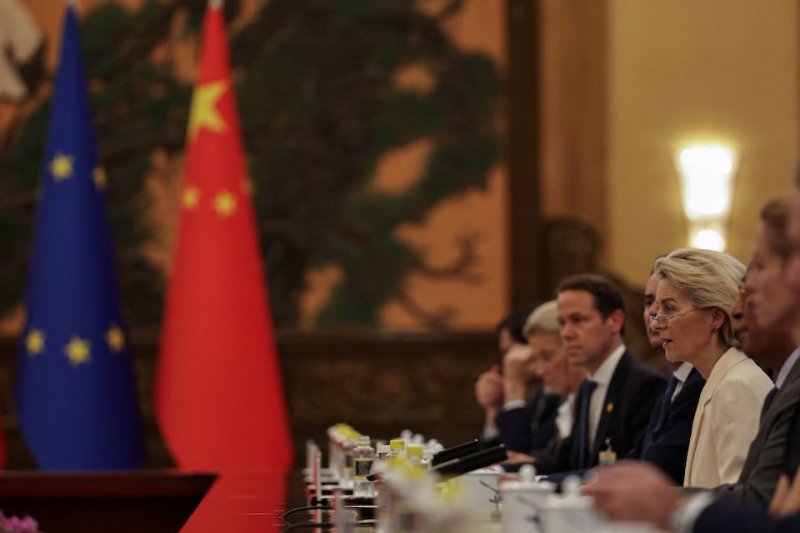
At a tense one-day summit in Beijing on Thursday, European Commission President Ursula von der Leyen warned that EU-China relations have reached an "inflection point," urging a fundamental rebalancing of trade and cooperation. Speaking alongside European Council President Antonio Costa during the 25th EU-China Summit, von der Leyen directly addressed Chinese President Xi Jinping, citing the EU’s record trade deficit with China and escalating geopolitical tensions as key concerns.
Von der Leyen emphasized the need for “real solutions” to address the deepening imbalance in trade, News.Az reports, citing Reuters.
In 2024, the EU's trade deficit with China reached a historic €305.8 billion ($360 billion), raising alarms in Brussels over Chinese industrial overcapacity and market distortions. “As our cooperation has deepened, so have imbalances,” von der Leyen said. “We have reached an inflection point. Rebalancing our bilateral relation is essential.”
Expectations for the summit were muted, with the duration of the meeting reduced to a single day at Beijing’s request. The lead-up to the talks was marked by weeks of rising tensions, including tit-for-tat trade measures and sharp rhetoric from EU officials. Earlier this month, von der Leyen accused China of flooding global markets and “enabling Russia’s war economy” by supplying dual-use materials.
In response, President Xi offered a more guarded message, calling on the EU to “make correct strategic choices” and stressing the need for communication and cooperation despite growing challenges. “The more severe and complex the international situation, the more China and the EU must strengthen communication, enhance mutual trust, and deepen cooperation,” Xi said, according to state broadcaster CCTV.
Despite the sharp tone of earlier statements, von der Leyen struck a more conciliatory note shortly before the summit, describing it as a chance to “advance and rebalance” the relationship. “I’m convinced there can be mutually beneficial cooperation,” she wrote in a post on X.
Later in the day, von der Leyen and Costa were scheduled to meet Chinese Premier Li Qiang, with hopes of releasing a modest joint statement on climate change—one of the few areas where EU-China cooperation remains relatively strong. State news agency Xinhua echoed a softer tone, calling China a “critical partner” rather than a “systemic rival,” and emphasizing shared interests in trade, climate, and global governance.
Still, many difficult issues loom large. EU leaders are pressing concerns over industrial overcapacity, particularly in the electric vehicle sector, as well as China’s recent restrictions on rare earth exports. Those controls, introduced in April, disrupted global supply chains and temporarily halted automotive production lines across Europe. Although Chinese exports of rare earth magnets to the EU rebounded by 245% in June compared to May, volumes remain 35% lower than the same time last year, according to customs data.
Meanwhile, the EU is reportedly close to finalizing a trade deal with the United States that would impose a 15% tariff on its exports—averting a harsher 30% tariff previously threatened by President Donald Trump.
As the EU seeks to redefine its strategic approach to Beijing, the bloc continues to label China a “partner, competitor, and systemic rival.” The outcome of this summit, while unlikely to produce breakthroughs, reflects an ongoing struggle to maintain constructive dialogue amid growing mistrust and diverging global agendas.


Similar news