Why annular solar eclipses never turn day fully into night


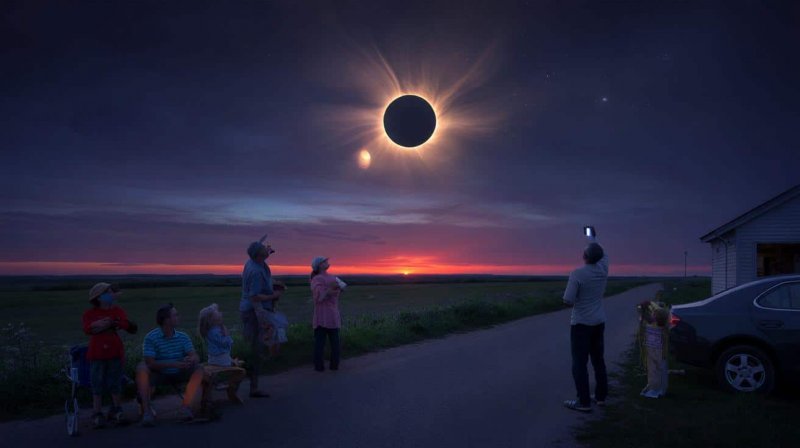
An annular solar eclipse is a specific type of solar eclipse that occurs when the Moon passes directly between the Earth and the Sun while being too far from Earth to completely cover the solar disk.
Because the Moon appears slightly smaller in the sky at that moment, it does not block all of the Sun’s light. Instead, a bright ring of sunlight remains visible around the Moon’s silhouette. This striking phenomenon is commonly called the ring of fire.
RECOMMENDED STORIES
Unlike total solar eclipses, annular eclipses never bring full darkness to daytime skies. Even at the maximum phase, the Sun’s outer edge continues to shine, preventing the dramatic twilight effect that total eclipses produce. Nevertheless, annular solar eclipses remain among the most visually distinctive and scientifically valuable astronomical events observed from Earth.
Why annular solar eclipses happen
The key reason annular solar eclipses occur lies in the geometry of the Earth Moon Sun system and the nature of the Moon’s orbit. The Moon travels around Earth in an elliptical path rather than a perfect circle. As a result, the distance between Earth and the Moon constantly changes.
When the Moon is closest to Earth, a point known as perigee, it appears larger in the sky. When it is farthest from Earth, known as apogee, it appears smaller. A total solar eclipse happens when the Moon is close enough to fully cover the Sun. An annular solar eclipse happens when the Moon is near apogee during its alignment with the Sun and Earth.
At the same time, the Earth’s distance from the Sun also varies slightly over the year. This variation influences the apparent size of the Sun in the sky. When the Sun appears slightly larger and the Moon appears slightly smaller, the conditions favor an annular eclipse rather than a total one.
How annular solar eclipses differ from total eclipses
Although annular and total solar eclipses share a similar alignment, the experience for observers is fundamentally different.
During a total solar eclipse, the Moon completely obscures the Sun, allowing the Sun’s corona to become visible. Temperatures can drop noticeably, animals may behave as if night is approaching, and the sky can darken dramatically.
In an annular solar eclipse, the Sun is never fully covered. The ring of sunlight prevents the appearance of the corona and maintains a high level of daylight. Shadows remain sharp, and the surrounding environment does not experience the same atmospheric changes seen during totality.
From a safety perspective, annular eclipses always require eye protection during all phases. There is no safe moment to look at the Sun directly without proper solar filters, unlike the brief totality phase of a total eclipse.
The path of annularity and why location matters
An annular solar eclipse is only visible in its full ring form along a narrow track on Earth known as the path of annularity. Observers located within this path will see the complete ring of fire at maximum eclipse.
Outside this narrow zone, people may still witness a partial solar eclipse. In these areas, the Moon covers only a portion of the Sun, and the ring effect is not visible.
The path of annularity is determined by precise orbital mechanics and can cross oceans, deserts, cities, or remote regions. Because Earth is mostly covered by water, many annular eclipses occur over areas where few people can observe them directly.
Historical understanding of annular solar eclipses
Ancient civilizations observed solar eclipses long before understanding their true cause. Early records from Mesopotamia, China, and the Islamic world describe unusual solar events that modern astronomers have identified as annular eclipses.
In many cultures, eclipses were interpreted as omens or messages from the divine. The appearance of a fiery ring in the sky could inspire awe or fear. Over time, systematic observations helped scholars recognize patterns and predict future eclipses.
The development of mathematical astronomy in the medieval Islamic world and later in Europe significantly improved eclipse prediction. By understanding orbital cycles such as the Saros cycle, astronomers learned that annular eclipses recur in predictable sequences over centuries.
Scientific value of annular solar eclipses
Although total solar eclipses attract more public attention, annular eclipses offer important scientific opportunities. Researchers use these events to study the Sun’s photosphere, measure precise timings of celestial motions, and test atmospheric models.
The sharp contrast between the Moon’s edge and the Sun’s bright ring allows astronomers to refine measurements of the solar diameter. These measurements contribute to long term studies of solar variability and help improve climate modeling.
Annular eclipses also provide valuable data for understanding how Earth’s atmosphere responds to sudden but partial reductions in solar radiation. Changes in temperature, wind patterns, and ionospheric behavior can be measured during the event.
How annular solar eclipses are observed safely
Safe observation is critical during any solar eclipse, especially annular ones. Because the Sun is never fully covered, looking directly at it without protection can cause permanent eye damage.
Certified solar viewing glasses with proper filtration are the most common method for safe observation. These glasses reduce sunlight to safe levels and block harmful ultraviolet and infrared radiation.
Another safe method involves indirect viewing techniques. Pinhole projectors, solar projection through telescopes equipped with proper filters, and specially designed solar viewers allow people to observe the eclipse without looking directly at the Sun.
Ordinary sunglasses, smoked glass, or improvised filters are not safe and should never be used.
Cultural impact and public fascination
Annular solar eclipses often spark widespread public interest, especially when the path of annularity crosses populated regions. Media coverage, educational programs, and public viewing events help transform these astronomical moments into shared cultural experiences.
In many societies, eclipses are used as opportunities to promote science education. Schools and universities organize lectures and observation sessions to explain celestial mechanics in an accessible way.
Social media and digital photography have amplified the cultural impact of annular eclipses. Images of the ring of fire quickly circulate worldwide, turning a geographically limited event into a global visual phenomenon.
How often annular solar eclipses occur
On average, two to five solar eclipses occur somewhere on Earth each year. Annular eclipses are less frequent than partial eclipses but more common than total eclipses.
A given location on Earth may experience an annular eclipse only once every several decades or even centuries. This rarity adds to their appeal and encourages travel to regions within the path of annularity.
Because eclipses follow long term cycles, astronomers can predict annular solar eclipses centuries in advance with remarkable accuracy.
Why annular eclipses are called the ring of fire
The phrase ring of fire is a descriptive term rather than a scientific one. It refers to the bright circle of sunlight visible around the Moon at maximum eclipse. The contrast between the dark lunar disk and the glowing solar edge creates an image that resembles a fiery halo.
This dramatic visual effect has helped annular eclipses capture public imagination across cultures and eras. Even today, the phrase is widely used in media coverage to convey the unique appearance of the event to broad audiences.
Annular eclipses in the modern scientific era
Modern technology has transformed how annular solar eclipses are observed and studied. High resolution cameras, space based solar observatories, and coordinated global observation networks allow scientists to collect detailed data during each event.
Satellites monitor changes in solar output, while ground based instruments track atmospheric responses. Amateur astronomers also contribute valuable observations, particularly in remote regions where professional facilities may be limited.
This collaboration between professionals and enthusiasts highlights how annular eclipses continue to play a role in advancing astronomical knowledge.
Educational value for future generations
Annular solar eclipses offer powerful teaching moments. They provide a real world demonstration of orbital mechanics, scale, and perspective. Concepts such as elliptical orbits, angular size, and celestial alignment become tangible when people witness an eclipse.
Educators often use eclipses to spark curiosity about astronomy and physics. For many students, seeing a ring of fire eclipse can be a formative experience that inspires long term interest in science.
Long term significance of annular solar eclipses
Beyond their immediate visual impact, annular solar eclipses contribute to humanity’s broader understanding of the cosmos. They remind observers that Earth is part of a dynamic system governed by precise physical laws.
Each eclipse reinforces the predictability of celestial motion while also emphasizing the rarity of perfect alignments. In this way, annular solar eclipses balance scientific precision with a sense of cosmic wonder.
They serve as recurring milestones that connect ancient sky watchers with modern scientists and future observers, all sharing the same sky and the same sense of awe.
By Faig Mahmudov


Similar news