Why is the Middle Corridor becoming Eurasia’s new trade lifeline?


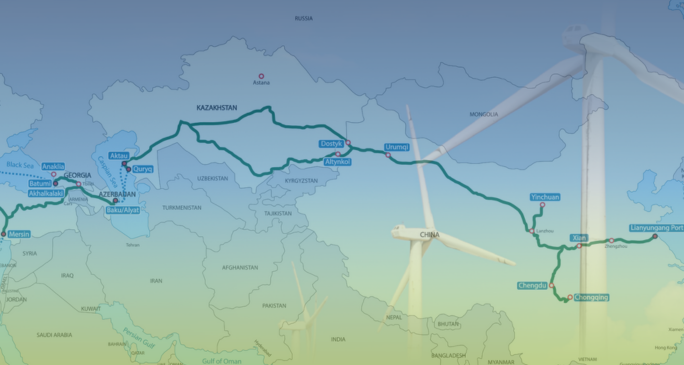
The Middle Corridor is rapidly emerging as one of the world’s most strategically important trade routes as countries across Eurasia seek alternatives to traditional transportation networks dominated by Russia and maritime chokepoints vulnerable to geopolitical tensions.
Stretching from China through Central Asia, across the Caspian Sea, through the Caucasus and Türkiye, and onward to Europe, the route is transforming the geopolitical and economic landscape of Eurasia.
RECOMMENDED STORIES
Officially known as the Trans Caspian International Transport Route, the Middle Corridor has gained extraordinary attention since the war in Ukraine disrupted traditional northern trade routes through Russia.
Governments, logistics companies, investors, and international organizations increasingly see the corridor as a crucial link connecting East and West while reducing dependence on politically sensitive transit routes.
The route involves a complex network of railways, highways, ports, and shipping connections that pass through China, Kazakhstan, the Caspian Sea, Azerbaijan, Georgia, and Türkiye before reaching European markets.
Supporters describe it as the modern Silk Road of the twenty first century.
The corridor not only reshapes trade flows but also strengthens the geopolitical importance of Central Asia and the South Caucasus.
It is increasingly viewed as a strategic project involving energy security, supply chain diversification, digital connectivity, and geopolitical competition between global powers.
As international trade patterns evolve, the Middle Corridor may become one of the defining infrastructure projects of modern Eurasia.
What exactly is the Middle Corridor?
The Middle Corridor is a multimodal trade and transportation network connecting Asia to Europe without passing through Russia.
The route begins in western China, crosses Central Asia primarily through Kazakhstan, continues across the Caspian Sea by ferry, enters the South Caucasus through Azerbaijan and Georgia, and then reaches Europe through Türkiye.
The corridor combines railways, roads, seaports, logistics hubs, and maritime shipping routes.
Unlike the traditional northern corridor that relies heavily on Russian rail infrastructure, the Middle Corridor offers countries an alternative Eurasian connection.
The route is formally called the Trans Caspian International Transport Route and involves cooperation among multiple governments and transportation companies.
Although still developing, the corridor’s strategic importance increased dramatically after geopolitical tensions involving Russia and Western sanctions reshaped global trade patterns.
Why has the Middle Corridor become so important recently?
The corridor’s importance surged after the outbreak of the Ukraine war in 2022.
Western sanctions against Russia, combined with concerns about political risk and transportation disruptions, pushed many companies and governments to search for alternative trade routes connecting Asia and Europe.
Before the war, many Eurasian rail shipments passed through Russian territory because northern routes were faster and better developed.
However, geopolitical uncertainty created fears over sanctions exposure, insurance complications, and supply chain instability.
As a result, interest shifted toward routes bypassing Russia entirely.
The Middle Corridor suddenly became strategically attractive because it offered an alternative East West transportation network.
At the same time, global supply chain disruptions during the COVID era highlighted the importance of diversified logistics systems.
Governments increasingly realized that overdependence on single transportation corridors creates major vulnerabilities.
Which countries benefit most from the Middle Corridor?
Several countries stand to benefit significantly from the corridor’s expansion.
Kazakhstan plays a central role because it serves as the primary transit bridge between China and the Caspian Sea.
Kazakhstan has invested heavily in rail infrastructure, logistics centers, and port modernization to strengthen its position as a Eurasian transit hub.
Azerbaijan is another key player because of its strategic location on the Caspian coast.
The country’s Port of Baku has become one of the corridor’s most important logistics hubs.
Azerbaijan also benefits from its growing role as both an energy exporter and transportation center linking Central Asia to Europe.
Georgia gains importance through Black Sea connectivity and rail transit infrastructure.
Türkiye benefits enormously because the corridor strengthens its role as a gateway between Asia and Europe.
China additionally gains access to diversified export routes, while European countries benefit from improved connectivity to Asian markets.
How does the Middle Corridor compare to routes through Russia?
Historically, northern routes through Russia dominated Eurasian land transportation because they were faster, more direct, and supported by extensive Soviet era rail infrastructure.
However, the Middle Corridor offers several strategic advantages despite still facing logistical challenges.
The main advantage is geopolitical diversification.
Companies and governments increasingly value transportation routes that reduce exposure to sanctions, political instability, or geopolitical conflicts.
The Middle Corridor also provides opportunities for countries outside Russia to capture transit revenues and strengthen economic integration.
However, the route currently remains less efficient than northern alternatives in some areas.
The corridor involves multiple border crossings, maritime shipping across the Caspian Sea, and varying rail standards.
Infrastructure bottlenecks, customs procedures, and limited port capacities still create delays.
Nevertheless, major investments are gradually improving efficiency.
Why is the Caspian Sea so important for the corridor?
The Caspian Sea forms the central maritime link of the Middle Corridor.
Cargo traveling from Central Asia must cross the sea by ferry or cargo ship before continuing through the South Caucasus toward Europe.
This makes Caspian ports critically important.
The Port of Baku in Azerbaijan and Kazakhstan’s Aktau and Kuryk ports are especially significant.
Governments are investing heavily in port expansion, logistics infrastructure, and shipping capacity to handle growing trade volumes.
The Caspian crossing remains one of the corridor’s main logistical challenges because weather conditions, ferry schedules, and limited vessel capacity can create delays.
Still, improving maritime infrastructure is becoming a major regional priority.
How is China connected to the Middle Corridor?
China views the Middle Corridor as an important component of broader Eurasian connectivity strategies linked to the Belt and Road Initiative.
Beijing seeks diversified trade routes reducing dependence on maritime chokepoints and politically sensitive transit networks.
Western China especially benefits because overland transportation routes shorten shipping times to European markets compared to traditional sea routes.
Chinese companies and investors have therefore supported infrastructure projects, logistics hubs, and rail networks connected to the corridor.
At the same time, China’s growing influence in Central Asia strengthens its economic role across Eurasia.
The corridor also helps Beijing maintain trade flexibility amid rising geopolitical tensions with the United States and its allies.
Why is Europe interested in the Middle Corridor?
European countries increasingly view the corridor as strategically important for both economic and geopolitical reasons.
The route offers opportunities to diversify trade and energy connections away from Russia.
Europe also seeks stronger economic engagement with Central Asia and the South Caucasus.
The European Union has intensified interest in transportation infrastructure, renewable energy projects, and critical minerals cooperation involving corridor countries.
Supply chain security became a major concern after both COVID disruptions and the Ukraine war.
The Middle Corridor therefore fits broader European goals of creating more resilient and diversified trade systems.
Additionally, Europe sees the route as important for future energy and digital connectivity projects.
How important is Azerbaijan in the corridor?
Azerbaijan occupies one of the most strategically important positions in the Middle Corridor.
Located between Central Asia, the Caspian Sea, the South Caucasus, and Türkiye, Azerbaijan effectively serves as a gateway connecting multiple regions.
The country invested heavily in logistics infrastructure over recent years.
Projects including the Baku Tbilisi Kars railway significantly strengthened regional transportation connectivity.
The modernization of the Port of Baku additionally transformed Azerbaijan into a growing logistics center.
Baku increasingly positions itself not only as an energy exporter but also as a transportation and trade hub linking East and West.
This growing role enhances Azerbaijan’s geopolitical importance internationally.
What role does Türkiye play?
Türkiye serves as the corridor’s main bridge into Europe.
Its railways, ports, highways, and logistics infrastructure connect the South Caucasus to European markets.
Türkiye also strongly supports Turkic cooperation across Central Asia and the Caucasus through political, cultural, and economic initiatives.
Ankara views the corridor as strategically important for expanding trade, increasing geopolitical influence, and strengthening regional integration.
The route additionally supports Türkiye’s ambition to become a major Eurasian transportation and energy hub.
Infrastructure projects such as Marmaray and rail links into Europe further increase Türkiye’s role within the corridor.
What are the biggest challenges facing the corridor?
Despite rapid development, the Middle Corridor still faces major obstacles.
Infrastructure gaps remain one of the biggest challenges.
Some railways, ports, and customs systems require modernization and expansion.
Border procedures can also create delays because cargo must pass through multiple countries with different regulations and administrative systems.
Maritime shipping capacity across the Caspian Sea remains limited compared to growing demand.
Geopolitical risks additionally affect the region.
Tensions involving Armenia and Azerbaijan, instability in parts of the Caucasus, and broader regional rivalries could influence future development.
Financing large infrastructure projects also requires enormous investments.
Competition from alternative routes through Russia, Iran, and maritime shipping remains another challenge.
Can the corridor transform Central Asia economically?
Potentially yes.
The Middle Corridor could significantly increase Central Asia’s economic importance by turning the region into a major transit and logistics hub.
Countries such as Kazakhstan may generate substantial revenues from transportation, logistics services, warehousing, and industrial development linked to trade flows.
Improved infrastructure may additionally stimulate manufacturing, digital connectivity, tourism, and foreign investment.
The corridor could also reduce Central Asia’s historical isolation and strengthen regional economic integration.
However, long term success will depend on political stability, continued infrastructure development, and effective regional cooperation.
Could the corridor reduce global dependence on maritime shipping?
Not entirely, but it may become an increasingly important supplement.
Sea transportation remains cheaper for large scale global trade volumes.
However, overland routes like the Middle Corridor offer faster delivery times for certain goods and provide alternatives during geopolitical or logistical disruptions.
Companies increasingly value flexibility and diversified supply chains rather than relying exclusively on maritime routes.
The corridor therefore complements rather than replaces traditional sea transportation.
Why is the Middle Corridor geopolitically important?
The corridor reshapes the geopolitical map of Eurasia.
It reduces Russian dominance over regional transit routes while increasing the strategic importance of Central Asia, the South Caucasus, and Türkiye.
The project also strengthens China’s westward connectivity while giving Europe alternative access to Asian markets.
Countries positioned along the route gain greater geopolitical leverage because they become essential links in international trade networks.
This growing importance may increase foreign investment, diplomatic engagement, and strategic competition involving the region.
The corridor effectively transforms countries once considered peripheral into central players within Eurasian geopolitics.
Could the Middle Corridor become the new Silk Road?
Many analysts increasingly describe it as the modern Silk Road because it reconnects Asia and Europe through overland Eurasian trade networks.
Historically, ancient Silk Road routes passed through Central Asia and the Caucasus, linking civilizations, trade, and cultural exchange.
Today’s Middle Corridor revives that historical logic in modern form through railways, ports, pipelines, and digital infrastructure.
Although challenges remain, the corridor’s strategic importance continues growing rapidly.
As geopolitical tensions reshape global trade patterns, the Middle Corridor may ultimately become one of the defining transportation arteries of the twenty first century, reshaping not only Eurasian commerce but also the global balance of economic and geopolitical influence.
By Faig Mahmudov


Similar news