Why removing a drug lord may spark more violence


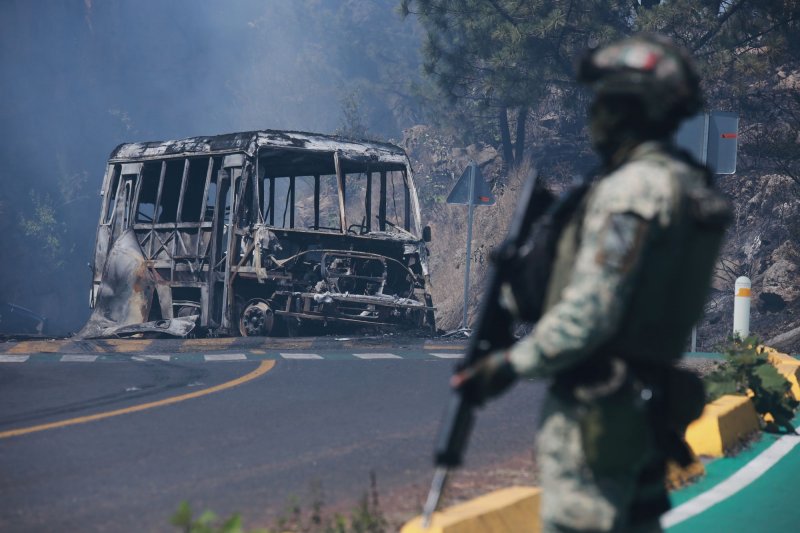
Reports that Nemesio Ruben Oseguera Cervantes, widely known as El Mencho and identified by Mexican and United States authorities as the leader of the Jalisco New Generation Cartel, was killed during a Mexican military operation have been followed by a fast moving wave of unrest in parts of western and central Mexico.
Authorities and multiple media reports describe coordinated retaliation tactics that have included burning vehicles, closing highways, and creating improvised roadblocks that disrupted travel, commerce, and daily life across several states, News.Az reports.
RECOMMENDED STORIES
What follows is a question and answer explainer of what is known so far, what remains unclear, and what typically happens when a major cartel leader is suddenly removed from the scene.
What happened, in simple terms
According to multiple reports, Mexican forces carried out an operation in the western state of Jalisco that ended with El Mencho dying from wounds sustained during the mission. Within hours, security incidents spread well beyond the immediate area, with cartel affiliated actors allegedly staging coordinated disruptions including vehicle burnings and road blockades.
Where did the unrest occur, and what did it look like
Reports describe narco blockades and large scale traffic disruptions across a wide area, especially in western Mexico. The pattern involved burning or abandoning vehicles on major roads to paralyze movement and strain security forces, alongside attacks on property and confrontations with authorities in some locations. Schools were suspended in some areas and officials urged people to stay indoors in specific localities as the situation developed.
Because early incident counts can shift quickly in a fluid situation, precise numbers of affected states, casualties, and incidents should be treated as provisional until authorities publish consolidated tallies.
Was it really a riot, or something else
Different headlines use different shorthand. In many Mexico security crises, the most visible public disruption is not a spontaneous crowd riot in the classic sense, but organized violence and intimidation that creates chaos in public space: blocked highways, burning vehicles, disrupted airports or bus routes, and sudden local business closures.
Street level clashes can occur, and people may gather, panic, or flee in ways that look like civil unrest. However, these events are often driven by coordinated criminal tactics designed to overwhelm the state, not by a single crowd with a unified political demand.
Who was El Mencho, and why does his reported death matter so much
El Mencho is described by Mexican and United States authorities as the top figure in the Jalisco New Generation Cartel, one of the most powerful and violent criminal organizations in Mexico, with international trafficking reach. The group has been linked to fentanyl trafficking and has a reputation for military style capabilities, including heavy weaponry and sophisticated operations.
When a figure of that stature is killed, it is not only a symbolic blow. It can also trigger immediate retaliation for deterrence, followed by internal power struggles for succession.
Why do cartels respond with roadblocks and mass disruption
Roadblocks and vehicle burnings serve several purposes simultaneously.
First, they create instant fear and uncertainty, pushing civilians to stay home and limiting witnesses.
Second, they slow down police and military movements, complicating reinforcements and evacuation routes.
Third, they signal capacity. By paralyzing multiple corridors at once, a cartel demonstrates it can impose costs on the state and on the economy quickly.
Fourth, they can be used to divert attention away from a specific area, potentially enabling escape, regrouping, or the movement of people and resources.
How do reports like this spread so fast and intensify fear
In major security events, information moves at two speeds: official confirmation, which is cautious and often delayed; and informal circulation on social media and messaging apps, which is immediate but often inconsistent.
When the subject is a high profile cartel leader, rumors and partial details can spread within minutes. Even if the core claim later proves accurate, early posts often inflate geography, casualty figures, or alleged targets. That can amplify panic, lead to sudden closures, and encourage opportunistic violence or copycat roadblocks by smaller groups.
Is there official confirmation, or is this still reports
Multiple reports state that the Mexican army killed El Mencho during an operation in Jalisco, and that the aftermath included widespread retaliatory disruption.
In rapidly evolving events, the wording reports may persist even as outlets converge on the same account, because officials may take time to issue full statements, confirm identity details, or release operational timelines.
What does the Mexican government say, and what is the political stake
Mexico’s president, Claudia Sheinbaum, urged calm and presented the operation as evidence of strengthened national capacity.
The political stake is significant. A major cartel leader’s death can be framed as a security victory, but the immediate backlash tests public confidence and state control. Citizens focus on whether daily life can continue safely: schools open, roads function, and local businesses operate without intimidation.
Why can a win against a cartel produce more short term violence
A cartel leader can act as a stabilizing manager inside a violent organization. Removing that leader can produce:
A short term retaliation surge, meant to punish the state and deter future operations.
A succession contest, where factions compete violently to inherit authority, territory, and revenue streams.
A fragmentation effect, where the cartel splits into multiple groups that are harder to deter and potentially more unpredictable.
This can temporarily increase violence even if the long term goal is to weaken the organization.
Will the cartel collapse now that its leader is gone
Not automatically.
Large cartels often operate as resilient networks with layered leadership structures. Removing the top leader can degrade coordination and trigger instability, but it does not guarantee collapse unless followed by sustained pressure on finances, logistics, and successor figures.
In some cases, the successor consolidates quickly. In others, fragmentation leads to chaotic competition.
What is the Jalisco New Generation Cartel in brief
The Jalisco New Generation Cartel is widely described as one of Mexico’s most powerful trafficking organizations, with influence across multiple regions and international connections. It has been portrayed as highly aggressive and adaptable, combining traditional trafficking with intimidation tactics aimed at state forces and local communities.
Its rise has been associated with rapid expansion, recruitment, and a willingness to use public spectacle to send messages.
Why do these events affect multiple states, not just one
A cartel with a national footprint can activate networks across different regions rapidly. Even when the trigger event occurs in one state, the response may be designed to demonstrate reach. Creating disruptions across many corridors forces the federal government to distribute resources more widely and signals that the cartel is not confined to a single locality.
What should residents and travelers do during a fast moving security event
General safety guidance often includes:
Avoid unnecessary travel through affected areas.
Follow official local alerts, as conditions can change quickly.
If roadblocks or violence are reported nearby, stay indoors and avoid approaching the scene.
Keep communication simple and rely on verified information.
International travelers should monitor advisories from their governments and local authorities and be prepared for sudden disruptions.
Is this connected to United States involvement
El Mencho had long been a top target for both Mexico and the United States, with a reward offered for information leading to his capture. Reports suggest that intelligence cooperation may have supported enforcement efforts.
However, the visible operation is described as carried out by Mexican forces. Cooperation in counter narcotics operations can be politically sensitive, and governments often emphasize sovereignty in public messaging.
How do authorities confirm the identity of a major figure
Identity confirmation typically involves biometric comparisons, forensic analysis, and cross verification with intelligence databases. Officials may delay releasing detailed confirmation until these checks are completed.
Could this be misinformation or strategic rumor
Criminal conflicts often involve misinformation. Cartels may exaggerate their reach to intimidate rivals or the public. Social media can amplify unverified claims.
However, when multiple mainstream outlets converge on the same account of an operation and subsequent unrest, the core narrative gains credibility, even if some details remain fluid.
What happens in the first week after a cartel leader’s death
Common near term developments include:
Deployment of federal forces to restore order and reopen highways.
Efforts to arrest or disrupt commanders responsible for retaliation.
Public messaging from the government emphasizing control and stability.
Temporary economic disruption in affected regions.
Close monitoring of potential successors.
What happens over the next months
Several scenarios are possible.
A consolidated succession may stabilize the cartel’s structure after a brief surge in violence.
Fragmentation could lead to prolonged competition between factions.
Sustained state pressure could exploit the disruption to weaken the organization more broadly.
The outcome depends on enforcement capacity, internal cartel cohesion, local governance, and regional dynamics.
Does this mean Mexico is becoming less safe overall
Security conditions in Mexico vary widely by region. A dramatic event in one or several states does not define the entire country. However, short term volatility can increase in affected areas following such a high profile operation.
What is the broader significance
Beyond immediate violence, the event highlights the complexity of dismantling large criminal organizations. Removing a top leader can be necessary, but it can also trigger retaliatory shocks that affect civilians and local economies.
The coming days and weeks will determine whether authorities can convert a tactical success into sustained public safety gains, or whether internal cartel dynamics and retaliation prolong instability in key regions.
By Faig Mahmudov


Similar news