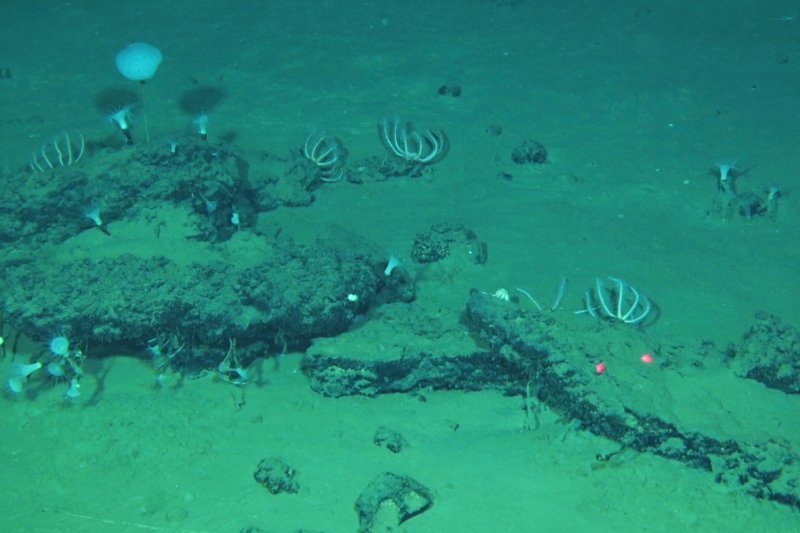
Dubbed a “whale necropolis”, the extraordinary discovery was made in the Diamantina Zone, where researchers found hundreds of fossil whale remains alongside active whale-fall ecosystems at depths reaching 7,001 meters, News.az reports.
The findings, published in the journal Nature, suggest the site has been accumulating whale remains for at least 5.3 million years.
A lost world beneath the sea
During a 2023 expedition, scientists carried out 32 dives using the deep-sea submersible Fendouzhe and surveyed a 1,200-kilometer stretch of ocean floor.
The team discovered:
- 5 active whale-fall ecosystems
- 476 fossil whale sites
- Remains located between 4,616 and 7,001 meters deep
- The deepest active whale-fall ecosystem ever recorded at 6,789 meters
Researchers calculated an astonishing density of up to 759 whale remains per square kilometer.
“If that figure is applied across the entire zone, there could be more than 10 million whale carcasses preserved there,” said Professor Peng Xiaotong of the Chinese Academy of Sciences.
Why did millions of whales end up there?
Scientists believe the area serves as an important feeding ground for deep-diving beaked whales.
The unique V-shaped seafloor acts like a natural funnel, directing whale carcasses into the trench after death. Extremely slow sediment accumulation then helps preserve the bones for millions of years.
Among the fossils were remains of both living and extinct whale species, including a newly identified species named Pterocetus diamantinae.
A hidden carbon vault
The discovery could also reshape scientists’ understanding of how the deep ocean stores carbon.
Researchers estimate that if the area contains around 10 million whale carcasses, they could collectively lock away approximately 6.7 million tonnes of carbon.
That amount is equivalent to nearly 4,700 years of marine snow — the continuous fall of organic material from the ocean surface to the deep sea.
Scientists say whale falls may represent a major and previously overlooked source of carbon storage in the deep ocean while simultaneously supporting unique ecosystems populated by bone-eating worms, sea stars and other specialized creatures.
Rewriting marine history
The newly discovered whale graveyard extends the known depth record for whale-fall ecosystems from just over 4,200 meters to nearly 7,000 meters.
Researchers believe the Diamantina Zone may form a vast underwater biological corridor that has sustained deep-sea life for millions of years, offering an unprecedented glimpse into the evolution, migration and extinction of ancient whales.
The discovery is being hailed as one of the most significant deep-ocean findings in recent years and highlights how much of Earth's deepest waters remains unexplored.