A new perspective on oil: How demand and supply will change in 2024-2025



By Asif Aydinli
The updated report from the U.S. Energy Information Administration (EIA), released on August 6, 2024, has drawn significant attention to global trends in the oil and liquid hydrocarbons (LH) market. The report revised key forecasts concerning both demand and supply, reflecting current economic and geopolitical realities.The EIA predicts that global demand for oil and LH will grow by 1.14 million barrels per day in 2024, reaching 102.94 million barrels per day. This forecast was revised upward by 30,000 barrels per day compared to the previous report. In 2025, further demand growth of 1.61 million barrels per day is expected, bringing the total to 104.55 million barrels per day. However, despite the positive trend, the forecast for 2025 was lowered by 160,000 barrels per day due to uncertainty in China’s economic development, News.Az reports, citing neftegaz .
China plays a central role in the global energy market as one of the largest consumers of oil. However, in recent months, a noticeable slowdown in China’s economic growth has directly impacted energy demand. Specifically, reduced demand for diesel fuel reflects broader economic difficulties, including a downturn in the real estate sector and a lack of job opportunities. These factors have led analysts to lower expectations for oil demand growth in China, which in turn is putting pressure on global prices.
Despite the negative news from China, the EIA emphasizes that growth in global oil and LH demand will be driven by non-OECD countries. In these countries, including China and India, oil demand will continue to grow, although at a slower pace than previously expected. For example, in India, demand is expected to increase by 280,000 barrels per day in 2024 and by 300,000 barrels per day in 2025. These figures indicate that global markets are still in a growth phase despite localized slowdowns.
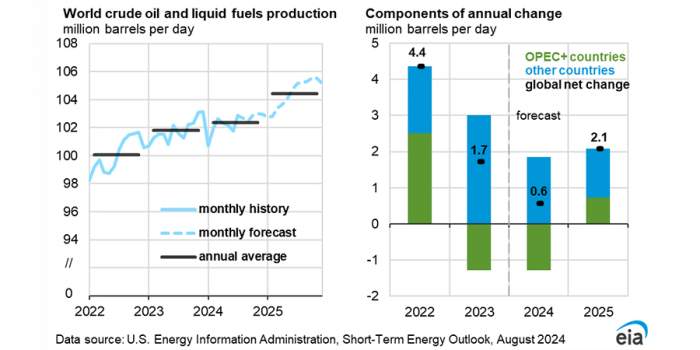
Meanwhile, forecasts for oil and LH supply have been revised downward. In 2024, production is expected to increase by 570,000 barrels per day, reaching 102.36 million barrels per day. In 2025, further growth of 2.08 million barrels per day is projected, bringing the total to 104.44 million barrels per day. However, despite these positive expectations, the forecasts were lowered by 70,000 and 90,000 barrels per day, respectively, due to lower expectations for production in OPEC+ countries.
OPEC+ countries continue to play a key role in the oil market, regulating production volumes and, consequently, influencing global prices. In 2024, production in OPEC+ countries is expected to decrease by 1.34 million barrels per day, but in 2025, an increase of 790,000 barrels per day is anticipated. This short-term decline in production could lead to a market deficit, which supports current prices at high levels.
In the U.S., despite downward adjustments in forecasts, stable growth in oil production is expected. In 2024, production is expected to increase by 300,000 barrels per day, reaching 13.23 million barrels per day. In 2025, further growth to 13.69 million barrels per day is expected. These figures underscore the resilience and significance of the American oil industry on a global scale.
 Special attention is given to oil production in U.S. shale basins, which play a crucial role in overall production volumes. For example, in the Permian Basin, production is expected to increase by 430,000 barrels per day in 2024 and by 310,000 barrels per day in 2025. However, in some other regions, such as Eagle Ford, production is expected to decline in 2024, followed by a slight increase in 2025.
Forecasts for oil production in Russia were adjusted slightly. It is expected that in 2024, production will decrease by 360,000 barrels per day, but in 2025, it will increase by 80,000 barrels per day, reflecting the stability of the Russian oil industry despite external challenges and sanctions pressure.
As for oil prices, the EIA predicts that the spot price for Brent crude will return to the $85-90 per barrel range by the end of 2024. However, overall, oil price forecasts for 2024 and 2025 were lowered due to uncertainty regarding global supply and demand. The forecast for the price of Brent crude in 2024 was lowered from $86.37 to $84.44 per barrel, and for 2025, from $88.38 to $85.71 per barrel. A similar trend is observed for WTI crude oil.
In conclusion, the EIA report highlights the complexity and multilayered nature of the situation in the global oil market. Despite growth in demand and supply, factors such as China’s economic slowdown, reduced production in OPEC+ countries, and adjusted price forecasts create uncertainty and require constant monitoring. In these conditions, the key tasks for market participants remain adapting to changes and responding promptly to new challenges, which will be the foundation for stabilizing and further developing the global energy sector.


Similar news