Arctic LNG 2 on ice: Can Russia break into India’s gas market amid sanctions?


By Asif Aydinly
The Arctic LNG 2 project - a cornerstone of Russia’s strategy to expand its liquefied natural gas (LNG) exports - finds itself in a paradoxical position, where resource strength does not translate into market value. Despite technological advances, large-scale investment, and official announcements of production launch, actual LNG exports remain severely constrained under the current sanctions regime. NOVATEK’s recent talks with potential Indian buyers on the sidelines of India Energy Week in February 2025 mark a renewed effort to bring the project’s output to global markets. However, economic, logistical, and legal obstacles create a fragile foundation for real deliveries.
Arctic LNG 2: A project in search of a market
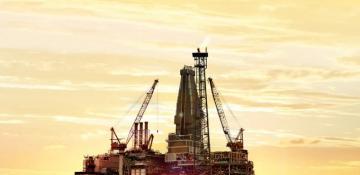
The project is located on the Gydan Peninsula, based on the Utrenneye field, and is designed to operate three liquefaction trains with a total capacity of nearly 20 million tons of LNG per year. The first train was commissioned in late 2023, the second was delivered in August 2024, and the third - according to unofficial sources - is unlikely to be launched before 2028. On the surface, Russia appears to have gained a powerful new instrument to strengthen its foothold in the Asian energy market, particularly amid growing demand in Southeast Asia and instability in the Middle East.
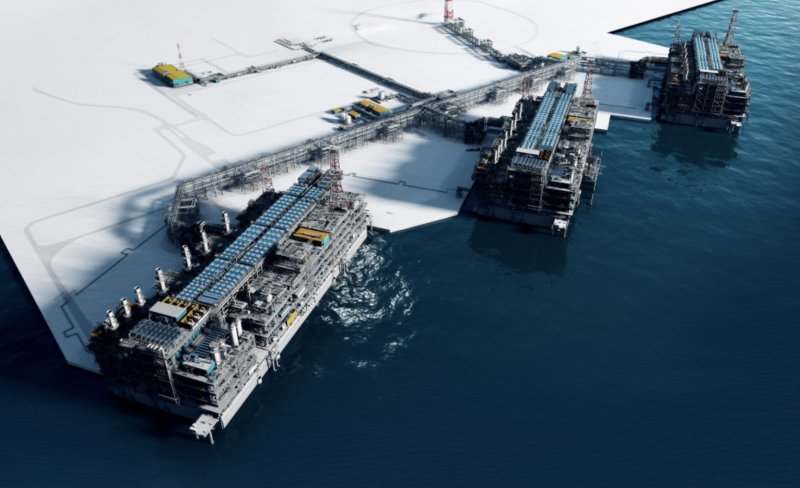
Arctic LNG 2 in its final configuration with all three trains installed. (Source: Courtesy of Novatek)
However, by November 2023, the United States had imposed blocking sanctions on the project, including infrastructure used for LNG storage and transportation. Specifically, floating storage units (FSUs) such as Saam FSU (Murmansk region) and Koryak FSU (Kamchatka) came under restrictions, as did various companies and vessels involved in the so-called "shadow fleet." By 2025, this fleet included around ten LNG tankers idling off Russia’s coasts and in international waters. As a result, the logistical chain was effectively severed, despite the infrastructure being technically ready for exports.
India: A window of opportunity or a risk zone?
Against this backdrop, NOVATEK attempted to step up engagement with Indian importers. According to Bloomberg, the company offered LNG supply contracts at discounted rates - before a hypothetical lifting of sanctions would drive prices up. NOVATEK representatives referenced the potential for improved U.S.-Russia relations under a Donald Trump presidency and suggested that Washington might ease sanctions. However, they acknowledged that there were no guarantees, only that “the process is underway.”
This approach reflects an attempt by NOVATEK to use informal political signals as a bargaining tool. But for India, the economic rationale is highly questionable. First, since 2024, Indian firms - including Ocean Speedstar Solutions, Zara Shipholding, Gotik Energy, and Plio Energy - have been sanctioned by the U.S. precisely for participating in logistical operations linked to Russian LNG. Second, even with attractive pricing, the threat of secondary sanctions and restrictions on access to the dollar system make such deals potentially unprofitable in the medium term.
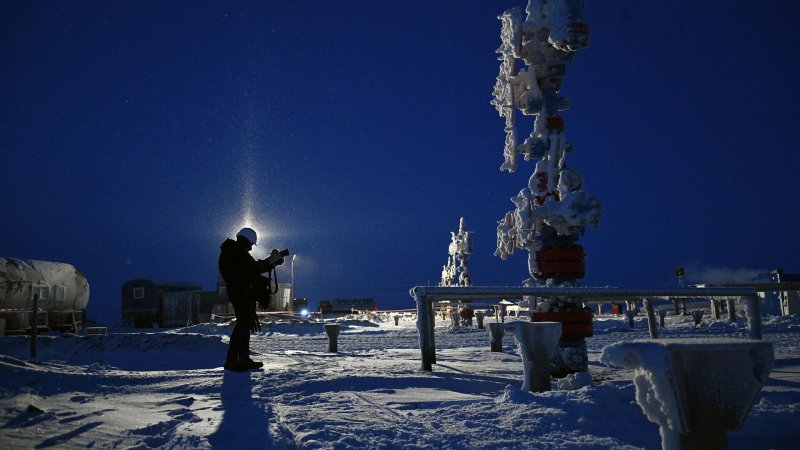
© Sputnik / Maksim Blinov
Additionally, any agreement with a Russian project would need to address insurance, vessel certification, and transactional support - all of which remain under the control of G7 countries. Without a clear mechanism to bypass these hurdles, Indian companies are likely to remain extremely cautious, even about signing preliminary framework agreements.
Production trends: From record highs to stagnation
Gas production at Arctic LNG 2 has shown sharp volatility. Peak volumes of 361 million cubic meters were recorded in September 2024, but by December output had plunged to a critical low of 29,000 cubic meters, pointing to storage overflows and the inability to sell the product. In January 2025, volumes began recovering (up to 85,000 cubic meters), possibly due to preparations for summer navigation via the Northern Sea Route (NSR). However, in winter months - without ice-class tankers and with frozen logistics - production is effectively paralyzed.
The political dimension: Betting on hypothetical thaw
NOVATEK’s bet on political easing of sanctions is a strategic advance payment - but the likelihood of it materializing in 2025 is extremely low. Even under a Trump administration, revising sanctions policy would be a lengthy process, involving consultations with Congress, financial institutions, and NATO allies. Moreover, lifting sanctions on one of Russia’s largest energy projects without reciprocal political concessions seems unlikely amid the ongoing war in Ukraine.
Sanctions against the Russian energy sector are not merely a pressure tool - they are part of the architecture of a new global economic order being shaped by the West. Expecting that Arctic LNG 2 will gain formal access to international markets in the near future, without serious geopolitical changes, is to overestimate the flexibility of U.S. foreign policy institutions.
Conclusion: Exports in doubt, investments in limbo
The economic fate of Arctic LNG 2 in 2025 hinges on two factors: seasonal accessibility of the Northern Sea Route and the willingness of non-Western countries - primarily India and China - to accept sanctioned gas. Even in the event of partial shipments, the project’s economic efficiency would remain low due to additional logistical costs, a limited pool of buyers, and the impossibility of long-term hedging.
In this context, NOVATEK’s efforts to court partners in India seem more like a politico-economic demonstration than a viable commercial initiative. Until a stable export route is secured and institutional sanctions relief occurs, the project will remain a frozen asset - one with high potential returns, but extremely low liquidity.


Similar news