Azerbaijan tops EU business climate report: What drove this major success?


.png)
Recent assessments of Azerbaijan’s business environment show that reforms across the country’s entrepreneurial ecosystem are already delivering tangible results.
In particular, international partners have noted progress in the efficiency, accessibility and transparency of services for small and medium-sized enterprises (SMEs). In recent years, the introduction of mechanisms that simplify daily business operations, the consolidation of services and a stronger dialogue between the state and entrepreneurs have significantly enhanced the country’s institutional capacity. New models introduced in Azerbaijan, including practical examples of rapid support for businesses, have also drawn the interest of European institutions.
These developments indicate that Azerbaijan’s approach to SME development is now reflected not only in domestic policymaking but also in international assessments. At the same time, the expansion of support for entrepreneurs in the regions remains one of the key pillars of this progress.
Azerbaijani economist Eldaniz Amirov told News.Az that newly created service models for small and medium businesses, institutional reforms and the SME Friends network, which operates directly in the field, have raised efficiency standards in Azerbaijan’s business environment, giving the country a leading position at the European level.
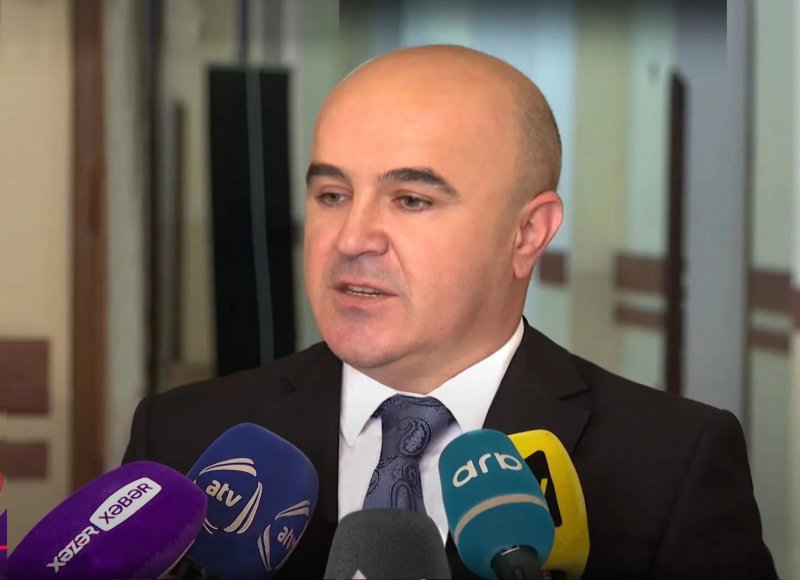
Photo: Eldaniz Amirov, Azerbaijani economist
“The Small and Medium Business Development Agency (SMBDA) ranked first among all state institutions for efficiency in the ‘EU Business Climate Report: Azerbaijan 2024’, prepared with the support of the European Union. This shows that the institutional policies aimed at the SME sector and implemented by SMBDA are creating measurable, real impact and are being recognized internationally,” he said.
According to him, steps taken by SMBDA in recent years to simplify the business environment, modernize services and make business–state communication more flexible are producing practical results.
“It is no coincidence that the EU has recognised the SME Houses model as an innovative initiative. This model offers entrepreneurs one-stop-shop convenience, reduces bureaucratic burdens and is designed to meet their daily needs in a practical way,” he said, adding that he considers the role of the SME Friends network one of the most notable aspects of the report’s findings. “This team works directly with businesses on the ground, both in the capital and the regions, listening to entrepreneurs, helping resolve issues and genuinely fulfilling the role of a ‘friend’,” Amirov noted.
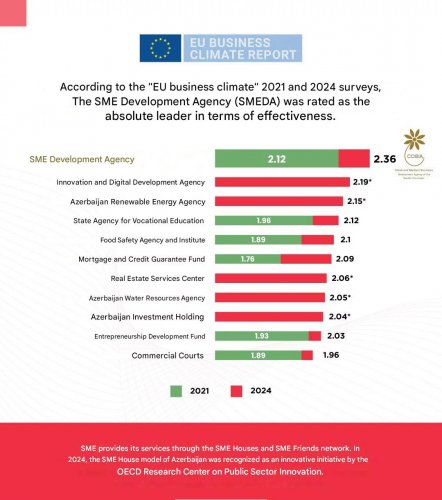
The expert added that over the past six years, SME Friends have built a new model of young and professional public service in the regions, transforming the traditional approach to public administration and becoming an important support mechanism for entrepreneurs. “The strong international evaluation achieved today is the logical outcome of this long-term effort, consistent work and hands-on engagement with the field,” Amirov concluded.


Similar news