Calin Georgescu shakes up Romanian politics: What led to his unexpected victory?


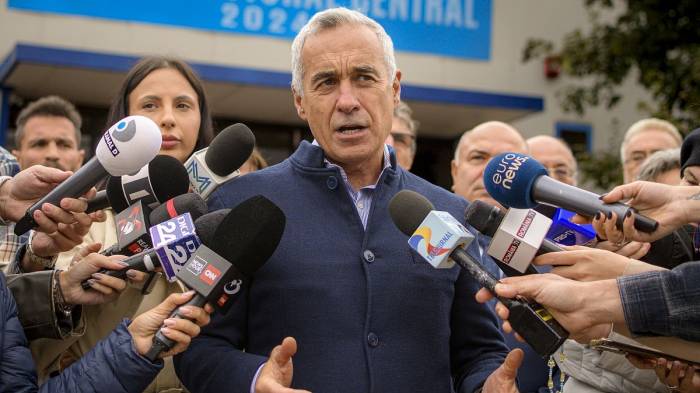
Photo: AP
News.Az presents an interview with Moldovan political analyst Ruslan Shevchenko.
social media
- How do you assess Calin Georgescu's success in the first round of elections? What factors, in your opinion, played a key role in his victory?
The main points of Georgescu's program were:
Criticism of NATO, as he believes the alliance would not support Romania in the event of an attack. Rejection of support for Ukraine, as Georgescu argues that Ukraine cannot defeat Russia. Admiration for Putin, whom Georgescu has described as one of the few genuine global leaders, as well as for Orban. Criticism of the European Union for often dictating to its member states what to do, essentially forcing them to cede sovereignty to Brussels. Reduction of dependency on foreign products and support for Romanian farmers to boost the country's agriculture. Sympathy for Ion Antonescu, who led Romania from 1940 to 1944 as an ally of Hitler against the USSR. Antonescu's activities were condemned by Romanias Supreme Court of Cassation in 2008.
In Romania, which has largely lost the agricultural and industrial potential it had during Ceausescus era, Euroskeptic sentiment and criticism of Brussels actions—often perceived as dismissive of national interests—are gradually growing. Georgescu has become a spokesperson for this perspective. NATOs indecisive stance on Putin also influenced Romanians, leading many to lose faith in NATOs ability to protect them from a potential Russian military strike.
Additionally, anti-Ukrainian sentiment has always been strong in Romania, stemming from historical grievances over the USSRs annexation of Northern Bukovina and coastal regions of Southern Bessarabia from Romania in 1940 in favor of Ukraine.
Furthermore, pro-Russian and pro-Soviet sympathies (partially stemming from fear of Russia) have deeply rooted themselves in the minds and hearts of many Romanians—up to 40% or more according to some surveys. Lastly, for many Romanians, Antonescu remains a figure who "reclaimed Bessarabia and Northern Bukovina," despite court rulings.
Georgescu skillfully leveraged all these factors, which brought him a largely unexpected success—few in Romania had anticipated it.
- If Georgescu wins the second round, how might this affect Romanias domestic political course, particularly in the context of NATO membership and relations with the EU?
- If Georgescu wins, Romanias relations with the EU will sharply deteriorate. The country could become a second Hungary, which under Orban often opposes Brussels decisions and pursues an independent course within the EU framework. This will exacerbate divisions within the EU, with Romania aligning itself with Hungary. This will force Brussels and its leading powers, Germany and France, to make more concessions and compromises.
Georgescu's favorable stance toward Putin will also place him at odds with most EU nations, where anti-Putin sentiments are strong. Thus, ahead of the second round of elections, scheduled for December 8, 2024, the EU is expected to back Georgescus opponent, the leader of the "Union to Save Romania" (USR), Elena Lasconi.
As for NATO, Georgescu will demand tangible rather than symbolic protection from external threats. Otherwise, he is likely to frequently challenge NATO leadership, calling for reforms and a sharp increase in military funding. This aligns with the stance of newly elected US President Donald Trump, who has expressed similar views.
- What consequences could Georgescus victory have for neighboring Moldova, considering his inclination toward closer ties with Russia?
- Georgescus victory in the second round would be a major shock for Moldovas authorities, who have publicly set a goal of joining the EU and NATO by 2030. It would lead to a significant deterioration in Moldovan-Romanian relations, including personal conflicts (Georgescu and Moldovan President Maia Sandu have almost completely incompatible political stances and personalities—Sandu is intolerant of criticism, while Georgescu is decisive and outspoken) as well as at the intergovernmental level.
Given that Romanias president wields considerable power, Georgescu could revisit many current projects. For the first time in Europe, there might be a state whose leader openly criticizes Sandu and Moldovas ruling Party of Action and Solidarity (PAS). This would have severe electoral consequences for Moldovan authorities: pro-Russian propaganda, which is already strong in Moldova, would exploit such statements to its advantage.
For Sandu and her associates, who hold Romanian citizenship, criticism coming from Romania would be particularly painful. Consequently, PAS and Sandu's popularity could decline further, potentially accelerating ahead of Moldovas 2025 parliamentary elections.
- How is Moldovas leadership reacting to the results of the first round in Romania? Is there a contingency plan for a potential political course change in Bucharest?
- Moldovas leadership has shifted its support from Romanias National Liberal Party (led by former Prime Minister Nicolae Ciuca, who lost in the first round) to the Union to Save Romania, led by Elena Lasconi. PAS actively participated in Lasconis campaign, with supporters even sending numerous text messages in her favor.
Thus, Lasconis progress to the second round can be seen as a success for PAS and Sandu personally. However, Georgescus success was an unpleasant surprise for Moldovas authorities and the pro-Romanian segment of the population, as he had virtually no supporters in Moldova.
Initially, Moldovas right-leaning press was silent in confusion, but it soon began attacking Georgescu, viewing him solely as a Putin supporter and Ukraines adversary. Officially, Moldovan authorities have never disclosed whether they have a contingency plan for Georgescus victory. Even if he wins, their strategy is clear: since Georgescu lacks backing from any political party (he was expelled from the Alliance for the Union of Romanians for expressing support for Antonescu), he would likely be politically isolated. Moldovas leadership might thus choose to ignore his stance.
- What strategies could the candidates use in the second round to mobilize voters? Who, in your opinion, has a better chance of winning?
- The strategies of Lasconi and Georgescu for the second round are already apparent. Georgescu will focus on strengthening Romanias independence within the EU and NATO, criticizing his opponent for excessive concessions to the EU and neglecting Romanian interests. He will highlight the need to quickly end the war in Ukraine, even if it involves territorial compromises.
Lasconi will emphasize the "extremism" of Georgescu and the dangers he poses to Romanias future in NATO and the EU. She will also remind voters of his sympathies for Putin, who is waging an aggressive war in Ukraine.
While Lasconis perspective and those of her supporters have historically prevailed in Romania, growing criticism of the EU and NATO in the country has now leveled the playing field. Both viewpoints have substantial support in todays Romanian society.
The recent election of Donald Trump as US president, with his critical stance toward the EU and NATO, further complicates the situation. While Lasconi currently has a slightly higher electoral potential—partly due to EU support—her success depends on how effectively she can leverage it. Failure to do so could steer Romania onto an entirely new path, one its current political establishment is wholly unprepared for.


Similar news