Can the waves of the Caspian Sea contribute to the development of renewable energy?


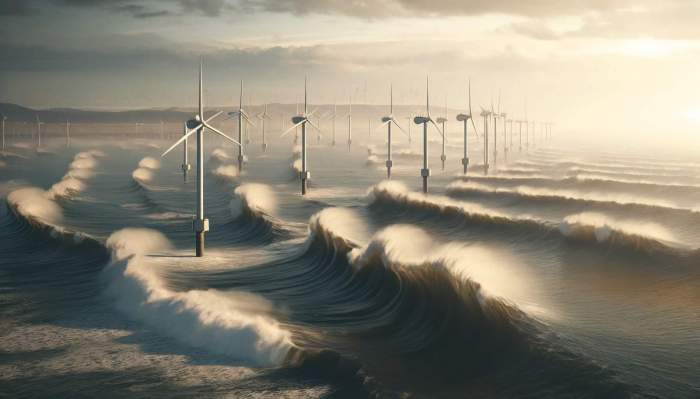
In mid-2025, the world’s most powerful wave power plant will begin generating electricity—albeit in a test mode—in the North Atlantic.
The plant is being constructed off the coast of Scotland, with the European Union having already approved the €20 million WEDUSEA project. The OE35 wave power plant will be installed near the Orkney archipelago and connected to the energy grid.To clarify, a wave power plant is a facility located in a water environment that aims to generate electricity from the kinetic energy of waves. Although several such plants already exist worldwide, most are still in the developmental or pilot stages and thus have relatively low capacities—typically just a few hundred kilowatts.
For those unfamiliar with the technology, it may be difficult to imagine how such a system operates. Media outlets often provide simplified explanations. The OE35 will be a floating platform with an air chamber and a turbine. The air chamber is open at the bottom, while the turbine sits above sea level. When a wave arrives, the water level inside the air chamber rises, forcing air through the turbine and generating electricity. In essence, electricity is produced through the movement of air, not water—waves merely set the process in motion. When the wave recedes, the air chamber refills, and the turbine’s special design allows it to continue producing energy even during the wave’s retreat.
The Scottish coast is known for its rough seas, and earlier test installations were destroyed by storms. However, the new wave power plant, weighing 800 tons, will be robust enough to withstand severe sea conditions.
While construction in Scotland is underway, the world’s most powerful wave power plant remains the Agucadoura Wave Farm off the coast of Póvoa de Varzim in northern Portugal. This is the world’s first commercial wave power plant and resembles a partially submerged "snake" measuring 150 meters in length and 3.5 meters in width. As waves pass over these "snakes," they transmit oscillations, which are then converted into energy.
The U.S. is also planning to launch a powerful wave power plant—a massive buoy weighing 826 tons, designed to convert wave energy into electricity.
As we can see, the ingenuity of engineers knows no bounds. Experts note that wave energy technologies are still in their infancy. However, the rapid pace of technological advancement suggests that a wave power plant could soon appear in the Caspian Sea. Russian scientists are already exploring the potential of wave energy, considering it economically advantageous. According to them, the waves of the Caspian Sea could provide energy to some coastal areas. However, Caspian waves lack the strength needed for large-scale power generation. Nevertheless, the advantage of ocean waves lies in their consistent presence, making them accessible to all coastal nations.
The Caspian region is also rich in solar and wind energy resources. Significant wind resources naturally lead to a considerable potential for wave energy generation.
It is worth noting that in 2015, Israel proposed collaborating with Azerbaijan to harness the energy of Caspian waves. Israeli company WERPO (Wave Electricity Renewable Power Ocean), specializing in wave energy production, expressed interest in cooperation. This was discussed by then-Israeli Ambassador Dan Stav. However, the proposal did not progress beyond the initial stage.
Currently, discussions about the development of alternative energy sources in Azerbaijan primarily focus on solar and wind energy. There are no concrete plans or decisions regarding wave energy yet, though pilot projects exist, and there is interest in the topic. Most likely, this renewable energy sector will be explored in the future. The technologies required for wave energy are still in the development phase, even in countries that have been researching wave energy for some time. These technologies require appropriate technical equipment and expertise.
Meanwhile, global interest in wave energy continues to grow. It first emerged following the oil crisis of the 1970s. In the Soviet Union, interest in wave energy began in the 1960s, but the efforts did not bear fruit. In 1985, Norway built two pilot industrial wave power plants. Today, countries such as the United Kingdom, Portugal, Australia, and the U.S. are actively developing this renewable energy sector. The U.K. alone spent over 15 years inventing and testing various wave generator designs.
Given modern technologies, gigantic waves could become an inexhaustible energy source in the 21st century. According to experts, the wave energy of the world's oceans could meet at least 20% of humanity’s energy needs. It has been estimated that the global wave energy potential stands at 80,000 terawatt-hours, which is equivalent to a tenfold increase in current energy consumption. The regions with the greatest wave energy potential include the western coast of Europe, the British Isles, the Pacific coasts of North and South America, New Zealand, Australia, and South Africa.
At the same time, the question remains: is it worth investing in wave power stations when offshore wind energy may be more profitable? Only time will provide the answer.


Similar news