War rhetoric toward Baku: Should Armenians elect Karapetyan?


Do Robert Kocharyan and Samvel Karapetyan understand that they will have to deal with Baku?
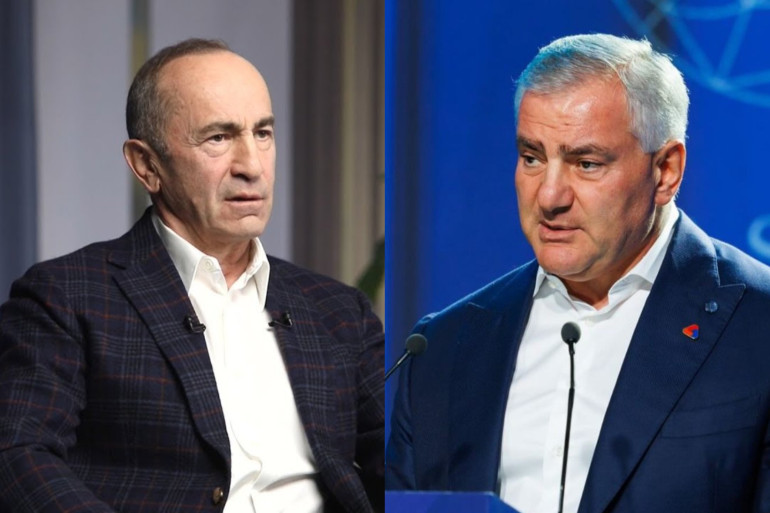
Let us begin with Kocharyan, the former president of Armenia. He is once again seeking power, appearing to disregard the potential consequences for Armenia. In Azerbaijan, Kocharyan is viewed as a war criminal, and a criminal case has been opened against him. From Baku’s perspective, it makes little difference whether he is elected by the Armenian public. In 1998, Kocharyan was also presented as the “choice” of the Armenian people, yet he ultimately forced his way into power, halting his predecessor Levon Ter-Petrosyan’s attempts to reverse earlier policies.
Today, Kocharyan is campaigning under the slogan of correcting what Nikol Pashinyan has done — specifically, rolling back the peace process, abandoning the Washington agreements, and reintroducing the “Karabakh issue,” which many argue poses serious risks for Armenia.
Samvel Karapetyan appears to be taking an even more ambitious approach than Kocharyan, despite lacking the constitutional eligibility to run for prime minister. Holding dual citizenship and not meeting the residency requirement, Karapetyan nevertheless continues to invest substantial financial resources into building a large-scale political campaign and assembling a team far beyond what Kocharyan has previously managed.
RECOMMENDED STORIES
Like other opponents of Pashinyan, Karapetyan is campaigning on promises to reverse current policies and rebuild relations with neighboring countries from the ground up — but on Armenia’s terms. In this regard, the Russian-based billionaire, who is widely seen as relying on Moscow’s backing, aligns closely with Kocharyan’s political stance. His platform, titled “Six Promises for a Lasting Peace,” along with the team expected to implement it, has already been made public. On Wednesday, the Strong Armenia party formally presented its security program, branded as “Strong Peace.” Among the pledges was a commitment to “return everyone” — referring to Armenians to Karabakh — accompanied by assurances that Karapetyan fulfills his promises. His nephew, Narek Karapetyan, also spoke of large-scale investments that would supposedly bring prosperity, arguing that historically, key East-West routes have passed through Armenia.
One particularly striking statement from the presentation was: “The army lost the war because of weak leadership. We now have a historic opportunity to change reality.”
 Source: tert.am
However, it is widely understood that regional transit routes can only function with the consent of Baku. This raises a key question: how does Karapetyan intend to secure such approval while simultaneously issuing threats of war against Azerbaijan? A settlement based solely on Armenia’s terms appears unrealistic, particularly given that such outcomes were not achieved even during earlier periods of control. Promising such results to Armenian society today may therefore be misleading.
Moreover, while Azerbaijan, under Pashinyan’s current diplomatic approach, has at times taken regional interests into account, these conditions are not guaranteed to remain unchanged in the future.
In his “Six Promises for a Lasting Peace,” Karapetyan proposes establishing a peace framework backed by multiple guarantors, alongside building a strong military. He has pledged to procure advanced equipment, including thousands of drones, air defense systems, and border security technologies, and to personally invest in the defense sector. These measures, he suggests, would enable Armenia to capitalize on what he calls a “historic opportunity” with the support of external actors.
Skeptics argue that such promises lack realism. Given the current geopolitical climate, it is unclear whether any international actors would be willing to act as guarantors in a way that could restore the situation to its pre-September 27, 2020 state. Even traditional partners are now preoccupied with other global challenges, making such commitments unlikely.
Turning to Karapetyan’s team, several foreign experts have been brought in as advisors. Among them is retired Israeli Brigadier General Zvika Haimovich, presented as an air defense specialist. According to the Strong Armenia platform, Haimovich has over three decades of experience in aerospace and defense, including leadership roles within Israel’s air defense system and involvement in projects such as Iron Dome, Arrow 3, and David’s Sling. There is speculation that he could serve as defense minister in a future government.
Additionally, Greek expert Efthymios Tourtidis has been recruited as a special forces advisor. His background includes service in Greek special forces, academic credentials in defense studies, and involvement in training programs across multiple regions. He is also credited with developing a methodology for controlled intervention and self-defense.
Another figure is Michael Darbinyan, described as a foreign policy advisor with experience in diplomacy and security consulting. He previously worked with organizations involved in demining and analysis in conflict zones, including the previously occupied territories of Azerbaijan, and currently serves as a risk consultant for a European firm.


Similar news