Absheron gas field defies pessimistic forecasts on Azerbaijan’s reserves


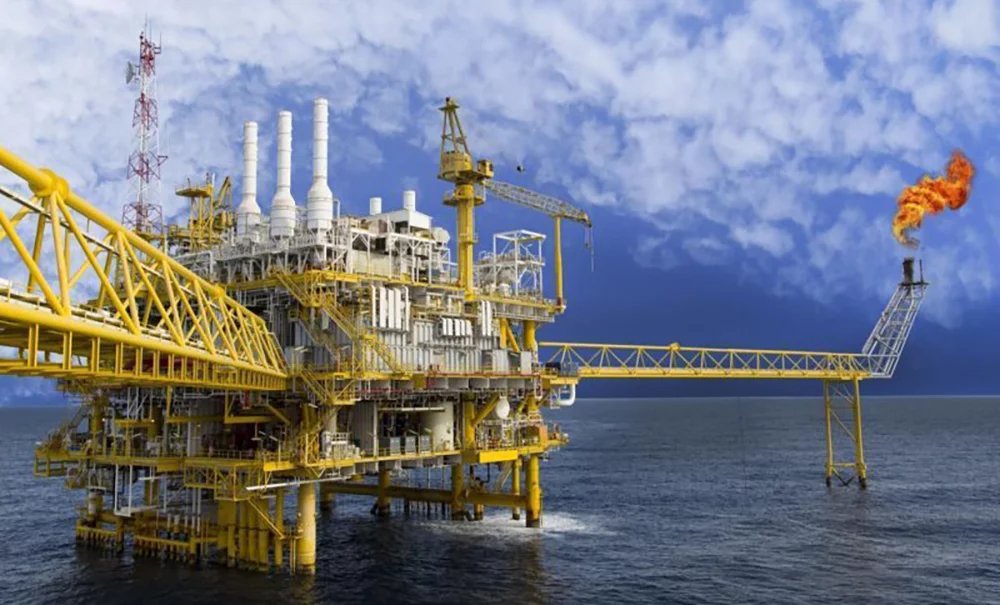
Production in Azerbaijan’s sector of the Caspian Sea under the full-scale development of the Absheron gas-condensate field is scheduled to begin on September 1, 2029, TotalEnergies announced to journalists on Monday.
An Environmental and Social Impact Assessment (ESIA) has already been completed, and the project will be implemented by TotalEnergies Absheron B.V. The company estimates the project’s lifespan at approximately 30 years. Plans include drilling three subsea wells, with an additional well planned, as well as the development of subsea infrastructure and the installation of offshore and onshore pipelines.
A key component of the project is the construction of a Central Processing Facility located about 4 kilometers from the Sangachal Terminal. This facility will process gas and liquid hydrocarbons extracted from the field. The processed gas will be transported to the South Caucasus Pipeline and Azerbaijan’s domestic gas network, while unstabilized condensate will be sent to the Sangachal Terminal.
RECOMMENDED STORIES
The Absheron gas-condensate field is located approximately 100 kilometers southeast of the Caspian Sea coastline. The project is being developed by a joint venture comprising TotalEnergies EP Absheron B.V. (35%), SOCAR Absheron (35%), and ADNOC XRG (30%).
The first phase of production began in July 2023. Current output stands at around 4 million cubic meters of gas per day and 13,000 barrels of condensate. At present, the gas is supplied exclusively to the domestic market. At peak production, output is expected to reach 12.7 million cubic meters of gas per day (about 4.5 billion cubic meters annually) and approximately 35,000 barrels of condensate per day.
 Source: Reuters
Experts estimate that the Absheron field, discovered in 1960, contains around 350 billion cubic meters of gas, making it the second-largest gas field in the Caspian Sea after Shah Deniz.
The Absheron project is receiving particular attention as a strategic energy asset. Speaking at a meeting of the Southern Gas Corridor Advisory Council, TotalEnergies Senior Vice President Martina Opizzi described the project as a clear example of successful long-term cooperation between TotalEnergies, SOCAR, and XRG, combining international expertise with strong regional partnerships.
“Together with SOCAR and XRG, we are currently exploring the second phase of development of the Absheron field,” Opizzi said. She noted that production, which began in July 2023, has remained stable, demonstrating high reliability and strong industrial safety standards, and providing a solid foundation for further expansion.
The full-scale development of Absheron was also discussed during a January meeting between SOCAR President Rovshan Najaf and Musabbeh Al Kaabi, CEO of Upstream at ADNOC Group.
Founded in 1971, ADNOC is a major diversified energy company fully owned by the Abu Dhabi government. Its integrated operations span the entire energy value chain, enabling it to respond flexibly to evolving global energy demand. The company is also recognized as one of the lowest-carbon oil and gas producers globally.
ADNOC joined the Absheron consortium in August 2023, acquiring a 30% stake after SOCAR and TotalEnergies each sold 15% of their shares.
Emmanuel de Guillebon, Chairman of TotalEnergies Azerbaijan, announced at the 30th Baku Energy Forum that the second phase of Absheron’s development would be based on an innovative subsea concept. Plans include drilling additional wells, constructing a 140-kilometer pipeline to Sangachal, and building a processing facility.
According to de Guillebon, the Absheron project exemplifies innovative approaches in the Caspian region. Advanced technical solutions have enabled the project to overcome major engineering challenges, including the construction of a 45-kilometer multiphase pipeline across complex rocky terrain. These innovations have significantly reduced both construction risks and costs.
The project incorporates automated subsea systems and modern digital monitoring technologies, including internet-connected platforms, ensuring high levels of safety and operational efficiency. Notably, the use of an automated pigging system eliminates the need for surface maintenance, further reducing operational risks and costs.
 Source: AZERTAC
At the same forum, TotalEnergies also announced its involvement in renewable energy projects in Azerbaijan. The company signed a memorandum with the Ministry of Energy to develop projects with a total capacity of 500 megawatts—250 MW in Nakhchivan and another 250 MW near the Sangachal Terminal. TotalEnergies views Azerbaijan as a key partner in advancing its global transition toward sustainable energy.
The production-sharing agreement for the exploration and development of the Absheron offshore block was signed on February 27, 2009. Later, on November 21, 2016, SOCAR and TotalEnergies formalized the main contractual and commercial terms for the first phase of development.
Experts view progress at Absheron as confirmation of Azerbaijan’s substantial gas reserves, reinforcing earlier statements by government officials and industry specialists. At a ministerial meeting of the Southern Gas Corridor Advisory Council, President Ilham Aliyev noted that production from the deepwater Azeri-Chirag-Gunashli gas reserves is expected to begin this year, while full-scale development of Absheron will start within two to three years, potentially tripling output at the field.
In addition, gas production is expected to increase through the second phase of the Umid field and further development of Shah Deniz. According to the president, these projects could collectively add 10 to 15 billion cubic meters of gas at peak production.
In this context, earlier negative forecasts regarding Azerbaijan’s gas reserves have not materialized, as ongoing and planned projects continue to strengthen the country’s energy potential.
By Tural Heybatov


Similar news