China’s diplomatic power play: Redefining the global balance


.png)

In the grand theater of global diplomacy, where every move is scrutinized and every word carries the weight of history, China has spoken with deliberate clarity. Lu Shaye, Beijing’s special envoy for European affairs, has declared that Europe and Ukraine must not be mere spectators in the pursuit of peace—they must stand as equals alongside Russia and the United States. With this pronouncement, China has subtly but firmly signaled its dissatisfaction with the current framework of negotiations, a stage set by Trump and Putin, which it finds unsatisfactory—if not outright dismissive of broader international voices.
The envoy’s words carried the weight of a nation accustomed to long-term strategic maneuvering: "Decisions must be reached through dialogue on equal footing, not dictated by a select few," he asserted. "This is not a matter for Washington and Moscow alone, especially when Europe—directly impacted—finds itself relegated to the margins, a bystander in discussions that shape its own fate."

Source: Reuters
On the surface, the statement appeared straightforward and unassailable. Yet beneath the polished rhetoric lay a striking shift in Beijing’s approach. A nation that had long observed the shifting tides of power with quiet calculation now seemed to be reconsidering its stance. The geopolitical landscape was evolving, shaped by the emerging thaw between Washington and Moscow—an alignment China could not afford to ignore. The era of passive observation, it seems, is coming to an end.
China’s economic stakes in the Russia-Ukraine war
Despite its brutality, the war in Ukraine has, in some ways, served China’s interests. As the saying goes, "war is not only about destruction but also about opportunities." Beijing has actively seized these opportunities—purchasing discounted Russian energy resources, flooding Russia with Chinese goods from electronics to automobiles, and supplying dual-use technology to Russia’s military sector. However, the rapid shift in U.S.-Russia relations presents a fundamental challenge to Beijing’s strategic calculus.
China’s leadership understands that Trump’s declared intention to end the war in Ukraine quickly could have far-reaching consequences—potentially leading to the return of Western companies to the Russian market and a diminished need for Chinese goods once sanctions are lifted. Such a scenario would directly undermine Beijing’s economic foothold in Russia, making a swift peace settlement undesirable for China.

Source: Xinhua
Adding another layer to Beijing’s concerns is Taiwan. Until now, China has observed the Ukraine conflict through the lens of precedent: if Russia successfully annexed Ukrainian territories and the global community tacitly accepted it, Beijing could potentially use that precedent to justify a military resolution of the Taiwan issue. After all, a global tolerance for territorial annexation would already exist.
China’s foreign policy has long been guided by Mao Zedong’s metaphor of two fighting tigers and a wise monkey. In this analogy, the tigers represent the U.S. and Russia, while China plays the role of the wise monkey, observing the battle from the safety of the mountain. For years, Beijing has skillfully maneuvered through the U.S.-Russia rivalry, adjusting its foreign policy based on shifting power dynamics.

Source: Associated Press
As political analyst Ilya Gerashchenkov astutely noted, since 2022, China has carefully watched the war unfold. It has seen how the "second strongest army in the world" (Russia’s) failed to swiftly achieve its objectives in Ukraine. It has also observed the weaknesses of the U.S., NATO, and the EU—what some in Beijing now call "paper tigers."
Gerashchenkov believes China now feels emboldened to assert its interests—primarily in reclaiming Taiwan. However, much will depend on the evolving agreements between Moscow and Washington.
China’s strategic focus: The EU market
Should the U.S. and Russia succeed in improving their relations, Beijing will have no choice but to adjust its course—potentially making decisions that would have been unthinkable just a few years ago. This explains why China, through its diplomatic channels, is signaling what kind of geopolitical arrangement it finds acceptable. In this framework, Beijing’s immediate focus is Ukraine, but in the long run, its priority is the European Union.
The stakes are high. A full-blown trade war with the U.S. looms on the horizon, putting China’s access to the American market at risk. At the same time, if Western companies return to Russia, China may suffer significant economic losses there as well. Given this scenario, the EU market becomes Beijing’s only viable alternative.
Thus, the stability of the European economy is now of paramount importance to China. Every move Beijing makes going forward will be aimed at mitigating the risks posed by an anticipated rapprochement between Moscow and Washington.
The growing U.S.-China confrontation

Source: BBC
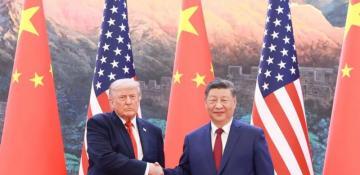
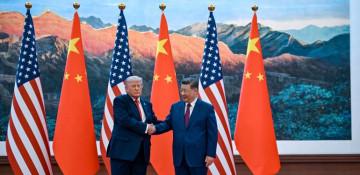
Meanwhile, tensions between the U.S. and China are escalating rapidly. Chinese Foreign Minister Wang Yi made Beijing’s stance clear on March 7, warning the U.S. to "abandon the illusion that it can pressure China while simultaneously maintaining friendly relations."
"Such duplicity will not only destabilize bilateral relations but also undermine the possibility of mutual trust," he added, emphasizing that Washington’s attempts to contain China would not go unanswered.
Chinese Foreign Ministry spokesperson Lin Jian echoed this sentiment when responding to Donald Trump’s proposal to raise tariffs on Chinese goods from 10% to 20%. "If the U.S. wants war—be it a tariff war, a trade war, or any other war—we are ready to fight to the end," he declared.
The confrontation is not limited to trade. U.S. Defense Secretary, Pete Hegseth, recently stated on Fox News: "Those who seek peace must prepare for war... That’s why we are rebuilding our military and strengthening deterrence. We live in a dangerous world with powerful nations on the rise—nations with entirely different ideologies, rapidly increasing their defense spending, developing advanced technologies, and seeking to push the United States aside."
One thing is clear: China can no longer afford to sit back and wait for the outcome of the struggle between the two tigers. The real challenge now is to ensure it does not become prey to these very tigers. Beijing must urgently recalibrate its strategy; otherwise, it risks serious long-term consequences.
(If you possess specialized knowledge and wish to contribute, please reach out to us at opinions@news.az).


Similar news