Editor’s note: Moses Becker is a special political commentator for News.Az, holding a PhD in political science and specializing in interethnic and interreligious relations. The views expressed in this article are the author’s own and do not necessarily reflect the position of News.Az.
When things become too comfortable, that can be a problem in itself. Modern Europe illustrates this clearly: a high level of social protection often makes people increasingly reluctant, even infantile, when it comes to starting families.
In some ways, this recalls the late Roman Empire, where crowds of idle citizens demanded “bread and circuses” while the elites drowned in luxury, decadence, and indulgence. From the 4th to the 6th centuries, the western part of Rome was slowly weakened and ultimately destroyed by waves of invading tribes. A great civilization, advanced yet no longer resilient, collapsed under the weight of its own fragility.
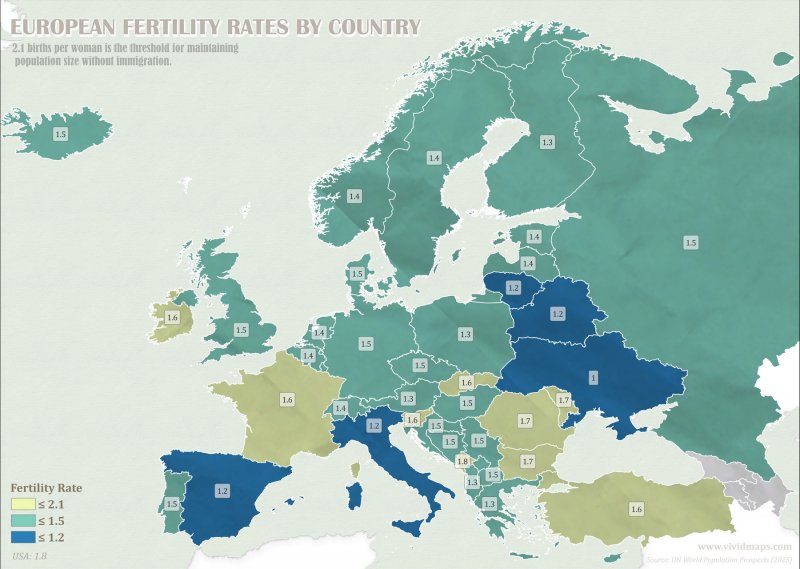
Today, the European Union is anxiously observing a similar demographic trend: shrinking populations and falling birth rates. “More deaths than births, too few children, too many people leaving their country,” officials warn. According to Eurostat baseline projections, “the EU population will grow gradually until 2026, reaching 453.3 million, before declining to 419.5 million by 2100.” The downward trajectory is expected to begin within just a few years. Between January 1, 2013, and January 1, 2023, the EU added 7.5 million people, but primarily due to immigration rather than natural growth.
Immigration has brought its own set of challenges. Most newcomers arrive from poorer regions of Asia and Africa, often bringing traditional mindsets shaped by mountains, deserts, and rural life. Many lack professional qualifications or even basic education. Some insist on living by customs that clash with modern European norms.
Here lies a deep contradiction: without migrants, Europe’s population would be shrinking faster, yet mass migration also fuels political backlash. It strengthens movements pushing to close borders and has led to a rapid rise in anti-immigration sentiment.
The demographic crisis, however, is not exclusive to Europe. Japan has long struggled with the same issue, along with China and South Korea, all among the world’s lowest birth rates. Yet East Asia tackles labor shortages through technology, automation, and artificial intelligence, replacing entire sectors instead of setting mass immigration as the solution.
According to the United Nations, the EU’s working-age population (20–64), the core source of tax revenue, has fallen from a peak of 270 million in 2011 to about 261 million in 2025. In February, Germany's Economy Minister Robert Habeck called labor shortage the biggest threat to Germany’s economic growth. The Cologne Economic Research Institute estimates that this deficit will cost Germany €49 billion in lost production in 2024. A similar picture is visible across the EU.
Meanwhile, the United States under President Donald Trump tightened migration policies and began deporting illegal entrants. Japan and South Korea are even stricter, largely rejecting foreign labor. This is partly because many migrants hesitate to enter the workforce and instead rely on long-term benefits, housing support, and public health care, turning immigration into a politically explosive topic for EU societies and voters.
The “Great Replacement” conspiracy theory has gained mainstream traction and, critics argue, not without some basis. The family reunification principle remains in place, meaning that one migrant can later bring dozens of spouses, children, and relatives. Many Europeans believe liberal elites deliberately encourage immigration to reshape Europe’s ethnic landscape and secure their long-term political dominance. This sentiment is driving the rise of nationalist parties across the continent.

Photo: BBC
France, Germany, and the United Kingdom are seeing record support for far-right forces and could face political shifts in the coming years. In Spain and Sweden, right-wing parties may soon become core parts of future government coalitions. Responding to public pressure, centrist governments in Denmark and the UK have already restricted access to citizenship and residency rights. Opposition parties openly campaign on anti-immigration agendas, speaking directly to what they believe voters and media want to hear.
Elections in 2026 could reshape Western Europe even further. In Portugal, the far-right Chega party polls around 24%. France will hold Senate and local elections, with Marine Le Pen’s movement continuing to grow and counting on a potential political crisis to trigger early national elections. Germany’s AfD reaches 27–38% in some regions, while Chancellor Friedrich Merz’s migration shift to the right has paradoxically cost his party support. Sweden will vote on September 13, 2026. The Sweden Democrats already influence government policy and propose reviewing residency for about 100,000 people and tightening citizenship rules. If the right retains power, the far-right could demand ministerial roles and push even harsher restrictions.
Anti-immigration parties continue to rise across Europe. Centrist governments are responding accordingly. As of January 1, new re-emigration subsidies come into effect, and beginning June 1, stricter citizenship requirements will extend residency from 5 to 8 years.
Ultimately, Europe faces two opposing forces. On one hand, the shortage of skilled labor demands more foreign workers. On the other, most migrants arriving today are not aligned with the needs of technologically advanced economies, offering little contribution to growth. Many adhere to traditional lifestyles and struggle to assimilate, provoking irritation and hostility among native populations.
This means European societies will have to adapt to a new demographic reality and likely restructure their economies and way of life to survive the coming decades.
(If you possess specialized knowledge and wish to contribute, please reach out to us at opinions@news.az).
News.Az