Why China is consolidating


Editor’s note: Moses Becker is a special political commentator for News.Az. He holds a PhD in political science and specializes in interethnic and interreligious relations. The views expressed in this article are the author’s own and do not necessarily reflect the position of News.Az.
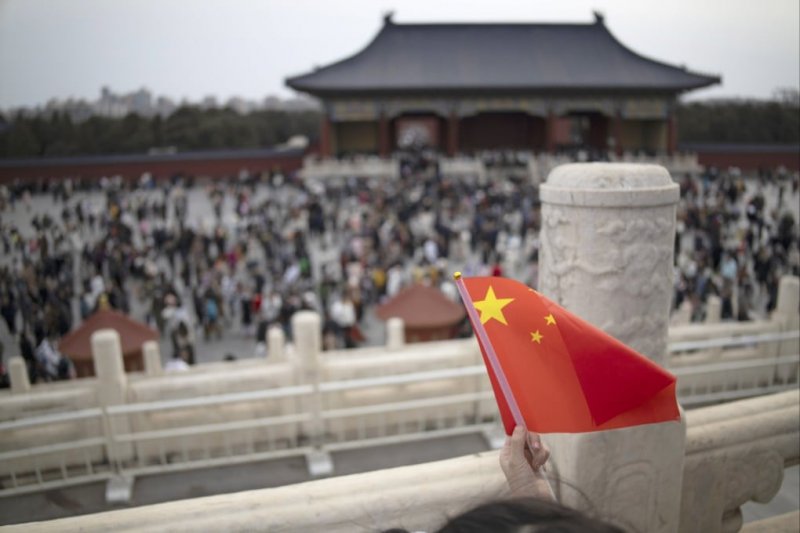
While Europe experiments with multiculturalism, creating multinational and multiconfessional communities that risk blurring its ethnic identity, China has chosen the path of ethnic consolidation. Apparently, both the experience of European countries and China’s own history are pushing the country’s leadership toward building a solid monolith out of all the ethnic groups inhabiting the People’s Republic of China, united by a common ideology and, in the long run, possibly by a shared origin.
Taking into account the experience of the Soviet Union, Chinese leaders seem to have concluded that ideology alone does not always guarantee unity. Moreover, the Chinese state has periodically plunged into the abyss of internal wars. At the dawn of its history, China experienced the era of the Warring States, which ended under Emperor Qin Shi Huang in 221 BC. Yet even after that, cycles of fragmentation and reunification occurred repeatedly, weakening the country and turning it into easy prey for stronger neighbors.
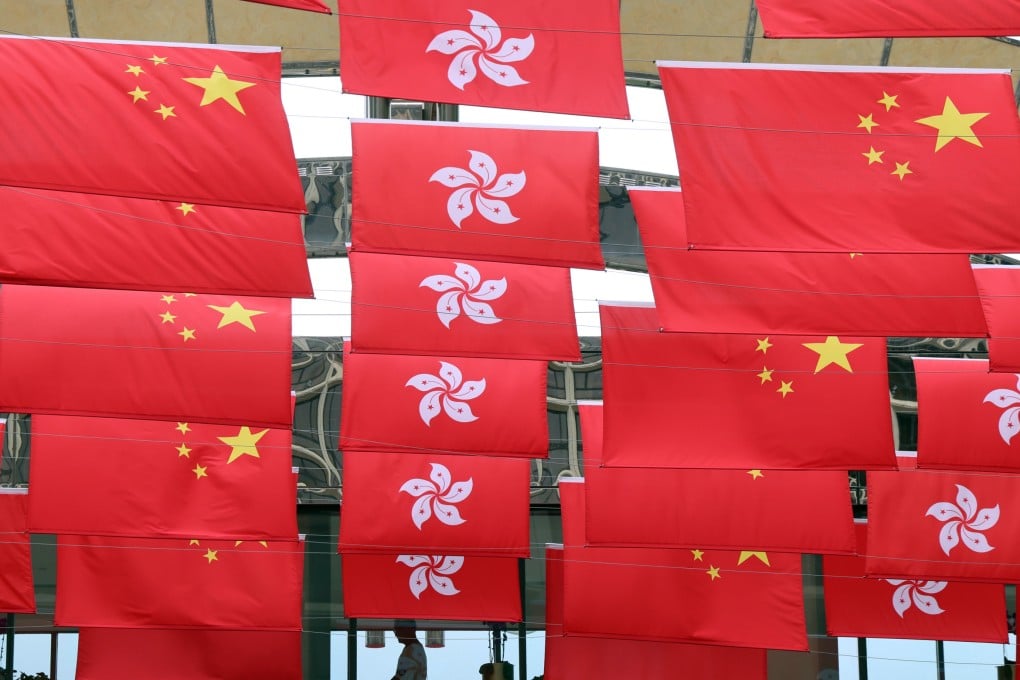
For this reason, the leadership of the Communist Party of China apparently decided to eliminate ethnic diversity by creating a powerful unified force capable of resisting any forms of separatism in the future. To some extent, the actions of the Chinese authorities also serve as a signal to Hong Kong and Taiwan.
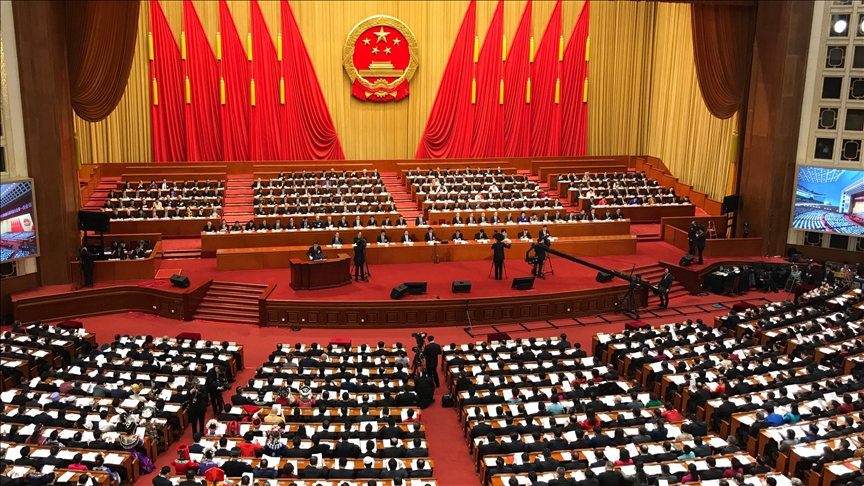
Thus, on March 12, 2026, China adopted a law aimed at “strengthening the sense of community of the Chinese nation.” It is designed to promote the integration of the various ethnic groups in the People’s Republic of China, which number 56 in total. In this regard, a comprehensive set of measures is planned in the fields of education, public life, culture, and development policy.
In response to claims that the initiative represents another attempt to assimilate ethnic minorities, the Chinese newspaper China Daily accused critics of reviving “long-standing stereotypes” and refusing to “examine the contents of the draft law.”
Source: Xinhua
The law is titled “Promoting Ethnic Unity and Progress.” As Luo Qinjiang, a delegate of the National People’s Congress (NPC), stated: “The law is designed to strengthen the sense of community among all ethnic groups of the Chinese nation.”
“The state respects and protects the study and use of the languages and writing systems of national minorities,” the document emphasizes. However, in public spaces where Chinese and minority languages are used together, the Chinese language must be given “priority in placement, order, and similar aspects.”
The titular ethnic group — the Han Chinese — makes up about 91 percent of the country’s population. The overwhelming majority of the 55 officially recognized minority groups are quite small in number and largely unknown outside China. Internationally, the most widely known groups are Tibetans, Uyghurs, and Mongols, mainly because of reports in Western media concerning restrictions on their religious rights and freedoms.
Relations between Beijing and the local populations in Xinjiang and Tibet have indeed never been entirely harmonious. However, in recent years, the central authorities have attempted to address problems in these two autonomous regions not with a heavy hand but through financial incentives.
For example, for several years, the Chinese government offered incentives to Han Chinese to relocate to Tibet or Xinjiang. As a result, in both Lhasa and Urumqi, the capitals of these regions, the demographic balance between the indigenous population and Han Chinese has shifted in favor of the latter.
The central government of the PRC has also financially encouraged interethnic marriages, particularly between Uyghurs and Han Chinese. The new law also pays special attention to this aspect. While the text does not explicitly promote interethnic marriages, it introduces, for the first time, a ban on interfering with the freedom to enter into such marriages on the basis of a person’s religious or ethnic affiliation.
This is particularly relevant in Xinjiang, where the majority of the population is Muslim. There are frequent cases in which an imam or parents oppose the marriage of a Uyghur woman if the groom is a Han Chinese man. In principle, this policy is understandable: in such families, the religious component gradually fades, as children are unlikely to follow the traditional lifestyle.
Source: Xinhua
The law also instructs parents to “educate and guide minors to love the Communist Party of China” and calls on religious groups and institutions to adhere to “the direction of the Sinicization of religion in China.”
Among other provisions, the document states that organizations and individuals outside China who carry out actions that “undermine ethnic unity and progress or create ethnic separatism will be held legally accountable in accordance with the law.”
This partly echoes the provisions of the National Security Law introduced by China in Hong Kong in 2020, which allows authorities to prosecute individuals outside the PRC for actions that Beijing classifies as separatism or subversive activity.
It is clear that such measures limit freedom of choice. Nevertheless, in China, it is believed that such actions are necessary to achieve national unity and address common challenges.
According to Chinese Communist Party Chairman Xi Jinping, China’s ethnic groups should resemble “pomegranate seeds that stick tightly together.” For this purpose, the adopted law requires that Mandarin script be more prominent on public signs than the scripts of ethnic minorities.
According to recent reports from Inner Mongolia, where protests took place in 2020 against the diminishing use of the Mongolian language, some public signs have already been updated so that Chinese characters stand out more clearly than Mongolian writing.
Yalkun Uluyol, a China researcher from a well-known international human rights organization, notes: “Many of the policy directives proposed in the new law are already being implemented in practice in Xinjiang, Tibet, or Inner Mongolia.”
As The Guardian emphasizes, the Communist Party attaches particular importance to the law on ethnic unity. In an interview with China Global Television Network (CGTN), Zheng Qian, deputy director of the China National Museum of Ethnology, referring to museum documents, noted that the bill represents an interpretation different from previous legislative acts adopted in other countries.
She also emphasized the role of modern museums in promoting ethnic unity and preserving culture.
“After studying the relevant materials, I found that similar legislation in most countries usually has several directions. One of them is the fight against racism and cultural discrimination. Another may emphasize multiculturalism or the cultural rights of specific ethnic groups or communities. In our case, however, we use key concepts such as ‘ethnic unity’ and ‘promotion of progress.’”
Speaking about the new law, it should be particularly emphasized that, contrary to Western values, China demonstrates its own distinctive approach to resolving ethnic issues, moving from diversity toward uniformity.
Time will show what this approach will lead to. Most likely, diversity remains brighter and richer than the dull uniformity of opinions and tastes.
(If you possess specialized knowledge and wish to contribute, please reach out to us at opinions@news.az).


Similar news